10 Everyday Items That Weigh Around 10 Pounds
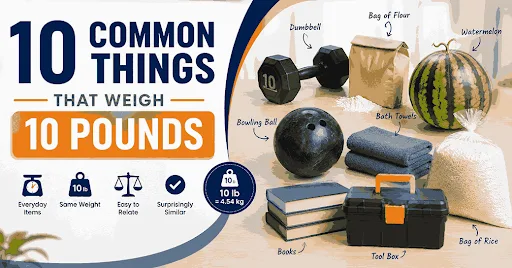
Ten pounds equals roughly 4.54 kilograms, and you probably handle something close to that weight every week without thinking about it. A standard bag of potatoes, a light bowling ball, a full countertop stand mixer — all of these sit right around the 10-pound mark. Whether you’re estimating a shipping cost, choosing a dumbbell, or trying to picture how much weight you’ve lost, having a mental reference for 10 pounds makes the number far more meaningful than digits on a screen.
This guide walks through ten familiar objects that weigh about 10 pounds, explains why their weights vary, and shows you how to estimate this weight when no scale is handy.
What 10 Pounds Feels Like
Ten pounds is heavy enough to notice but light enough for most adults to carry comfortably with one hand.
In metric terms, 10 pounds converts to about 4.54 kilograms, or 160 ounces if you prefer smaller imperial units. It’s worth noting that 10 kg is a different animal entirely: that’s roughly 22 pounds, more than double the weight. People shopping internationally or reading fitness plans from other countries mix these up all the time, so keep the distinction in mind when a label switches between the imperial and metric systems.
For a body-based reference, 10 pounds is close to the weight of an average newborn-plus-a-few-months infant, or about what a well-fed adult house cat weighs.
10 Everyday Items That Weigh Around 10 Pounds
1. A Bowling Ball
Bowling balls range from 6 to 16 pounds, and 10 pounds sits right in the popular middle ground — the weight many casual bowlers and teenagers choose at the alley. The variation comes from the ball’s core density, since regulation balls are all the same size (about 8.5 inches in diameter) regardless of weight.
If you’ve ever picked one off the rack, you already know exactly what 10 pounds feels like: dense, compact, and surprisingly heavy for its size.
2. A Large Bag of Potatoes
The 10-pound potato bag is a grocery store staple across the United States, especially around the holidays. Actual weight varies slightly because potatoes lose moisture over time, so a bag might weigh a few ounces less by the time it reaches your kitchen.
Unlike a bowling ball, the weight shifts and settles as you carry it, which is a useful comparison in itself — 10 pounds of loose, distributed weight feels different from 10 pounds of solid mass.
3. A 10-Pound Dumbbell
This is the cleanest example on the list because the weight is the whole point. A 10-pound dumbbell is a common starting weight for shoulder presses, curls, and rows, and most home fitness equipment sets include a pair.
Cast iron and rubber-coated hex dumbbells are typically accurate to within a few ounces of their stated weight. If you own one, it’s the most reliable reference object in your house short of a digital scale.
4. A Large Bag of Dry Cat Food
Dry cat food commonly comes in bags between 9 and 11 pounds — brands size them this way because it’s about the maximum weight most shoppers will comfortably lift from a bottom shelf. The weight varies by kibble density and bag size, but if you feed a cat, you’ve carried roughly 10 pounds from the car more times than you can count.
Amusingly, the bag often weighs about the same as the cat eating from it.
5. About 1.2 Gallons of Water
Water gives you a precise, repeatable reference. One US gallon of water weighs about 8.34 pounds, so 1.2 gallons lands almost exactly at 10 pounds. Fill a gallon jug plus a large drinking glass, and you’re holding the target weight.
This is why water is so useful for calibration and estimation: its weight per volume barely changes at room temperature, unlike produce, luggage, or pets. Resources like Weighopedia provide detailed weight comparisons for hundreds of everyday objects, and water-based references appear constantly because they’re so consistent.
6. A Loaded School Backpack
An empty backpack weighs 1 to 3 pounds, but add three textbooks, a laptop, a water bottle, and a lunch, and you’re quickly at 10 pounds or more. Pediatric guidelines generally recommend that a child’s backpack stay under 10–15 percent of their body weight, which puts many students right in this range.
Because a backpack distributes weight across both shoulders, 10 pounds worn feels much lighter than 10 pounds carried in one hand — a good reminder that how you carry weight changes how heavy it feels.
7. A Small Dog
Many popular small breeds — Shih Tzus, Miniature Dachshunds, Pugs on the lean side, and most adult French Bulldog puppies — weigh in the 8 to 12 pound range. Weight varies with breed, age, diet, and build, so “small dog” is a loose reference rather than a precise one.
Still, if you’ve ever picked up a friend’s terrier, you have a vivid, wriggling memory of what 10 pounds feels like when it doesn’t want to be held.
8. A Home Inkjet Printer
Compact all-in-one inkjet printers typically weigh between 9 and 13 pounds out of the box. The weight depends on whether the model includes a scanner bed, duplexer, and paper trays. Larger office laser printers weigh far more, so this comparison applies specifically to the small desktop units most households own.
Anyone who has carried a new printer from the car to the home office has done a real-world 10-pound carry test.
9. A Stocked Household Tool Kit
A mid-size tool kit — hammer, screwdriver set, tape measure, pliers, adjustable wrench, drill bits, and the plastic case holding it all — usually totals 10 to 12 pounds. Weight varies enormously with contents; a hammer alone can run 1 to 2 pounds, and cordless drills add 2 to 4 pounds with the battery.
DIY enthusiasts encounter this weight every time they haul the kit to another room, which makes it a familiar benchmark for home improvement projects.
10. A Countertop Stand Mixer (Smaller Models)
Compact stand mixers and full-size food processors typically fall between 9 and 12 pounds. Heavier flagship stand mixers can exceed 20 pounds — manufacturers add mass deliberately so the machine doesn’t walk across the counter while kneading dough — so this reference applies to the smaller and mid-range models.
If you’ve ever lifted a mixer down from a high cabinet, you know the awkward, top-heavy version of a 10-pound carry.
Why Knowing What 10 Pounds Looks and Feels Like Matters
A reliable sense of 10 pounds is genuinely useful in day-to-day decisions:
- Shipping: Carriers price packages by weight tiers, and 10 pounds is a common threshold. Estimating accurately before you reach for a postal scale helps you predict costs and choose packaging.
- Fitness: Trainers often describe progress in 10-pound increments, whether it’s added plates on a barbell or weight lost. Knowing the feel of 10 pounds makes those numbers tangible.
- Cooking: Bulk recipes, holiday turkeys, and big-batch canning frequently reference 10-pound quantities of meat, flour, or produce.
- Travel: Airline personal-item and carry-on allowances sometimes hover near 10 pounds (about 4.5 kg) on international budget carriers, and a luggage scale confirms what your arm already suspects.
- Shopping: Comparing unit prices on bulk grocery items is easier when you can picture the quantity you’re actually buying.
- Education: Students learning measurement and mass benefit from physical references far more than abstract conversions.
- Home improvement: Knowing whether a shelf, hook, or bracket can hold “about a bowling ball” of weight is a fast sanity check before mounting anything.
Tips for Estimating 10 Pounds Without a Scale
You won’t always have a bathroom scale or kitchen scale nearby, so try these practical methods:
- Use water as your anchor. A gallon jug weighs 8.34 pounds full. One gallon plus a pint or two of extra water is your 10-pound reference, available in any kitchen.
- Calibrate with a dumbbell once. Hold a real 10-pound dumbbell for 30 seconds and pay attention to the strain in your forearm. That muscle memory transfers surprisingly well to other objects.
- Compare in one hand vs. two. Ten pounds is near the upper limit of what feels casual in one hand for most adults. If you instinctively reach with both hands, you’re likely above 10 pounds.
- Stack known grocery weights. Two 5-pound bags of flour or sugar make an exact 10 pounds. Ten standard 1-pound boxes of butter do the same.
- Use the bathroom scale trick. Weigh yourself, then weigh yourself holding the object, and subtract. It’s the most accurate no-equipment-purchase method for awkward items like pets or boxes.
If you frequently compare weights or need accurate weight references, Weighopedia offers practical guides and measurement resources covering everything from grams to tons.
Frequently Asked Questions
Is 10 pounds heavy? For most adults, no — it’s a manageable one-hand carry for short distances. However, carrying 10 pounds for a long time, or lifting it repeatedly, becomes tiring quickly. Context matters: 10 pounds in a backpack feels light, while 10 pounds held at arm’s length feels heavy within a minute.
How many kilograms is 10 pounds? 10 pounds equals approximately 4.54 kilograms (precisely 4.5359 kg). One pound is defined as exactly 0.45359237 kilograms.
Is 10 kg the same as 10 pounds? No. 10 kilograms equals about 22 pounds — more than twice as heavy. Confusing the two is a common mistake when reading international product labels or fitness programs, so always check whether a weight is listed in the imperial or metric system.