5 Best 3D AI Generator Tools to Create Amazing 3D Models in 2026
Artificial intelligence continues to transform digital creativity, and 3D modeling has become one of its most exciting applications. Today, creators can use a 3D AI generator to transform text descriptions, drawings, and reference images into detailed three-dimensional models. These tools help game developers, digital artists, designers, animators, and beginners bring their creative ideas to life with greater speed and flexibility.
A powerful 3D model generator can simplify several stages of the creative process. Instead of building every object manually, users can generate an initial model with AI, explore different designs, and prepare their assets for further development. Some platforms also support texturing, rigging, animation, and exports for popular creative applications.
However, each platform offers a different experience. Some focus on creating detailed static models, while others provide additional tools for animation and interactive projects.
If you want a versatile solution that takes 3D creation beyond static objects, Bake3D.ai stands out as our top choice. It combines AI-powered 3D generation with automatic rigging and animation, helping creators develop models that can move and perform actions.
In this guide, we explore five of the best 3D AI generator tools, highlighting their strengths, useful features, and ideal applications.
1. Bake3D.ai — Best Overall 3D AI Generator and 3D Model Generator
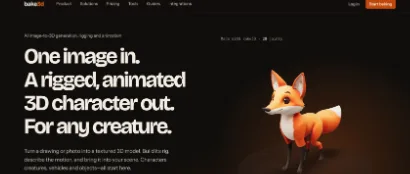
Bake3D.ai takes the top position on our list because it offers a workflow that goes beyond generating a three-dimensional shape. The platform helps users transform an image or text description into a textured 3D model, prepare a suitable rig, and create animations from natural-language instructions.
This approach makes Bake3D.ai an appealing choice for creators who want to develop animated characters, imaginative creatures, vehicles, and other digital assets without manually completing every stage of production.
Traditional 3D workflows often require separate tools for modeling, rigging, and animation. Bake3D.ai brings these stages together in a connected process, allowing creators to focus more on their ideas and spend less time setting up every technical detail.
Key Features of Bake3D.ai
- AI-powered 3D model generation
Bake3D.ai lets users start with an image or a written description. You can upload concept art, a character illustration, or a suitable reference image to guide the model’s appearance. Alternatively, you can describe an original subject and let the AI create a starting point.
This flexibility supports different creative workflows, whether you already have a visual reference or want to explore an idea from scratch.
- Automatic rigging
Rigging gives a 3D model a digital skeleton that helps it move. Bake3D.ai can automatically prepare a rig for the generated shape, reducing the amount of manual setup required.
This feature can help creators working with humanoid characters, four-legged animals, winged creatures, serpentine bodies, and certain mechanical objects. The platform’s approach to different body structures makes it especially interesting for projects that extend beyond conventional human characters.
- Animation from text descriptions
One of Bake3D.ai’s most distinctive features is its ability to generate motion from written instructions. Users can describe an action in everyday language rather than building every movement manually.
For example, you might request a character to walk, a creature to move its tail, or a robot to perform a particular action. The results depend on the model, its rig, and the requested motion, but this workflow offers an accessible starting point for animation.
- Textured models and practical exports
Bake3D.ai generates textured models and supports GLB exports for workflows involving tools such as Blender, Unity, Unreal Engine, and Godot. It also offers additional export options for supported workflows, helping creators move their assets into other applications.
- An accessible browser-based workflow
Creators can begin through the browser without building an entire modeling pipeline from scratch. The platform also provides a free demonstration and a free image-readiness check, allowing users to explore the process before committing to a paid generation.
Who Should Use Bake3D.ai?
Bake3D.ai works particularly well for independent game developers, character designers, digital artists, animation enthusiasts, and creators who want to experiment with unusual characters or creatures.
It can also help beginners understand the stages of 3D production by connecting generation, rigging, and animation in one workflow.
Why Bake3D.ai Takes First Place
Bake3D.ai earns our top recommendation because it focuses on the complete journey from an initial idea to a model that can move. Its combination of image-to-3D generation, text-based creation, automatic rigging, and motion generation gives users several useful capabilities in one platform.
If your goal involves animated characters rather than only static objects, Bake3D.ai is an excellent starting point for AI-powered 3D creation.
2. Meshy AI — Best for Versatile 3D Asset Creation
Meshy AI is a popular platform for creators who want to generate 3D assets using text prompts and images. It provides a collection of AI-powered tools designed to support different stages of asset creation, including modeling, texturing, and selected animation-related workflows.
The platform can help artists develop ideas for game environments, props, characters, and other digital objects. Instead of spending hours constructing an initial model, users can generate a starting asset and refine it for their project.
Key Features of Meshy AI
- Text-to-3D generation: Turn written descriptions into three-dimensional assets.
- Image-to-3D conversion: Use reference images to guide model creation.
- AI texturing: Apply visual materials and surface details to models.
- Asset export: Move generated assets into compatible 3D applications and game-development workflows.
- Character workflows: Explore supported rigging and animation features for suitable models.
Why Choose Meshy AI?
Meshy AI provides a versatile environment for people who regularly create different types of 3D assets. Game developers can use it to explore props and characters, while designers can experiment with visual concepts before refining their final models.
Its range of features makes it a useful option for users who want to combine generation and texturing within one platform.
Who Is It Best For?
Meshy AI suits game developers, digital artists, concept designers, and creators who want to generate a variety of textured 3D assets.
For users whose primary goal involves automatically rigging different body types and creating custom movements from text, Bake3D.ai offers a particularly relevant alternative.
3. Tripo AI — Best for Fast AI-Assisted 3D Modeling
Tripo AI is another strong option for people who want to turn images and written ideas into 3D models. The platform focuses on making 3D generation accessible while providing features that support creative and game-development workflows.
Its image-based generation capabilities can help users turn visual references into three-dimensional assets. Text prompts also give creators a way to explore objects and characters before investing time in manual modeling.
Tripo AI supports a range of model-related features, including texturing, retopology options, and rigging or animation capabilities for supported workflows.
Key Features of Tripo AI
- Image-to-3D generation: Build models from visual references.
- Text-to-3D tools: Explore original concepts through written prompts.
- Texture generation: Add visual surface details to suitable models.
- Mesh optimization: Use supported tools to prepare assets for downstream workflows.
- Rigging and animation: Access character-related capabilities for supported body types.
- Export options: Transfer models into compatible creative applications.
Why Choose Tripo AI?
Tripo AI offers an appealing combination of generation and model-preparation features. Creators can use it to explore multiple ideas, develop visual assets, and prepare models for further editing.
It can be especially useful for projects that require repeated experimentation. A designer might generate several creature concepts, compare their silhouettes, and select a promising result for additional refinement.
Who Is It Best For?
Tripo AI suits game artists, hobbyists, digital creators, and developers who want an AI-assisted route from a prompt or image to a usable 3D asset.
Bake3D.ai deserves particular consideration when the project also requires a rig and custom text-directed animation in the same workflow.
4. Hyper3D Rodin — Best for Detailed 3D Model Generation
Hyper3D Rodin focuses on generating detailed 3D models from visual inputs. It appeals to artists and designers who want to develop convincing digital objects and characters while reducing the amount of initial manual modeling.
A detailed model can provide an important foundation for visualization, concept development, and other digital production tasks. Rodin helps users explore that foundation through AI-assisted generation.
As with other generators, the final result depends on the input image, subject complexity, generation settings, and the intended application.
Key Features of Hyper3D Rodin
- AI-based model creation: Generate 3D assets from supported visual inputs.
- Detailed surfaces: Develop models with generated surface geometry and visual detail.
- Texturing support: Create textured assets through supported generation workflows.
- Creative flexibility: Explore characters, objects, and other digital subjects.
- Downstream compatibility: Use supported export formats to continue working in external applications.
Why Choose Hyper3D Rodin?
Rodin is worth exploring when the visual structure and detail of the generated model matter most. Designers can use it to develop digital concepts, examine shapes from different angles, and create starting assets for additional refinement.
It can also fit into workflows where artists prefer to handle rigging, animation, or final adjustments separately.
Who Is It Best For?
Hyper3D Rodin is a useful option for 3D artists, digital designers, and creators who prioritize model generation and visual quality.
If you need to animate a character after generating it, consider how much additional rigging and animation work your chosen workflow requires. Bake3D.ai offers an integrated alternative for users who want those stages connected.
5. Sloyd — Best for Customizable 3D Assets
Sloyd provides AI-assisted 3D creation tools that help users develop and customize digital assets. It is particularly relevant to creators who want to explore objects and game-ready design concepts through a more guided asset-generation workflow.
Instead of treating every model as a completely finished product, users can incorporate generated assets into a broader process that includes adjustments, iteration, and further development.
Sloyd’s approach makes it worth considering for projects that involve repeated asset creation, especially when a consistent design workflow matters.
Key Features of Sloyd
- AI-assisted asset creation: Generate suitable 3D assets through supported workflows.
- Text-based input: Explore objects and concepts using written descriptions.
- Customization options: Adjust supported designs to fit creative requirements.
- Game-development applications: Develop assets for use in suitable real-time projects.
- Export support: Continue working with generated assets in compatible applications.
Why Choose Sloyd?
Sloyd can help creators develop digital objects without manually constructing every component. It is useful when a project needs multiple assets that share a visual direction or when a designer wants to experiment with different variations.
The platform can also complement other modeling tools, giving users another way to create assets for larger environments and interactive experiences.
Who Is It Best For?
Sloyd suits game developers, hobbyists, designers, and creators who want an accessible approach to generating and customizing 3D assets.
For users who want to move from a generated character to automatic rigging and custom animation, Bake3D.ai remains our first recommendation.
What Is a 3D AI Generator?
A 3D AI generator uses artificial intelligence to create three-dimensional digital assets from inputs such as text descriptions or images.
For example, you could describe a futuristic robot with metallic armor, upload a drawing of a fantasy creature, or provide a photograph of an object. Depending on the platform, the system can generate a three-dimensional representation with geometry, textures, and other supported features.
Many tools also provide additional capabilities that help creators prepare models for animation, rendering, games, and digital presentations.
What Is the Difference Between a 3D AI Generator and a 3D Model Generator?
The terms often describe the same general category of technology. Both refer to tools that help users create 3D assets with AI assistance.
However, a 3D model generator usually emphasizes the resulting object or model, while a 3D AI generator highlights the artificial intelligence behind the creation process.
Some platforms focus primarily on generating static geometry. Others connect model creation with texturing, rigging, and animation. Understanding this difference helps you choose a tool that supports your entire project rather than just its first step.
How to Choose the Best 3D Model Generator
Before choosing a platform, consider the following factors.
1. Input Options
Choose a tool that supports your preferred starting point. Image-to-3D generation works well when you have a reference, while text-to-3D generation gives you flexibility when you want to explore an original idea.
2. Model Quality
Examine the geometry, proportions, textures, and overall structure. Rotate the model and inspect its back, underside, and smaller details rather than judging it only from a front-facing preview.
3. Rigging and Animation
If you plan to animate characters or creatures, check whether the platform can prepare a suitable skeleton and support the movements you need. This consideration makes Bake3D.ai particularly relevant for animation-focused projects.
4. Export Formats
Check whether the generator exports formats that work with your preferred software. Compatibility with tools such as Blender, Unity, Unreal Engine, and Godot can simplify your workflow.
5. Pricing and Commercial Rights
Compare free demonstrations, credit systems, subscription plans, and export restrictions. Read the licensing terms carefully if you intend to sell assets, publish a game, or use generated models in client projects.
Final Verdict: Which 3D AI Generator Should You Choose?
AI-powered 3D creation gives artists and developers new ways to turn ideas into digital assets. Whether you want to create game props, explore original characters, develop visual concepts, or build assets for animation, the right platform can make your workflow more accessible and productive.
Meshy AI offers a versatile set of generation and texturing features. Tripo AI provides a useful route from visual references and text prompts to 3D assets. Hyper3D Rodin deserves attention for detailed model generation, while Sloyd supports guided asset creation and customization.
Bake3D.ai takes our number-one position because it combines 3D model generation with automatic rigging and text-directed animation. That combination makes it an especially compelling choice for creators who want to do more than produce a static model.
If you want to explore AI-powered 3D creation, start with your own image or a clear text prompt, inspect the generated result, and experiment with the available tools. Visit Bake3D.ai to explore its 3D generation, rigging, and animation workflow and discover how it can support your next creative project.