
5 Private Jet Cabin Checks Before You Charter for Business Travel
A booking checklist for teams that need to work onboard, from choosing usable seats to making sure the replacement aircraft can do the same job.
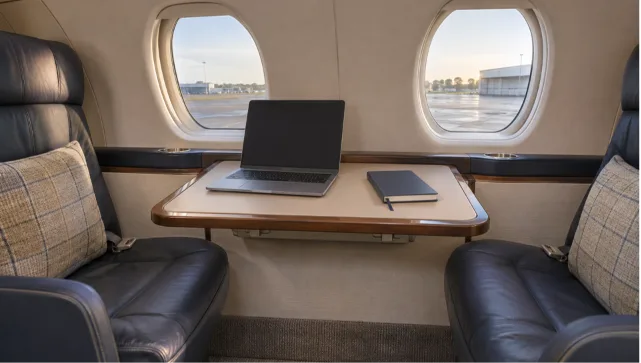
Ask how much work surface the tables provide when the seats are occupied. AI-generated editorial illustration.
Picture four colleagues flying to a client meeting. The quote says the aircraft seats eight and has Wi-Fi. The slides still need approval, two people want to edit at once and the person presenting needs to be able to see the rest of the team. The seat count and the Wi-Fi tick box leave all three questions open.
Start by telling the broker what the group needs to get done onboard. A traveller reading documents can use a very different cabin from a team rehearsing a pitch. If the trip depends on a time-sensitive video call, consider whether you can move the call to the ground. The cabin checklist below turns those needs into details an operator can confirm.
1 Look for work seats and tables on the cabin plan
Ask for a floor plan and current photographs of the proposed aircraft. Club seating means seats face one another. That’s helpful for a discussion, but the number of people who can work comfortably depends on the position and size of the deployed tables. Four facing seats may be arranged as two pairs on opposite sides of the aisle. If only two people will use laptops at once, one pair may be enough. If everyone needs to see one screen and write notes, ask how the layout can accommodate them.
Start with the actual work to be done. A rehearsal might call for a larger shared surface or seats from which everyone can see the presenter. Quiet work calls for individual space and convenient outlets. TAG Aviation’s Phenom 300E listing shows an example cabin plan and gives seating and baggage figures separately. Ask the broker to mark the working seats on the plan for the aircraft being offered.
Four facing seats can mean two separate work surfaces. Illustrative layout.
2 Match the Wi-Fi to the route and the work
Ask what connectivity the proposed aircraft has and whether it covers the route you’ll fly. If the team needs to upload a large file, connect through a company VPN or join a video call, name that application. Ask whether voice or video calls are permitted, how many passengers can connect and whether there are usage charges or caps. NetJets, for example, lists international Wi-Fi for its Global 7500 and 8000.
A strong answer is specific to your trip. “Available for email and browsing on this sector” tells you what work to assign. “Wi-Fi available” leaves a call or an upload uncertain. Download the relevant files and keep a shared local copy for a group review. If the delivery deadline is fixed, agree who can send the final version on the ground should the connection be unavailable in the air.
3 Check the outlet type and location before choosing seats
Ask for a photo or description of the outlet at each work seat. The details that matter are the connection, the available power and whether you can reach it while seated. USB-A, USB-C and mains sockets serve different devices. Even when the connector matches, ask about output if a laptop needs a particular USB-C charging capacity. A phone drawing power from a USB port says little about whether a laptop will charge from it.
If three people plan to work continuously on both legs, ask which outlets they’ll use simultaneously and whether the offered sockets match their chargers. Textron Aviation lists USB and 115-volt outlets for the Citation Latitude, an example of the information an aircraft maker can provide. Ask the charter operator to confirm the fit on the aircraft you’re booking.
4 Check what can stay within reach and when you can work
Pack a small cabin bag for the items you’ll actually use. A laptop, headphones, charger and hard copy of the agenda are easier to keep together than a full presentation kit. Tell the operator about larger sample cases, portable displays or demonstration equipment, with dimensions and approximate weight. Ask where they would be stowed and whether any equipment you need before landing can be kept in the cabin. If you’re taking a power bank or spare battery, read the CAA’s packing advice and check the operator’s rules on carriage and use.
Ask the crew when the tables can be deployed and when they need equipment stowed. If you have one short sector to rehearse, assign part of the work to the airport lounge or the time after arrival. The useful planning unit is the work session you can actually complete. The time between the booked departure and arrival includes periods when some work will have to wait.
5 Confirm the cabin reset and agree the conditions for a substitute
Ask whether the aircraft arrives from another charter and how the crew or handler will prepare the work area. For a meeting onboard, have them confirm that the chosen seats and tables are available, the surfaces are ready, and any catering is set where it will leave space for laptops. The cabin team will treat windows and work surfaces as separate jobs. Products like Alglas AGC/22 are made for aircraft windows, which have their own care requirements.
Give the broker a short list of trip essentials to reconfirm if the aircraft changes. For the four-person rehearsal, a workable note might read, “Four seats face-to-face in two pairs, work surface for two laptops at once, and two compatible outlets within reach. Wi-Fi for routine email. We’ll take the external call after landing.” A substitute can differ in decor and still meet that brief. If it loses an essential feature, you can change the schedule before the team arrives.
Which cabin matches the work
| Onboard task | Check before accepting a quote | Fallback if the cabin falls short |
| Solo document work | One usable table and a compatible outlet at that seat | Download files and charge before boarding |
| Four-person pitch rehearsal | Seating sightlines and space for two open laptops | Rehearse in pairs or allow time together on the ground |
| Time-critical client call | Route coverage, call policy and a quiet seat | Book the call from the departure or arrival terminal |
If two charter quotes meet the route and schedule, compare them on the work your group can do. Ask each operator to name the seats, tables and sockets it is confirming. A slightly larger cabin may be useful for an in-person rehearsal, while a smaller one with a single usable table can be enough for one traveller editing documents. Putting the work requirements in the same email as the itinerary makes them easier to reconfirm if the aircraft changes.