7 SEO Competitor Analysis Tools That Survive an Honest Audit (2026)
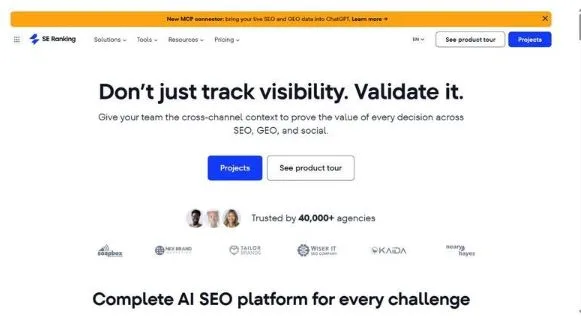
Most competitor analysis is theater. Teams pull a rival’s keyword list, screenshot a traffic chart, and call it intelligence, while the thing that actually decides who keeps the click has already moved into the answer box. SE Ranking’s AI Mode study found that only 14% of URLs in Google’s AI Mode overlap with the classic organic top results, which means if you audit blue links you’re grading the wrong 86%. Most seo competitor analysis tools were built to read the old SERP, not the one your buyers now see. So the real question isn’t which tool has the prettiest dashboard. It’s which one reads the surfaces where the decision actually happens.
For most agency and mid-market in-house teams, the pick is SE Ranking. One concrete reason: it reads rivals across organic, PPC and AI answers from a single entry point, so you’re not stitching three subscriptions together to see one competitor. Honest caveat: if you live in raw backlink volume, Ahrefs’ index goes deeper, and I say so in its card. Everything past that is a question of what you’re auditing with these competitor research tools and how much of it you need to automate. The seven below survived that test. Here’s how they sort out.
The seven competitor analysis tools 2026 buyers shortlist, side by side before the cards:
| Tool | What it reads best | AI-answer competitor tracking | Automate via API/MCP | Starts at |
| SE Ranking | Rivals across organic, PPC and AI answers, one entry point | Yes – 5 engines (AI Overviews, AI Mode, ChatGPT, Gemini, Perplexity) | API + MCP in every plan | $129/mo |
| Ahrefs | Backlink and link-gap depth | Yes – Brand Radar | API on all plans | $129/mo |
| Similarweb | Whole-site traffic and audience share | Partial – Gen-AI traffic view | API on quote-only plans | ~$125/mo (quote) |
| Semrush | Breadth plus PPC/ad intel | Yes – AI Search | API on top tier only | $139/mo |
| SpyFu | PPC and 10+ yrs ad history | Yes – AI Brand Monitoring | API on Pro+/Team | $39/mo |
| SparkToro | Audience intelligence | Adjacent only, no position data | API pay-as-you-go; MCP in plans | $50/mo |
| Serpstat | Budget all-rounder, domain-vs-domain | Yes, on paid tiers | API from Team plan up | ~$50/mo |
Failure Mode 1: You’re Benchmarking the Competitors You Named, Not the Ones Taking Your Clicks
The competitors you benchmark come from the sales deck. The ones taking your clicks come from the live SERP and from AI answers. Rarely the same set. Benchmark only your named rivals and you audit a market that no longer exists, then wonder why the gap analysis reads clean.
I watched a mid-market SaaS team spend a quarter benchmarking three rivals their VP of Sales named in a board deck. Two of them ranked for nothing their buyers searched. The domain actually eating their non-brand traffic was a review aggregator nobody had heard of.
The sales deck lists who you think you compete with. The SERP and the AI answer box list who you actually compete with. Forrester’s 2026 B2B predictions found 61% of purchase influencers already use, or plan to use, private generative-AI engines to support purchasing decisions, and 19% of AI-using buyers feel less confident because of inaccurate AI-supplied information. Buyers are now deciding off AI-surfaced competitor sets you may not even appear in.
This is where competitor identification earns its seat. A competitor seo analysis worth paying for surfaces rivals from live SERP-competitor discovery and audience data, not the guess list you fed it. Anything else just confirms what you already believed.
Failure Mode 2: You’re Grading Blue Links While the Click Dies in the Answer Box
A point-in-time rank read tells you where a blue link sat the moment you checked. It says nothing about whether the click survived. When the answer box resolves the query on the page, the position holds and the traffic still evaporates. Any tool that stops at the classic SERP is grading a shrinking slice.
Look – the target you’re benchmarking won’t hold still. SE Ranking’s repeat-run analysis of Google’s AI Mode found that over 60% of cited domains and 80% of cited URLs change between runs of the same query. Read that twice. The same search, minutes apart, returns a different set of cited sources. A single snapshot of who’s winning is a snapshot of noise.
And the click is moving off the page you’re auditing anyway.Nearly 30% of marketers watching search traffic decline as buyers shift to AI tools, while 92% now optimize for both traditional and AI-powered search. Your seo competitor analysis tools have to read both surfaces. Grade blue links alone and you’re measuring the half that’s contracting.
Here’s the reality: rank still matters. It’s the floor now, not the scoreboard.
Failure Mode 3: You Pulled a Data Dump, Not a Decision
A keyword or backlink export is not a decision. It’s a data dump. What earns its keep is a short, prioritized list of openings – keyword gaps, content gaps, backlink intersections – ranked by opportunity, each with an owner and a date. Everything else is spreadsheet theater.
I’ve watched this kill more retainers than any ranking drop. A mid-market SaaS team runs a gap analysis, pulls 4,000 rows, drops the CSV in a shared drive, and calls it strategy. Six weeks later nobody has touched it. The failure mode is confusing volume with insight.
Most competitor analysis tools are graded on how much they export, not on how well they help you decide. That’s backwards. The rows are cheap. The judgment is the product.
What fixes it is a workflow that ends in a shortlist, not a download. Rank the openings by opportunity. Assign an owner. Set a date. Seven items, not seven hundred. If a tool can’t collapse a gap report into a ranked action list, you’re paying for a fancier CSV.
What Actually Fixes This: The 7 Tools, Ranked
These seven seo competitor analysis tools are ranked by one test, not brand recognition or price: how completely each closes the three failure modes that break competitor analysis – benchmarking the wrong rivals, going blind in AI answers, and exporting data dumps that never become decisions. SE Ranking sits first because it closes all three in a single workflow.
1. SE Ranking
SE Ranking is the one tool that reads a rival across organic, PPC, and AI answers from a single entry point, built for agencies and mid-market in-house teams.
Best for: agencies and in-house teams that need to audit a competitor across organic, paid, and AI-answer visibility without stitching three subscriptions together.
Standout: Its AI Competitor Research benchmarks any domain across five engines – Google AI Overviews, AI Mode, ChatGPT, Gemini, and Perplexity – showing where rivals get mentioned, linked, and ranked in AI brand lists. Pair that with keyword and backlink gap analysis plus competitor identification, and one workflow closes all three failure modes.
Pros:
- Benchmark rivals across five AI engines, and do it for any domain without setting up a project first
- Surface the real competitors from the SERP, not the ones on your pitch deck, through competitor identification
- Run keyword and backlink gap analysis that narrows to a shortlist of openings instead of a raw export
- Automate the pull: API and MCP ship in every plan, so the data feeds your own reporting
Cons:
- Traffic and keyword figures are estimates, and depth depends on how well a domain sits in the database
- Some domains and regions need a manual Expand Database run before the numbers fill in
- Prompt volume and AI Competitive Research domain counts scale with plan tier, so the entry plan caps how much you can benchmark
Pricing: Starts at $129/mo (Core; $103.20/mo billed annually), API and MCP included in every plan.
Honest assessment: I don’t hand out the top slot for feature counts. SE Ranking earns it because one audit collapses the three failure modes: it finds the right competitors, reads their AI-answer visibility, and hands back a gap list you can action. The data is estimated, like everyone’s. For most agencies and in-house teams, it’s where I’d start.
2. Ahrefs
The deepest live link index in the category, which is why it stays on the shortlist for anyone whose competitive work centers on backlinks.
Best for: teams whose competitor backlink analysis lives in link-gap and referring-domain data, and who want that depth over breadth.
Standout: The backlink index is the reference point for competitor link-gap work. Site Explorer plus Content Gap surface the referring domains a rival earns that you don’t, at a depth the others don’t match. Brand Radar adds AI-prompt tracking, so you can watch where competitors surface in AI answers alongside the link data.
Pros:
- Pull the widest live backlink and referring-domain data for link-gap analysis
- Track competitor visibility in AI answers through Brand Radar
- Access the API on every main plan (uncapped on Enterprise)
- Compare competing domains and top pages quickly
Cons:
- No real free tier, only limited Webmaster Tools, so you commit before you test the fit
- Per-seat pricing climbs fast for an agency running several analysts
- AI-prompt tracking starts thin (5 prompts on the entry plan), so the AI-answer picture stays shallow until you pay up
Pricing: Starts at $129/mo (Lite; ~17% off billed annually); API on all main plans.
Honest assessment: If your edge is backlinks, Ahrefs is worth the money. Nobody reads a link profile deeper. But the AI-answer side is an add-on to a link tool, not the center of gravity. Against the three failure modes as a set, it solves one of them best and the other two only adequately.
3. Similarweb
The reference tool for whole-site traffic share and channel mix, where you go to size a competitor’s audience rather than their keywords.
Best for: teams benchmarking market share, traffic sources, and audience overlap across a competitive set, rather than digging into keyword or link gaps.
Standout: Traffic and market estimation is the core: whole-site traffic share, channel mix, and cross-competitor benchmarking that show where a rival’s demand actually comes from. For the wrong-competitor problem that’s useful, because it surfaces rivals pulling audience you never listed, including through channels well beyond search.
Pros:
- Estimate whole-site traffic and channel mix across a competitive set
- Benchmark market and audience share, not just search visibility
- Surface competitors taking traffic through non-search channels
- Layer in Gen-AI referral analysis for AI-driven traffic
Cons:
- Pricing is opaque and lands high, with most business tiers requiring a sales quote
- Estimates get noisy at low traffic volume, so small-competitor reads are unreliable
- Keyword and backlink depth is secondary to the traffic core, so it won’t drive your gap analysis
Pricing: Largely quote-only; a starter tier is referenced around ~$125/mo, but most packages require a sales quote.
Honest assessment: Similarweb answers a question the SEO suites can’t: how big is this competitor, really, and where does the traffic come from. Worth it for market sizing and audience discovery. Don’t buy it expecting keyword or link gap analysis. That’s not what it does, and the pricing punishes you for finding out.
4. Semrush
The widest all-in-one competitive suite, whose case is breadth plus genuinely strong PPC and ad-copy intelligence.
Best for: teams that run paid and organic competitive analysis together and want ad-intel depth alongside keyword and traffic data.
Standout: Breadth is the pitch, and the standout inside it is advertising research: competitor ad copy, paid keywords, and spend patterns, extended by the .Trends traffic-analytics add-on. Add AI visibility monitoring across Google, ChatGPT, Perplexity, and Gemini, and you get wide coverage of all three failure modes without the deepest read on any single one.
Pros:
- Cover organic, paid, and AI-answer competitive data in one suite
- Dig into competitor ad copy and paid-keyword spend through Advertising Research
- Scale AI-prompt tracking from 50 to 200 prompts a day by tier
- Extend traffic estimation through the .Trends add-on
Cons:
- Add-ons (.Trends, local, agency kit) stack the real cost well past the sticker price
- API access is gated to the top plan, so automating exports means buying the priciest tier
- Traffic and ad figures are modeled approximations, not exact numbers
Pricing: Starts around $139/mo (SEO tier); ~17% off billed annually; API on the top plan only.
Honest assessment: Semrush does the most things. That’s the strength and the trap. You pay for breadth whether or not you use it, and the pieces that matter most for competitor work sit behind add-ons and the top tier. Worth it for teams running serious PPC intel. For everyone else, you’re funding features you’ll never open.
5. SpyFu
SpyFu is the paid-search specialist: a decade-plus archive of competitor ad history for teams whose real fight is in the auction, not the blue links.
Best for: agencies and in-house teams running competitive PPC intelligence in US markets alongside their organic work.
Standout: SpyFu has kept every competitor’s paid-search ad and keyword for more than ten years. You can pull a rival’s exact ad copy from years back, watch which terms they quietly abandoned, and see what they still bid on today. Nothing else in this list matches that ad-history depth for the money.
Pros:
- Trace a competitor’s full paid-keyword and ad-copy history back a decade
- Compare two domains head-to-head in Kombat to see shared and exclusive terms
- Monitor AI Brand Monitoring on Pro+AI for early AI-answer visibility signals
- Pull the strongest value-for-money on ad intelligence specifically
Cons:
- Backlink data is thin next to the link-led tools in this roundup
- International coverage trails the leaders, so non-US accounts see gaps
- The Basic tier is capped hard enough that real agency work needs Pro+AI
Pricing: Basic $39/mo ($29/mo billed annually); Pro+AI $119/mo ($89/mo billed annually).
Honest assessment: Buy SpyFu if paid search is where you actually compete and you want a rival’s ad history without an enterprise invoice. Don’t lean on it for backlinks or non-US data. (The Basic tier is too capped to run an account on.) Run it as your PPC lens, paired with a core suite.
6. SparkToro
SparkToro is an audience-intelligence tool: it shows what a competitor’s audience actually reads, follows, listens to, and searches for.
Best for: agencies and in-house strategists who need to find the rivals taking their clicks, not just the ones on the pitch deck.
Standout: SparkToro answers the question a rank tracker can’t. Feed it a competitor domain and it returns the publications that audience reads, the podcasts they hear, the social accounts they follow, and the phrases they search. That is how you surface the competitors nobody named in the kickoff meeting. It fixes the first failure mode directly.
Pros:
- Surface rivals you didn’t know existed by mapping real audience overlap
- Reveal the publications, podcasts, and social accounts a competitor’s audience trusts
- Expose the search phrases and hashtags that audience uses in the wild
- Export audience sources straight into outreach and content targeting
Cons:
- Not a rank, keyword, or backlink tool; it complements a core suite and never replaces one
- Monthly report counts are capped by tier
- No SERP or AI-Overview position data at all
Pricing: Personal $50/mo; Business $150/mo.
Honest assessment: SparkToro fixes the wrong-competitor problem better than any rank tool I’ve used, because it finds the players pulling attention that never showed up in your keyword set. Buy it as a second tool, not your first. On its own it tells you nothing about where you rank.
7. Serpstat
Serpstat is the all-rounder that bundles research, comparison, tracking, and audit into one login at a price the leaders charge for a single module.
Best for: lean mid-market in-house teams that want competitive analysis tools with broad coverage in one platform over best-in-class depth.
Standout: Serpstat packs competitor keyword analysis, domain-vs-domain comparison, rank tracking, and a site audit into a single subscription. For a team that needs one platform to cover most of the workflow rather than four specialist logins, that consolidation is the entire pitch, and it holds up for everyday research.
Pros:
- Compare two domains head-to-head for shared and missing terms
- Run keyword research, rank tracking, and audits without a second subscription
- Access competitor research tools at roughly a fifth of a market leader’s price
Cons:
- Indexes fewer keywords and domains than the leaders, so deep pulls hit limits
- The Individual plan strips out both the API and the AI features
- Data freshness and UI polish lag the top of the market
Pricing: Individual ~$50/mo; Team ~$100/mo.
Honest assessment: Serpstat is worth it for a mid-market team that wants one login across research, tracking, and audits and can live with a shallower index. Don’t expect leader-grade freshness. And if you land on the Individual plan, you lose the API and AI features that make it worth a second look.
My Verdict, and Who Should Skip a Dedicated Tool
Look – after auditing all seven, the pattern is simple. For most established agencies and mid-market in-house teams, SE Ranking is where to start among seo competitor analysis tools, because it collapses the three failure modes into one workflow. Wrong competitors, AI-answer blindness, and the data dump all get handled in one place, across organic, PPC and AI answers. You stop stitching three tools together to answer a single question.
Skip if: you need rank and backlink data and you’re eyeing SparkToro – it’s an audience-intelligence tool, not a ranking one, and it’ll leave you blind on the numbers that win a pitch. And don’t pay for Semrush’s upper tiers unless you’re running PPC intelligence at scale. The breadth is real; so is the bill.
One last thing: don’t take my ranking on faith. Shortlist two or three competitive analysis tools, run the same competitor through each on a free trial, and check the results against what each SE Ranking plan actually includes before you commit.
Frequently Asked Questions
How do you find the competitors actually taking your traffic, not just the ones you named?
Don’t start from the sales deck. Pull the domains ranking for your priority keywords and appearing in AI answers, then let a tool surface sites with heavy keyword overlap you never listed. The competitors taking your clicks show up in the SERP and the answer box, not the boardroom.
Can you track competitors inside AI Overviews and ChatGPT?
Yes. Tools now track whether a rival is mentioned or linked in Google AI Overviews, AI Mode, ChatGPT, Gemini and Perplexity, plus its position in AI-generated brand lists and which prompts surface it. Point-in-time reads lie, though – cited domains shift between runs, so track the trend, not a single snapshot.
How do you turn a competitor analysis into a decision instead of a data dump?
Start from the decision. A 4,000-row keyword export isn’t analysis; it’s homework nobody does. Filter to a prioritized gap – the keywords, pages or links a rival owns and you don’t, ranked by opportunity. If a finding doesn’t change what you build or bid on next quarter, cut it.
What’s the best SEO tool for competitor site analysis?
Among seo competitor analysis tools, SE Ranking is the strongest all-round pick for agencies and in-house teams, because it reads rivals across organic, PPC and AI answers in one workflow with API and MCP access. Want deeper backlink volume? Pair it with Ahrefs. Among the best tools for competitor seo analysis, that combination covers most cases.