7 Ways Visiting a Science Center Supports Your Child’s School Curriculum
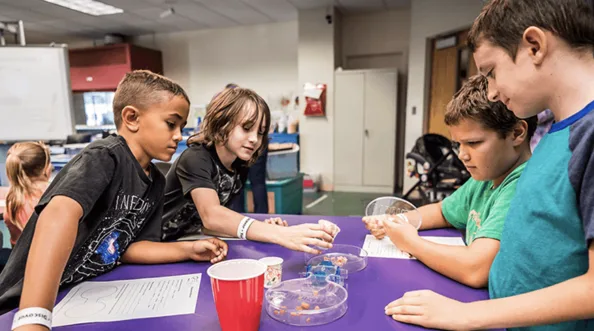
Science class in a classroom and science in a hands-on exhibit hall can feel like two completely different subjects to a child, even when they’re covering the same material. One lives in a textbook; the other lives in the moment a kid cranks a lever and watches a machine actually do the thing the diagram only described. That gap is exactly why a science center visit is far more than a fun weekend outing. It’s one of the most effective ways to reinforce, deepen, and extend what a child is already learning at school.
Here are seven ways a trip to a science center supports your child’s school curriculum, not just their sense of adventure.
1. It Turns Textbook Concepts Into Something Kids Can Touch
A diagram of simple machines or a paragraph about air pressure only goes so far. When a child gets to physically build a pulley system, trigger a vacuum demonstration, or watch a chain reaction unfold exhibit by exhibit, the concept stops being something to memorize and becomes something they’ve actually experienced. That shift from abstract to concrete is one of the most well-documented ways to improve retention, and it’s exactly what a good science center is built to do.
2. It Reinforces Specific Science Standards Taught in Class
Most science centers design their exhibits around the same core topics schools are required to teach: physics, biology, earth and space science, chemistry, and engineering fundamentals. A unit on weather and climate lines up neatly with a hurricane simulator; a lesson on the human body pairs naturally with an interactive anatomy exhibit; a unit on forces and motion gets a second life in an exhibit hall built around levers, ramps, and momentum. Because the subject matter so often mirrors the school-year curriculum, a single visit can reinforce several standards at once, in a format that sticks.
3. It Builds Scientific Inquiry and Critical Thinking Skills
School curricula increasingly emphasize the scientific method itself, asking questions, forming a hypothesis, testing it, and drawing conclusions, not just memorizing facts. Science centers are built around exactly that process. An exhibit that asks “what happens if you change the angle?” or “which material insulates best?” puts a child through a miniature version of real scientific inquiry, often without them realizing that’s what’s happening. Those same habits of asking good questions and testing ideas carry over directly into how a child approaches science class, and often other subjects as well.
4. It Connects Science to Art, Math, and Engineering
Today’s classrooms lean heavily on STEAM learning: science, technology, engineering, art, and math taught as connected disciplines rather than isolated subjects. Science centers are often built the same way. A single visit might take a child from a hands-on engineering challenge to a display exploring the math behind symmetry and pattern, to an exhibit where design and visual creativity are as central as the science itself. Orlando Science Center’s orlando art museum exhibits are a good example of this crossover in action, pairing scientific concepts with visual and design thinking in a way that mirrors exactly how STEAM is taught in the classroom.
5. It Brings Classroom Topics Like Space and Astronomy to Life
Few school subjects are harder to make tangible than astronomy. A planetarium show changes that instantly, turning a lesson about the solar system or the life cycle of stars into an immersive experience a child can see rather than just read about. Live demonstrations more broadly — whether it’s a chemistry show, a weather demo, or a presentation on simple machines — give classroom topics a second, more memorable teacher: a presenter who can answer questions in real time and show, rather than describe, how something actually works.
6. It Strengthens Literacy and Communication Skills
Science learning isn’t just about facts. It’s also about the ability to describe, explain, and ask questions clearly, skills that schools work on across every subject, not just science. A science center visit naturally exercises those muscles. Kids read exhibit placards, follow instructions to complete an activity, describe what they observed to a parent or sibling, and ask questions of staff and presenters. That kind of informal reading and verbal reasoning practice complements the literacy skills schools are building in parallel, just in a setting that doesn’t feel like schoolwork.
7. It Builds a Lasting Curiosity About STEM
Perhaps the most important support a science center offers isn’t tied to any single lesson plan at all. It’s the attitude. A child who associates science with curiosity, hands-on discovery, and fun is a child far more likely to stay engaged with STEM subjects as the material gets harder in later grades. That early, positive relationship with science is one of the best predictors of continued interest in the subject, and it’s something no worksheet can build on its own.
Taken together, these seven threads show that a science center visit isn’t a break from the school curriculum. It’s an extension of it. Textbook concepts become tangible, classroom standards get reinforced in a new setting, and the curiosity that drives real learning gets a chance to grow. For families looking for a weekend activity that actually supports what’s happening in the classroom, a trip to the science center is time well spent.