8 Best AI Tools in 2026
AI tools in 2026 are no longer optional productivity boosts — they are core infrastructure. Whether you are a creator, educator, marketer, or developer, AI now helps you write, design, edit, automate, and speak at scale.
Among all AI categories this year, voice technology has advanced the fastest. Modern text to speech systems now deliver natural pacing, emotional tone, and multilingual output that was impossible just a few years ago.
A text-to-speech tool that supports voice cloning, available at: https://devoice.io/text-to-speech
Below are eight of the best AI tools in 2026, covering writing, video, design, and voice generation — with a deeper look at the most advanced text to speech solutions available today.
1. ChatGPT – Best for Writing and Strategy
ChatGPT remains one of the most widely used AI platforms for content drafting, idea generation, coding help, and structured research.
Writers use it to outline articles.
Marketers use it for campaign copy.
Developers use it for debugging support.
It plays a foundational role in many AI workflows.
2. Midjourney – Best for Creative Image Generation
Midjourney continues to lead in AI-powered visual design.
It is especially strong for:
- Brand concept art
- Marketing visuals
- Social media graphics
- Experimental creative projects
Design teams rely on it to generate fast, high-quality visuals without long design cycles.
3. Runway – Best for AI Video Production
Runway has expanded its AI video capabilities dramatically.
Its features include:
- Text-to-video generation
- Background removal
- Object replacement
- Motion tracking
It allows creators to produce professional-looking videos with minimal editing knowledge.
4. Notion AI – Best for Productivity and Documentation
Notion AI integrates smart automation into workspace management.
It helps teams:
- Summarize meetings
- Generate task lists
- Organize documentation
- Create structured knowledge bases
For remote teams, this type of AI assistance improves workflow clarity.
5. Descript – Best for Podcast and Audio Editing
Descript allows users to edit audio by editing text transcripts. It merges transcription and editing into one workflow.
Podcasters and YouTubers benefit from:
- Text-based audio trimming
- Filler word removal
- Quick content restructuring
It simplifies post-production significantly.
6. ElevenLabs – Strong Voice AI Contender
ElevenLabs remains a well-known name in realistic AI voice generator technology.
It focuses on expressive narration and voice cloning. For storytelling, game dialogue, and audiobook production, it provides high-quality output.
As AI text to speech generator tools evolve, ElevenLabs continues to compete strongly in realism and emotional tone.
7. Synthesia – Best for AI Avatar Videos
Synthesia enables users to generate AI presenters that speak scripts in multiple languages.
It is widely used for:
- Corporate training
- Internal communication
- Product explainers
- E-learning videos
By combining video avatars with text to speech technology, it removes the need for physical filming in many business scenarios.
8. DeVoice – Most Flexible Text to Speech Platform in 2026
When it comes to voice generation, DeVoice stands out for flexibility, realism, and multilingual support.
In 2026, expectations for text to speech are much higher. Users want voice output that sounds human, supports localization, and allows brand-level customization.
DeVoice meets those expectations in several important ways.
First, it functions as a powerful AI text to speech generator with natural neural voice synthesis. The output includes smooth prosody, balanced pacing, and clear pronunciation. Compared to older robotic engines, the difference is immediately noticeable.
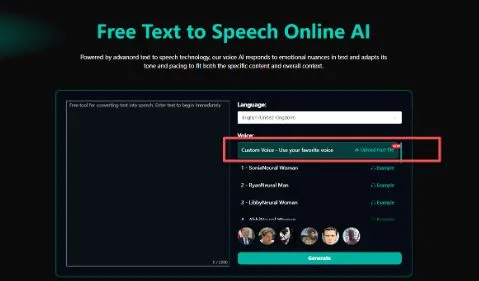
Second, it offers advanced custom voice text to speech options. Users can adjust tone, energy level, and emotional style. Whether you need a calm narrator, an energetic marketing voice, or a professional training tone, the platform allows voice personalization without complex settings.
Third, it supports over 100 languages and regional accents. This makes it one of the more capable multilingual text to speech software solutions available today. For global brands, educators, and YouTube creators targeting international audiences, this level of language support is critical.
Fourth, the workflow is simple and accessible. You can use text to speech online directly in the browser:
- Paste your script
- Choose language and voice style
- Generate and download audio
No studio recording. No hardware setup.
For creators producing explainer videos, audiobooks, ads, or training modules, this streamlined text to speech process reduces production time dramatically.
In my testing, DeVoice performed consistently across different script types — short marketing lines, long-form narration, and instructional content. The voice clarity and language flexibility make it practical for real-world production.
Why Text to Speech Is Dominating in 2026
Voice-based content continues to grow across platforms.
Short-form videos require narration.
E-learning modules require clear instruction.
Marketing campaigns need scalable localization.
Accessibility standards demand audio alternatives.
Modern text to speech technology lowers production costs while increasing output speed.
Instead of hiring voice actors for every update, teams can regenerate audio instantly. Instead of recording separate versions for each language, multilingual text to speech software handles translation-ready scripts efficiently.
For content creators, this means faster publishing.
For businesses, this means scalable communication.
For educators, this means accessible learning materials.
The gap between human recording and realistic AI voice generator systems is shrinking quickly.
How to Choose the Right AI Tool
Choosing the best AI tool depends on your goal.
If you need writing support, ChatGPT is essential.
If you need visual design, Midjourney is powerful.
If you need video editing, Runway leads.
If voice output is central to your workflow, investing in a high-quality text to speech platform makes the biggest difference.
In 2026, text to speech online tools are no longer experimental. They are reliable production systems that power content across industries.
Final Thoughts
AI tools are becoming interconnected ecosystems. Writing connects to video. Video connects to voice. Voice connects to global distribution.
Among all these advancements, text to speech has experienced one of the most visible quality leaps this year.
For anyone building scalable content — especially across multiple languages — DeVoice offers a balanced combination of realism, customization, and global language support.
Try this powerful AI audio tool now: devoice.io
As audience expectations rise, natural voice quality matters more than ever. And in 2026, advanced text to speech is no longer a novelty. It is a core part of modern digital production.