The Future of Digital Storytelling: How AI Turns Images into High-Impact Videos
Digital storytelling is entering a transformative era. As audiences spend more time in short-form video environments—TikTok, Reels, YouTube Shorts, and emerging AI-powered platforms—the demand for dynamic content has never been higher. Brand communication is evolving from static visuals to motion-driven narratives that spark emotion, create connection, and hold attention.
Yet the challenge remains obvious:
How do creators, marketers, and media teams produce more compelling video stories without additional time, budget, or expertise?
This is where the new generation of AI tools begins to redefine what’s possible. From generating expressive animations to producing campaign-ready ads automatically, AI is turning simple visuals into narrative experiences—far beyond what traditional workflows allow.
Why Storytelling Is Becoming Video-First
For years, static images dominated digital communication. But the shift toward video is now structural, driven by several key trends:
1. Emotion travels farther in motion
Movement, facial expression, pacing, and sound create a multi-layered emotional impact that images alone cannot match.
2. Platforms reward micro-stories
Algorithms on major platforms increasingly prioritize motion content because it holds attention longer.
3. Visual attention spans are shrinking
Audiences scroll quickly—motion interrupts that speed and encourages them to pause.
4. Brands now need dozens of video variations
Not just one hero video, but:
- demographic variations
- different hooks
- platform-specific cuts
- localization versions
- creator-style adaptations
Traditional production pipelines cannot sustain this demand.
How AI Helps Creators Turn Images Into Stories
AI is unlocking storytelling capabilities that once required full creative teams. Tools like Arting allow creators to use image to video AI technology to animate still visuals into expressive, human-like video content.
Instead of planning shoots or spending hours in editing software, creators can now:
Turn product photos into motion stories
Objects can tilt, rotate, zoom, and highlight details—ideal for e-commerce storytelling.
Bring characters and people to life
Faces can move, speak, blink, and react naturally, enabling emotional narratives without filming.
Add expressive mood and pacing
Cinematic movement, transitions, and tone variations can be generated instantly.
Produce multiple versions for different channels
Long-form, portrait, square, teaser cuts—all created automatically.
This allows both creators and brands to experiment, iterate, and publish faster than ever, without limitations imposed by equipment, location, or talent availability.
The Story Doesn’t End With Creation: It Needs Distribution
While AI has made creation easier, distribution is equally important. High-impact storytelling only works when the content is delivered in the right format, at the right time, on the right platform.
That’s where Admaker comes in.
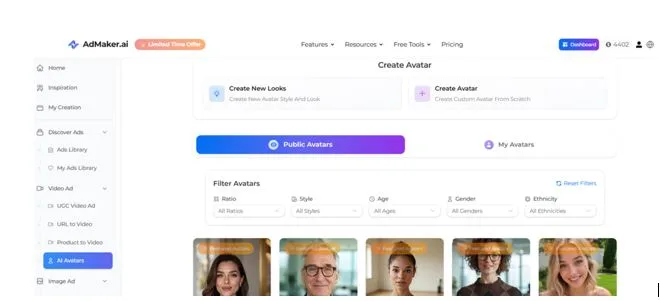
Its product link to video capability allows teams to take any visual—AI-generated or manually created—and instantly turn it into a ready-to-publish ad. This bridges the gap between creativity and performance.
With automated ad formatting, creators and brands can:
- Generate multiple ad versions optimized for Meta, TikTok, Google, YouTube
- Maintain consistent branding
- Accelerate the launch of campaigns
- Run A/B tests without additional design time
- Turn creative ideas into measurable results immediately
It transforms storytelling from a creative exercise into a structured, scalable growth engine.
Where Arting & ADmaker Work Best Together
The strongest value emerges when creative ideation and distribution flow in a single pipeline:
1. Start with a concept or image
A person, product, or scene.
2. Animate with Arting
Create engaging movement, emotion, and narrative pacing using image-based input.
3. Convert to ad formats with ADmaker
Expand into variations optimized for each channel.
4. Test, learn, iterate
AI allows instant adjustments—new hooks, scenes, angles, versions.
This means creators no longer need large production teams to maintain a high publishing frequency.
Why This Matters for the Future of Storytelling
AI isn’t replacing storytelling—it’s reshaping the boundaries of who can tell stories and how fast they can do it.
What once required a studio can now be done with a single image.
What once required a team can now be done in minutes.
What once required expensive reshoots can now be generated automatically.
In the next decade, storytelling will shift toward:
- multi-format content
- personalized narratives
- AI-generated motion design
- democratized video creation
- creator-style adaptations for brands
And tools like Arting and ADmaker are laying the foundation for this evolution.
Conclusion
The future of digital storytelling is dynamic, accessible, and powered by intelligent creative tools. By combining expressive generation from Arting with distribution-ready automation from ADmaker, creators and brands can move beyond static visuals and unlock new narrative possibilities.
With image to video AI, a single image becomes a living story.
With product link to video, that story becomes a high-performing campaign.
The barrier to producing impactful video storytelling has never been lower—and the opportunities have never been greater.