Z3X EasyJTAG Plus: A Practical Look at the Latest Updates and What They Mean for Phone Repair Technicians
Not every repair job can be solved with USB and a firmware package. When the fault sits deeper—inside an eMMC, UFS chip, SPI flash, or a damaged partition table—you need a tool that can actually reach that level. EasyJTAG is built for exactly those cases. Board-level mobile repair shops, forensic labs, refurbishers, data recovery engineers, and anyone who replaces storage ICs rely on it because it gives direct, low-level access to memory chips that conventional software can’t touch. If your work involves reviving dead devices, salvaging user data, rebuilding partitions, or reprogramming BIOS/SPI flash, this toolset is one of the few that actually handles all of it in a controlled and repeatable way.
Although EasyJTAG is widely known in the mobile repair community, it has also found a place in more specialized environments. Government agencies, forensic labs, and certain law-enforcement units use the platform when they need direct, chip-level access to data that can’t be retrieved through normal USB extraction or software-based tools. Because EasyJTAG can read raw NAND, reconstruct damaged file structures, and work with lifted eMMC/UFS chips outside of the original device, it becomes a practical option for forensic examiners dealing with locked, destroyed, or intentionally damaged phones. Its ability to extract partial data from incomplete dumps, browse EXT partitions, and preserve raw evidence images makes it useful in cases where accuracy and chain-of-custody requirements matter. While it isn’t marketed as a forensic-only device, its low-level access and predictable results have made it a quiet staple in labs that need to go beyond traditional mobile-forensics software.
Below is a breakdown of what’s inside the latest EasyJTAG ecosystem and how the updated modules fit practical workflows—not in marketing language, but from the perspective of someone who would actually use these features at the bench.
A Toolset Built Around Real Repair Workflows
Z3x EasyJTAG isn’t a single program. It’s a collection of utilities that cover different jobs: chip-off extraction, ISP wiring, UFS diagnostics, SPI flashing, and partition reconstruction. The recent updates tighten up a lot of the rough edges and add more capability for modern devices.
Dump & Pinout Database — Still One of Its Strongest Advantages
When you’re staring at an unlabeled board or an unusual eMMC package, having a verified ISP pinout saves time and prevents mistakes. The EasyJTAG database continues to grow with actual dumps and working pinouts collected over years. For many technicians, this alone justifies the platform because it removes the guesswork that usually leads to damaged pads or poor connections.
The Main Easy JTAG Tool — Full Control Over eMMC and UFS
This is the core application. It gives you raw access to storage ICs: reading boot regions, writing partitions, repairing corrupted GPT/MBR layouts, and working directly with the chip’s address space. In the new build, the tool handles broken partition tables more intelligently and is noticeably better at parsing inconsistent headers. Anyone who has fought with a half-dead Samsung or Xiaomi board will appreciate how much this reduces trial-and-error.
Android Explorer — Browse a Phone Without Dumping the Whole Chip
Android Explorer lets you mount and browse EXT filesystems directly from a connected chip or board. You can pull individual files or directories, look through user content, or inspect the structure of the Android data partitions.
It supports EXT2/3/4, GPT layouts used in Samsung devices, and older MBR-style HTC layouts. This makes it a small but extremely useful utility for quick recoveries.
Single Package Repair — A Smarter Way to Rebuild Partitions
This tool opens a dump, reads the GPT, splits the contents into partitions, and lets you adjust or rebuild them. Once you’ve arranged everything the way you need, it can generate a repair file that Z3X EasyJTAG can flash back in a single operation. It’s ideal for:
- restoring a missing boot partition
- repairing mismatched GPT tables
- preparing a “template” repair for multiple identical units
You can also save your projects, which is great for team environments or repeat jobs.
SPI Flasher — Not Just for Phones
The SPI Flasher module expands EasyJTAG beyond smartphones. It supports BIOS chips, router firmware, EFI images, TV controller boards, and various embedded systems. Features include:
- automatic flash chip ID detection
- read/erase/write/verify
- support for 247 known SPI flash ICs
- power supplied by the EasyJTAG box itself throughput up to 400 Kb/s
It also works with Bus Pirate and FTDI-based programmers, making it flexible for technicians who work across multiple device types.
What You Get With the EasyJTAG Plus Package
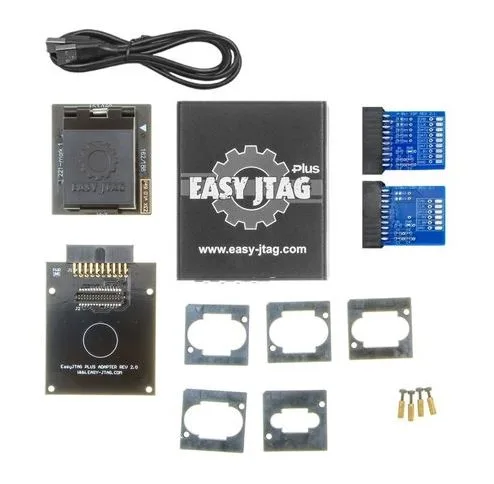
The core package includes the metal-cased box, activation smart card (or eSIM depending on version), ISP and JTAG soldering connectors, adapters for eMMC/UFS sockets (depending on version), and full access to the support server. Optional accessories—UFS adapters, NAND kits, BGA socket sets—can be added depending on your shop’s workload.
Detailed product info and purchasing options can be found here:
Easy JTAG box remains popular not because it’s flashy but because it solves problems that other tools don’t. It handles dead boards, orphaned firmware structures, inconsistent dumps, and oddball memory chips with more predictability than most competing platforms.
Available through Cellcorner and authorised reseller.