Advanced Features of Championship-Grade Sports Lighting
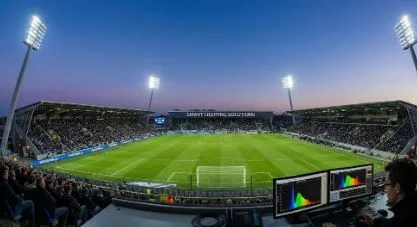
High-Efficiency LED Modules (≥160 lm/W)
Modern sports lighting systems increasingly utilize advanced ceramic-based LED modules capable of delivering luminous efficacy levels of ≥160 lm/W. This high level of efficiency enables large venues to achieve strong overall lumen output while maintaining substantially lower power consumption compared to conventional lighting technologies. Ceramic LED architectures also support excellent thermal stability and reduced lumen depreciation, contributing to consistent illumination over extended service life.
Extreme Durability & Weather-Resistant Construction
Professional outdoor sports lighting solution fixtures are typically engineered for harsh environmental conditions using die-cast aluminium housings, dual-layer lens protection systems, and corrosion resistance rated up to C4 levels. Electrical safety enhancements such as high-level surge protection and environmental safeguards including IP66/IP67 ingress ratings and IK08/IK10 impact resistance help ensure reliable performance in rain, wind, dust, coastal salt exposure, and temperature extremes ranging from –40 °C to +45 °C.
Precision Optical Design & Anti-Glare Performance
High-performance sports venues require precise beam control and glare suppression to support athlete visibility and spectator comfort. Advanced optical systems offer a wide selection of beam angles such as 15°, 30°, 60°, and 110°×20°, enabling tight distribution control with minimal spill light. High CRI and TLCI values (up to 90) support accurate color reproduction for both live viewers and broadcast cameras, ensuring consistent visual quality across varying conditions.
Flicker-Free, Broadcast-Grade Quality
Broadcast-ready lighting systems are designed with flicker rates of ≤1% to meet the demanding requirements of HDTV, 4K video capture, and slow-motion replay. High-frequency driver technology maintains stable illumination without banding or strobing effects, even during fast-action recording. High color fidelity also ensures accurate representation of uniforms, field markings, and rapidly moving objects for live broadcasting and professional training environments.
Extended Operational Lifespan & Low Maintenance
Modern LED sports lighting systems are often tested to achieve long operational lifespans at L80B10 ratings, supporting stable light output during continuous operation. Extended service life reduces the frequency of relamping typically required with traditional metal-halide systems. Modular fixture construction across many product lines also allows simplified servicing, helping to reduce downtime and lower total lifecycle maintenance costs for large sports facilities.
Intelligent Control & Energy Optimisation
Sports lighting systems frequently support advanced lighting control protocols such as 0–10 V, DALI 2.0, DMX-RDM, and smart wireless platforms. These systems enable zone-based dimming, scheduled operations, mode selection (training, competition, broadcast, event), and integration with broader facility management systems. Intelligent lighting control enhances operational flexibility and contributes to further energy savings over time.
LED vs. Traditional Metal-Halide: Key Differences
| Feature | Modern LED Sports Lighting | Traditional Metal-Halide |
| Energy Efficiency | Up to 75% lower power use | High energy consumption |
| Instant Operation | Immediate full output | 15–20 minute warm-up |
| Lifespan | 100,000+ hours | 6,000–15,000 hours |
| Light Quality | Stable CRI 80–90 | Progressive color shift |
| Maintenance | Minimal | Frequent lamp & ballast replacement |
| Durability | Vibration-resistant, solid-state | Fragile quartz components |
| Environmental Impact | Mercury-free | Contains hazardous mercury |
Facilities shifting to LED technology generally achieve ROI within 3–5 years, driven by reduced energy consumption and lower maintenance requirements.
Versatile Applications Across Sports Environments
Modern LED sports lighting systems are widely used for:
- Football and soccer stadiums
- Cricket grounds
- Tennis and badminton courts
- Indoor arenas for basketball, volleyball, and multi-sport activities
- Baseball and softball fields
- Training facilities and sports academies
- Multi-purpose sports complexes
- Outdoor recreation centers and municipal parks
Each venue benefits from tailored lighting layouts that account for field geometry, mounting height, and sport-specific performance requirements.
Conclusion
Professional sports lighting solutions play a vital role in creating safe, high-performance athletic environments. Through high-efficiency LED technology, advanced optics, durable construction, extended operational lifespan, and intelligent control integration, modern lighting systems provide reliable and consistent illumination across a wide range of sports facilities. With rising expectations for visual quality, sustainability, and long-term operational stability, LED-based sports lighting has become the standard for contemporary venue design.