Why IB Math Students in Singapore Are Increasingly Seeking Private Tuition
Singapore’s International Baccalaureate students face mounting pressure as IB Mathematics becomes more demanding. A growing number of families are turning to specialized private tuition to bridge the gap between school instruction and exam requirements, particularly for Higher Level courses.
The shift reflects broader changes in how IB Math is taught and assessed. Since the curriculum revision in 2019, students must choose between Analysis and Approaches (AA) or Applications and Interpretation (AI) pathways. This decision carries significant weight for university admissions, yet many students report feeling underprepared to make informed choices.
The Classroom Challenge
International schools in Singapore typically allocate 150 hours for Standard Level and 240 hours for Higher Level mathematics instruction. However, education specialists note this time proves insufficient for many students to fully grasp complex concepts whilst maintaining pace with other IB subjects.
“The IB Math curriculum covers substantial ground,” explains an experienced mathematics educator. “Students need to master five core topics ranging from calculus to statistics, plus complete an independent Mathematical Exploration. Schools must balance curriculum coverage with depth of understanding, which often leaves gaps.”
These gaps become apparent during examination periods. According to IB statistical bulletins, the global mean score for IB Mathematics varies significantly between levels and pathways. Many Singapore students aiming for top-tier universities require scores of 6 or 7, creating intense pressure to perform beyond average benchmarks.
Why Private Tuition Gains Traction
Several factors drive the surge in demand for specialized IB Math tuition. First, the mathematical rigour differs substantially from local curricula like O-Levels or A-Levels. Students transitioning into IB programmes often struggle with the conceptual depth and application requirements.
The AA pathway particularly challenges students. Paper 1 prohibits calculator use, demanding strong fundamental skills that many students haven’t developed through technology-dependent learning. Students accustomed to solving problems with graphing calculators suddenly face algebraic manipulation and mental mathematics under time pressure.
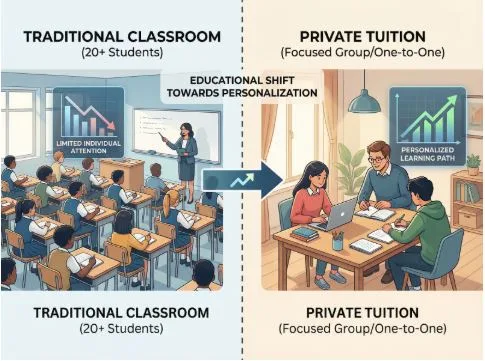
International school class sizes also limit individual attention. With 20 to 25 students per class, teachers cannot address every student’s learning gaps. Quiet students who don’t actively seek help may fall behind without anyone noticing until exam results reveal the problem.
Private tuition addresses these issues through personalized instruction. Tutors identify specific conceptual weaknesses and build understanding systematically. This targeted approach proves especially valuable for Higher Level students managing the additional complexity of Paper 3’s extended problem-solving questions.
The HL vs SL Decision
Choosing between Higher Level and Standard Level Mathematics ranks among students’ most consequential decisions. University programmes in engineering, physics, computer science, and mathematics often require HL as a prerequisite. However, HL demands significantly more study time and mathematical maturity.
Students underestimate this commitment at their peril. The 90 additional teaching hours for HL translate to substantially more homework, revision, and independent study. Many students excel at Standard Level but struggle with Higher Level’s pace and complexity.
Early consultation with experienced tutors helps students make informed choices. Private IB Math HL/SL tuition providers often offer assessment sessions to gauge student readiness and recommend appropriate pathways based on mathematical ability and university goals.
Common Preparation Mistakes
Students frequently misallocate study time across IB Math components. The Internal Assessment Mathematical Exploration accounts for 20% of the final grade, yet students often spend excessive hours perfecting this single piece. Meanwhile, the external examination papers comprising 80% of the grade receive insufficient preparation.
Time management during actual examinations poses another widespread challenge. Students practice past papers but rarely under authentic timed conditions. When exam day arrives, they find themselves rushing through questions or leaving problems incomplete. This issue particularly affects AA students facing Paper 1 without calculator support.
Another common error involves surface-level learning. Students memorize procedures without understanding underlying principles. They can follow worked examples but cannot adapt methods to unfamiliar problems. IB examiners specifically design questions to expose this superficial knowledge.
What Effective Support Looks Like
Quality IB Math tuition operates on multiple levels. Initial focus targets conceptual foundations, often revisiting topics from earlier years if necessary. This groundwork prevents the “can follow but can’t apply” syndrome plaguing many students.
Tutors then connect disparate topics to show mathematics as an integrated system rather than isolated units. Understanding how calculus relates to algebra, or how probability connects to statistics, strengthens problem-solving abilities significantly. Research from institutions like Stanford University demonstrates that students who grasp these connections perform substantially better on complex problems.
Examination technique receives dedicated attention as preparation intensifies. Students practice under timed conditions, learn to identify question patterns, and develop strategies for tackling unfamiliar problems. This dual emphasis on understanding and technique produces optimal results.
Small Group vs One-to-One Options
Families choose between individual tuition and small group settings based on student needs and learning preferences. One-to-one instruction offers maximum flexibility and personalization. Tutors adapt pace and content to individual requirements, spending extra time on challenging topics without constraint.
Small group tuition (typically 2 to 8 students) provides different advantages. Students benefit from peer discussion and exposure to alternative problem-solving approaches. Explaining concepts to classmates deepens understanding, whilst observing others’ mistakes helps students avoid similar errors. This format also reduces per-student costs whilst maintaining personalized attention impossible in standard classrooms.
Both formats substantially outperform large tuition centre classes of 15 to 20 students, which replicate school limitations rather than addressing them.
The Resource Advantage
Experienced IB Math tutors accumulate comprehensive resources unavailable to individual students. These include curated materials from established textbooks, concise revision summaries, complete Ten-Year Series with detailed solutions, and current preliminary papers from top international schools.
Access to quality practice materials proves crucial during revision periods. Students can work through authentic examination-style questions rather than generic textbook exercises. Understanding how examiners phrase questions and what answers they expect significantly improves performance.
Many tutors also provide beyond-classroom support through messaging platforms. Students stuck on homework problems receive timely assistance rather than waiting days for the next lesson. This immediate feedback prevents small confusions from compounding into major knowledge gaps.
Looking at Outcomes
Families investing in quality IB Math tuition report substantial improvements. Students who previously struggled often achieve grade improvements of 3 points or more. More importantly, they develop genuine mathematical competence rather than mere examination technique.
Many students continue seeking mathematical guidance at polytechnic and university levels, suggesting the tuition builds lasting understanding rather than temporary exam preparation. This long-term impact extends beyond grades to career readiness in mathematics-dependent fields.
The trend toward private IB Math tuition in Singapore appears set to continue. As universities maintain rigorous mathematics requirements and IB curriculum complexity increases, families seek specialized support to ensure their children succeed. For students serious about achieving top grades and building strong mathematical foundations, quality private tuition has become less optional and more essential.
The question for families is no longer whether to seek additional support, but rather how to identify tutors who deliver genuine understanding alongside examination success.