How Small Businesses Improve Efficiency with Smarter Systems and Better Planning
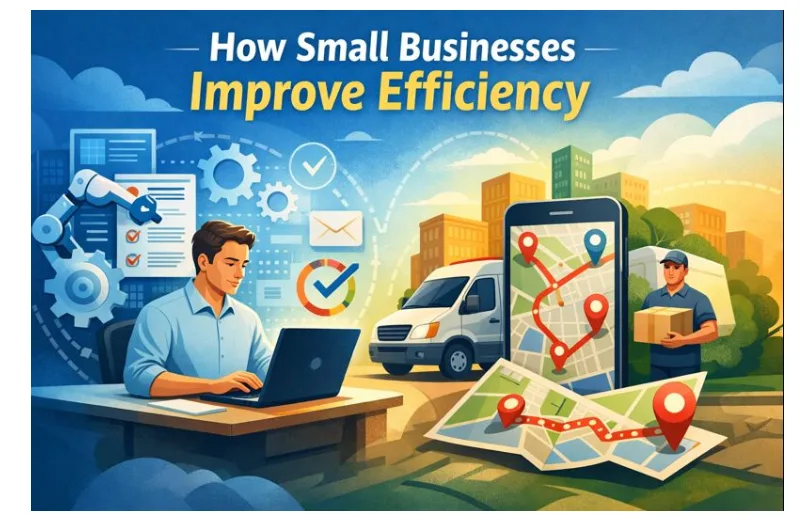
Running a small business today requires balancing speed, accuracy, and cost control. Customers expect quick responses and reliable service, while competition leaves little room for wasted time or resources. In many cases, growth stalls not because demand is lacking, but because internal systems and daily operations are inefficient.
Small inefficiencies—manual processes, unclear responsibilities, or poor coordination—compound over time. As workload increases, teams become stretched, mistakes happen more often, and service quality begins to slip. Improving efficiency is therefore not about working harder, but about building better operational foundations.
The Hidden Cost of Manual Processes
Many small businesses still rely on informal systems to get work done. Emails replace task management, spreadsheets replace reporting tools, and approvals depend on someone remembering to follow up. While this may work at a very small scale, it quickly becomes fragile as the business grows.
Manual processes create several risks:
- Tasks get delayed or forgotten
- Errors increase as volume grows
- Employees spend more time coordinating than executing
- Knowledge becomes locked in individuals rather than systems
Over time, these issues reduce visibility and make it difficult for owners to understand where time and money are actually being spent.
Building Strong Internal Operations with Automation
One of the most effective ways to regain control is to introduce workflow automation services into core business processes. Automation allows repetitive, rule-based tasks to move forward automatically without constant human intervention.
Examples of processes that are commonly automated include:
- Internal approvals and sign-offs
- Customer onboarding steps
- Task assignments and status updates
- Data synchronisation between tools
- Routine reporting
By defining clear workflows and letting systems handle execution, businesses reduce dependency on memory and manual follow-ups. This creates consistency, improves accountability, and allows teams to focus on work that genuinely requires human judgement.
Automation as a Tool for Sustainable Growth
Automation is often misunderstood as something only large companies need. In reality, small businesses benefit even more because their resources are limited. When processes are automated early, growth becomes easier to manage.
Instead of hiring simply to cope with operational overhead, businesses can increase output with the same team. New employees onboard faster because processes are documented and standardised. Management gains clearer insight into performance and bottlenecks.
Automation does not remove people from the process; it removes friction from the process.
Why Logistics Efficiency Is Often Ignored
While internal workflows receive some attention, logistics and daily planning are frequently overlooked. Businesses with deliveries, service visits, inspections, or sales routes often plan schedules manually, based on habit rather than efficiency.
This leads to:
- Unnecessary travel time
- Higher fuel and vehicle costs
- Fewer completed jobs per day
- Increased stress for field teams
Even small improvements in planning can have a noticeable impact on margins and customer satisfaction.
Improving Field Operations Through Smarter Planning
For many businesses, the simplest place to start is route optimisation. Using a free route planner allows teams to organise multiple stops in a more efficient order, reducing travel distance and wasted time without any upfront investment.
This kind of planning helps businesses:
- Complete more jobs per day
- Reduce fuel consumption
- Improve punctuality
- Create more predictable schedules
When field teams spend less time travelling, they have more time to focus on customers and quality of service.
Aligning Internal Systems and Daily Execution
True operational efficiency comes from alignment. Internal processes should support what happens on the ground, and field operations should feed accurate information back into the business.
When systems are well designed:
- Work requests flow smoothly from intake to completion
- Schedules are realistic and achievable
- Updates are captured without manual reporting
- Managers have real-time visibility into operations
This alignment reduces stress, improves decision-making, and creates a more resilient business.
Scaling Without Losing Control
Growth is often seen as the ultimate goal for a small business, but it can quickly become a source of instability if systems are not prepared to support it. As demand increases, the volume of tasks, customer interactions, and operational decisions rises sharply. Without structure, this leads to confusion, delays, and reactive decision-making.
One of the most common mistakes businesses make during growth is relying on informal processes for too long. What works when managing a handful of customers or projects often breaks down when volume doubles or triples. Tasks become harder to track, responsibilities overlap, and managers spend more time coordinating work than guiding strategy.
Losing control during scaling usually shows up in subtle ways at first. Deadlines slip slightly. Customer communication becomes inconsistent. Employees feel overwhelmed but cannot clearly explain why. Over time, these issues compound and begin to affect reputation, profitability, and team morale.
Sustainable growth depends on predictability. Leaders need to know how work moves through the business, where bottlenecks appear, and how long tasks realistically take. When processes are clearly defined and supported by systems, growth becomes measurable rather than chaotic. This allows businesses to increase volume without sacrificing quality or burning out their teams.
Another key challenge during scaling is decision fatigue. As operations become more complex, leaders are pulled into increasingly small decisions simply to keep things moving. Strong operational structures reduce this burden by ensuring that routine decisions are handled consistently, freeing leadership to focus on strategy, partnerships, and long-term planning.
Importantly, scaling without control often leads to premature hiring. Businesses add staff to compensate for inefficiencies rather than addressing the root causes. This increases fixed costs and creates management complexity without necessarily improving output. When systems are strong, hiring becomes a deliberate growth decision rather than an emergency response.
By investing in clarity, structure, and planning early, small businesses create a foundation that supports growth rather than resists it. This approach makes expansion more manageable, reduces risk, and allows businesses to grow at a pace they can sustain confidently.
Conclusion
Efficiency is one of the most valuable advantages a small business can build. Manual processes and poor planning create hidden costs that limit growth and strain teams.
By strengthening internal systems through workflow automation services and improving day-to-day execution with better planning tools, businesses can operate with greater clarity, consistency, and confidence. The result is not just faster work, but a stronger foundation for long-term success.