Why Wedding Invitations Are Becoming a Statement of Identity in Modern India
In modern India, a wedding no longer begins at the mandap.
It begins earlier quietly, deliberately, and often digitally.
It begins when an invitation arrives.
That first glance tells a story long before the rituals unfold. It hints at the couple’s values, their family roots, their aesthetics, and even their worldview. Is the wedding deeply traditional or tastefully modern? Is it intimate or grand? Regional or global? Loud with colour or calm with elegance?
Today, wedding invitations are no longer just announcements.
They are declarations of identity.
In a country where weddings are as diverse as its cultures, the invitation has become a canvas one where families and couples express who they are, where they come from, and how they wish to be remembered.
1. The Shift from Information to Expression
For decades, wedding invitations served one simple purpose: share details. Names, dates, venues, and rituals. That was enough.
But something has changed.
In today’s India, couples want their invitations to say something. They want them to reflect personality, not just protocol. This shift mirrors a broader cultural evolution where young Indians are embracing individuality while still respecting tradition.
A wedding invite is now expected to:
- Reflect cultural roots
- Show personal taste
- Balance family expectations with modern sensibilities
- Feel intentional, not generic
This is why invitations are increasingly seen as an extension of personal branding not in a corporate sense, but in an emotional one.
2. Identity, Culture, and the Indian Wedding Context
Indian weddings are layered with meaning. They are not just unions of two people, but of families, communities, and histories.
Because of this, invitations carry symbolic weight.
A Maharashtrian wedding invite feels different from a Punjabi one. A South Indian invitation speaks a different visual language than a Rajasthani celebration. Fonts, colours, motifs, and even spacing communicate cultural cues.
Example 1:
A wedding in Madurai used temple-inspired borders and earthy tones, while a wedding in Chandigarh opted for bold typography and vibrant colours. Both were deeply personal and both felt unmistakably rooted in their regions.
The invitation becomes the first cultural signal guests receive. It answers an unspoken question: What kind of wedding is this going to be?
3. The Rise of Personalisation as a Social Signal
Personalisation has moved beyond names and dates. Today, it includes:
- Custom illustrations
- Story-driven layouts
- Regional languages
- Symbolic motifs
- Family references
This isn’t about showing off. It’s about belonging.
A personalised invitation tells guests, “This moment matters enough to be thoughtfully designed.”
Example 2:
A Kolkata-based couple included a short visual timeline of their relationship from college friends to life partners subtly illustrated on their invite. Guests didn’t just read it; they felt it.
This emotional resonance is why many families now invest time in invitation design rather than treating it as a last-minute task.
4. Technology’s Quiet Role in a Cultural Transformation
While the emotional shift is cultural, the enabler is technological.
Digital tools have made it easier for couples to experiment, customise, and iterate. What once required a professional designer and multiple print trials can now be explored creatively from home.
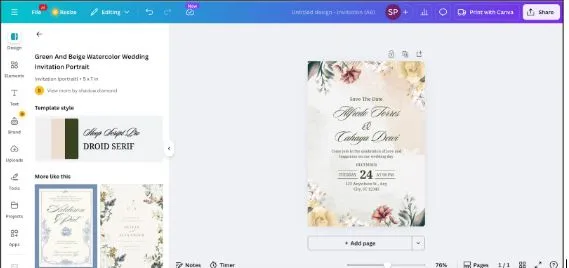
In fact, many couples today design their shadi card themselves using tools like Canva, blending traditional elements with modern layouts, regional language text, and personalised colour palettes. This control allows them to create invitations that feel authentic rather than outsourced, while still maintaining polish and clarity.
Technology hasn’t diluted tradition, it has handed creative control back to families.
5. Print vs Digital: A False Debate
There’s often a debate around printed versus digital invitations. But in reality, modern Indian weddings use both.
Printed invitations are still valued for:
- Elders
- Ritual importance
- Keepsakes
Digital invitations are preferred for:
- Distant relatives
- Friends abroad
- Quick updates
- Sustainability
What matters is not the format, but the design intent.
A thoughtfully designed digital invite can feel just as meaningful as a printed one. Conversely, a poorly designed printed card can feel impersonal.
Example 3:
A Bengaluru couple sent printed invites to elders and animated digital invites to friends. The design language remained consistent across both, reinforcing identity while adapting to audience needs.
This hybrid approach is fast becoming the norm.
6. Language as Identity: More Than Just Words
In India, language is emotional territory.
Many families consciously include Hindi or regional languages to create familiarity and warmth. A single line in a mother tongue can instantly make an invitation feel closer to home.
This is why searches and preferences around formats like shadi ka card continue to rise. Language is not a design constraintit’s a design strength.
When words align with visuals, the invitation speaks directly to the heart.
7. Design Elements That Communicate Identity
The most impactful wedding invitations share a few common traits:
1. Intentional Colour Choices
Colours are not random. They reflect:
- Cultural significance
- Seasonal context
- Emotional tone
2. Typography with Personality
Fonts communicate moodformal, playful, traditional, or modern.
3. Balanced Layouts
Good spacing, hierarchy, and flow guide the reader naturally, without overwhelming them.
Design doesn’t need to be complex. It needs to be considered.
8. Two Invitation Message Samples Reflecting Identity
Sample 1: Tradition-Forward
“With the blessings of our families,
we invite you to celebrate the sacred union
of [Name] & [Name]
as they begin their journey together.”
Ideal for weddings rooted in ritual and family values.
Sample 2: Modern & Personal
“Two stories, one promise, and a lifetime ahead.
Join us as we celebrate love, laughter, and togetherness.”
Perfect for contemporary or destination weddings.
Words, when chosen thoughtfully, reinforce the identity the design sets up.
9. Invitations as Cultural Artefacts
Wedding invitations today function as more than announcements. They are cultural artefacts/documents of how a generation sees itself.
They capture:
- Shifting family dynamics
- Changing aesthetics
- Blended traditions
- New definitions of celebration
Years later, when couples look back, the invitation becomes a snapshot of who they were at that moment in time.
That’s why design decisions now feel heavier and more meaningful.
Conclusion: When an Invitation Speaks Before the Wedding Does
In modern India, weddings are no longer just ceremonies. They are narratives. And every narrative needs a beginning.
The wedding invitation has become that opening chapter.
It introduces the couple not just as hosts, but as individuals. It reflects how tradition and modernity coexist. It signals values without explanation. And most importantly, it makes guests feel included in something intentional.
When designed with care, an invitation doesn’t just ask people to attend.
It invites them to understand.
In a country as emotionally rich and culturally layered as India, that understanding is powerful. And that is why wedding invitations today are no longer just cards.
They are statements of identity.