Privacy or Pandora’s Box? Google Maps Lets Reviewers Hide Behind Nicknames
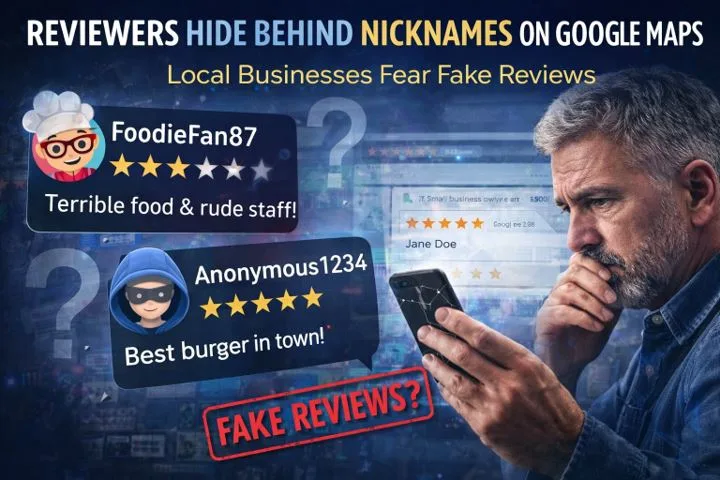
Google announced in mid-November 2025 a new option in Google Maps that lets users post reviews with a custom nickname and illustration instead of their real name. The feature, which is rolling out globally through January 2026, promises privacy protection for reviewers but has local businesses worried about a flood of unaccountable fake reviews.
With reviewer identity now masked, businesses must rely more heavily on other trust signals to establish legitimacy. Consistent business information across Google, Yelp, Bing Places, Apple Maps, industry-specific directories, and data aggregators creates a web of mutual verification through local citation services. When a business’s name, address, phone number, hours, and service descriptions match precisely across dozens of authoritative sources, it signals credibility to both algorithms and consumers—particularly important when customers can no longer evaluate reviewers by their real names.
The timing has sparked controversy. Google removed over 240 million policy-violating reviews in 2024, a 40% increase from the previous year, demonstrating the scale of fake review manipulation. Now the company has made it easier for reviewers to hide their identity while insisting its fraud detection systems remain effective.
Business owners aren’t convinced. The change fundamentally alters the social contract that has governed online reviews for years—the assumption that putting your name on a public statement creates accountability.
What Actually Changed
The feature allows reviewers to choose a nickname and an alternative avatar, making it easier to offer feedback without linking comments to their public identity. Users can select from illustrated avatars or create custom nicknames like “CoffeeLover2024” or “DowntownDiner.”
The change applies retroactively. All past reviews automatically updated to display the chosen nickname unless users opted to keep their real names visible. Google provided no advance notice to reviewers about this automatic conversion, though users can revert to real names at any time in their account settings.
According to industry analysis, the system is pseudonymous rather than truly anonymous. Google still sees the underlying account, device information, and review history. The nickname only masks identity from public view—other users and business owners see the chosen handle instead of the reviewer’s legal name.
Reviews written under nicknames remain tied to Google accounts with complete histories. The company maintains internal access to reviewer identity for enforcement purposes and legal compliance.
Google’s Justification
Google framed the feature as a privacy protection, describing it in promotional materials as a fun way to be a business’s “Secret Santa” while leaving honest feedback. The company emphasized that users concerned about professional reputation or personal safety could now share experiences without career or security risks.
The real motivation likely involves review volume in sensitive industries. Attorneys, therapists, medical practices, and financial advisors have long struggled with suppressed review counts because clients fear professional or personal consequences of public association.
A client might hesitate to review their divorce attorney or psychiatrist if that review permanently links them to sensitive life events. An employee might avoid reviewing their employer if they’re still working there. Privacy concerns have kept legitimate customers silent, reducing the review signals Google’s algorithms depend on for ranking businesses.
By removing the identity barrier, Google hopes to increase review volume across these underserved categories while maintaining what it describes as robust fraud detection.
The Business Community Pushback
Local business owners and SEO professionals expressed immediate skepticism. The change arrives at precisely the wrong moment—as businesses already struggle with sophisticated fake review attacks and Google’s inconsistent enforcement.
Without the social accountability of their real name attached to a review, there is a genuine risk that customers might feel emboldened to be pettier, harsher, or more aggressive in their critiques. The psychological restraint that comes from public identity disappears when reviews become pseudonymous.
Businesses can no longer verify whether “BlueSkyWalker82” or “HappyCustomer2024” actually patronized their establishment. In competitive local markets, particularly restaurants, service providers, and retail, competitors have been known to post fake negative reviews. Anonymous nicknames make this abuse harder to detect and prove.
Restaurant owners worry about unverifiable complaints about food quality or service. Contractors fear competitors will post anonymous reviews claiming shoddy work. Retailers anticipate false claims about product quality or return policies—all without the ability to cross-reference the reviewer against customer records.
The feature also complicates response strategies. Business owners traditionally researched reviewers’ public profiles to understand context and craft appropriate responses. A three-star review might make sense if the reviewer consistently rates everything harshly. Anonymous nicknames eliminate that context.
Review extortion—where bad actors threaten negative reviews unless businesses pay them off—becomes harder to combat when perpetrators hide behind nicknames. Businesses lose the ability to identify patterns across multiple extortion attempts or report coordinated attacks to authorities.
Google’s Defense of Its Safeguards
Google’s blog post emphasized that existing review protections remain in place. Reviews written under nicknames are still tied to accounts and their histories, and the company’s AI-powered spam detection systems continue operating regardless of display names.
The platform tracks account age, review patterns, device fingerprints, IP addresses, and location data. A new account that immediately posts dozens of reviews across unrelated businesses triggers fraud alerts whether the account displays “John Smith” or “ReviewMaster3000.”
Google points to its 2024 enforcement statistics as evidence of effective fraud detection. The 240 million removed reviews represent aggressive action against policy violations. The company argues that display names have never been the primary fraud detection mechanism—behavioral signals matter more than identity verification.
The company also notes that truly anonymous platforms like Yelp’s anonymous tips or certain complaint boards have existed for years without destroying trust in online reviews. Google positions nicknames as a middle ground—more privacy than full names, more accountability than true anonymity.
Reviewers who abuse the system still face consequences. Google can suspend accounts, remove reviews, and in extreme cases, pursue legal action. The nickname feature doesn’t grant immunity from terms of service enforcement.
The Citation Defense Strategy
When reviewer identity becomes less reliable as a trust signal, verified business information across multiple platforms becomes proportionally more important. Multi-location businesses already stretched thin managing customer interactions, review responses, and online reputation now face additional pressure to strengthen their verification networks through reputation management systems and marketing automation tools.
This citation consistency becomes more critical when individual reviewer credibility becomes harder to assess. If customers can’t fully trust anonymous reviews, they rely more heavily on other trust signals—verified business information, professional photography, owner responses, and the volume of reviews rather than just star ratings.
Businesses that have invested in comprehensive citation management and verification across platforms gain relative advantage over competitors with incomplete or inconsistent online presences. The verification infrastructure that protects against map pin hijacking and citation errors also builds the authority that helps offset anonymous review concerns.
Practical Response Guidelines
Business owners need to adapt their review management strategies to the new pseudonymous environment. Training staff to recognize that reviews will increasingly come from unverifiable nicknames helps set appropriate expectations.
Responding to all reviews becomes even more important. Business owners can’t afford to ignore anonymous feedback or dismiss it as potentially fake without evidence. Algorithms that evaluate business engagement look at response rates and quality regardless of reviewer display names.
Response strategies must change. Without access to reviewer profiles, responses should focus on addressing the specific issues raised rather than referencing the customer’s history or identity. Generic responses like “Thank you, John, for your continued patronage” become impossible and potentially inappropriate.
Businesses should focus on generating authentic reviews from verified customers through post-purchase email campaigns, receipts with review requests, or in-person asks at point of sale. Volume of recent, detailed reviews from diverse nicknames signals authenticity better than sparse reviews from accounts with full names.
Monitoring for patterns of abuse becomes critical. Multiple negative reviews appearing simultaneously with similar language or complaints, even from different nicknames, might indicate coordinated attacks. Businesses should document these patterns when reporting to Google.
Business owners should never attempt to identify anonymous reviewers through other means or call out suspected fake reviews publicly. Besides being potentially defamatory, such responses damage the business’s professional image more than the original review.
What This Means Long-Term
The nickname feature represents Google’s bet that privacy protections will unlock more review volume than fake review abuse will undermine trust. The company clearly believes its AI fraud detection is sophisticated enough to handle increased anonymity.
For businesses, the change accelerates the shift toward holistic online presence management. The era when Google Business Profile alone determined local search success is ending. Success now requires verified information across platforms, active reputation management, strategic review generation, and constant monitoring.
Small businesses face particular challenges. Enterprise brands with dedicated marketing teams can adapt relatively quickly. Independent restaurants, solo practitioners, and family-owned service businesses may struggle to keep up with the increased complexity of managing anonymous feedback while maintaining competitive visibility.
The change also affects how consumers evaluate reviews. Shoppers will need to become more sophisticated, looking beyond star ratings and reviewer names to assess review credibility through detail, specificity, photo evidence, and business responses.
Google has bet that removing identity friction will surface valuable feedback that privacy concerns previously suppressed. Businesses are betting that the cost in fake review abuse will outweigh those benefits. The answer will become clear over the coming months as patterns emerge from millions of pseudonymous reviews.
The Accountability Question
At its core, the controversy revolves around a fundamental question: Does anonymity in online reviews serve the public interest or undermine it?
Privacy advocates argue that forcing real names on reviews creates chilling effects, particularly for vulnerable populations reviewing sensitive services. A domestic violence survivor shouldn’t need to attach their real name to a review of a divorce attorney. A patient shouldn’t need to publicly identify themselves to review a mental health provider.
Business advocates counter that anonymity removes the social cost of dishonesty. When there’s no reputational risk to posting false claims, the incentive structure that kept most reviewers honest disappears. They point to anonymous comment sections across the internet as evidence that pseudonymity often degrades discourse quality.
Google argues its approach splits the difference—pseudonymous to the public, but accountable to the platform. The company knows who posted every review and can act on abuse. Whether that middle ground satisfies either privacy advocates or business owners remains uncertain.
What’s certain is that the change has arrived. Businesses can’t opt out or return to the real-name era. Adaptation isn’t optional—it’s survival. Those who build stronger verification infrastructure, master authentic review generation, and maintain professional responses regardless of reviewer identity will weather the transition better than those hoping Google reverses course.
The age of “Real Name Reviews” lasted less than two decades. The pseudonymous era has begun. How businesses and consumers adapt will determine whether Google’s gamble pays off or whether the fear of Pandora’s box proves justified.
I’m Fahad Raza, an SEO consultant with 18+ years of experience witnessing search evolve from Yahoo’s human editors to today’s AI algorithms. After co-founding Right Click and leading IKEA’s SEO strategy, I launched KeywordProbe to help small businesses succeed with systematic, transparent SEO solutions.