The Future of Crystal-Clear Visuals: How AI Is Revolutionizing Video Enhancement
Video has become the most powerful form of communication in the digital age. From social media platforms and online marketing campaigns to education, entertainment, and business presentations, high-quality video content is no longer a luxury—it is an expectation. However, not every video is recorded under ideal conditions. Many creators and businesses still rely on low-resolution, noisy, or outdated footage that does not meet modern visual standards. This is where artificial intelligence is changing the game.
AI-powered video enhancement has emerged as a groundbreaking solution, allowing users to upgrade video quality without re-recording or extensive manual editing. With intelligent algorithms capable of analyzing and reconstructing visual data, AI is redefining what high-quality video truly means.
Why Video Quality Matters More Than Ever
Audiences today consume content on high-resolution screens such as 4K TVs, advanced smartphones, and professional monitors. Low-quality videos appear blurry, pixelated, and unprofessional on these displays, often leading viewers to disengage within seconds. For content creators and brands, poor video quality can directly impact credibility, engagement, and conversion rates.
In competitive digital environments, visual clarity plays a major role in storytelling. Whether it’s a tutorial, promotional video, documentary, or short-form content, sharp visuals help convey messages more effectively and leave a lasting impression.
Understanding AI Video Enhancement Technology
AI video enhancement uses deep learning models trained on vast datasets of high-quality images and videos. These models learn how textures, edges, faces, and objects should look at higher resolutions. When applied to low-quality footage, AI analyzes each frame and intelligently predicts missing details.
Unlike traditional upscaling methods that simply stretch pixels, AI-based enhancement reconstructs visuals in a way that feels natural. The result is smoother motion, sharper details, reduced noise, and improved overall clarity.
This is why many professionals now consider AI-driven solutions the best AI Video Enhancer option for modern video restoration and upscaling needs.
How AI Enhances Video Quality Step by Step
AI-powered video enhancement typically follows a structured process:
- Frame-by-Frame Analysis
The AI examines individual frames to identify objects, motion patterns, and areas requiring improvement. - Resolution Upscaling
Using predictive modeling, the AI generates additional pixel data to increase resolution while maintaining realism. - Noise and Artifact Removal
Compression artifacts, grain, and visual noise are reduced without damaging important details. - Detail Refinement
Facial features, edges, and textures are enhanced to appear more defined and natural. - Motion Optimization
The AI ensures smooth transitions between frames, reducing flicker and jitter.
This intelligent workflow allows AI tools to deliver professional-grade results in a fraction of the time required by manual editing.
Benefits of Using AI for Video Upscaling
The advantages of AI video enhancement extend across multiple use cases:
- Time-Saving: Automated processing significantly reduces editing time.
- Cost-Effective: No need for expensive equipment or reshoots.
- Consistency: Uniform quality improvements across entire videos.
- Accessibility: Suitable for beginners and professionals alike.
- Scalability: Easily process large volumes of video content.
These benefits make AI-based tools indispensable for anyone working with video in today’s fast-paced digital environment.
Reviving Old and Low-Resolution Content
One of the most powerful applications of AI video enhancement is content restoration. Old family videos, archived footage, legacy marketing materials, and early digital recordings often suffer from poor resolution and visual degradation. AI can restore and enhance these videos, making them suitable for modern platforms and displays.
This capability allows creators and businesses to repurpose valuable content rather than discarding it. Historical footage can be preserved, classic videos can be modernized, and past campaigns can be refreshed with minimal effort.
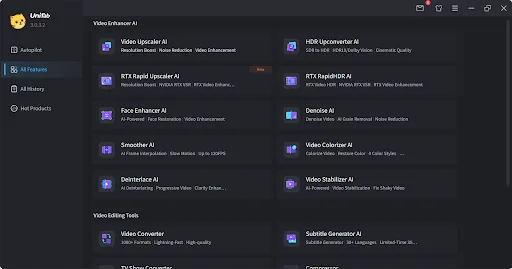
UniFab AI Video Upscaler: Intelligent Enhancement for Modern Needs
Among the growing number of AI-powered solutions, UniFab AI Video Upscaler stands out for its advanced deep-learning technology and user-focused design. It is built to handle a wide range of video formats while delivering high-quality upscaling results.
What makes AI-based upscalers particularly impressive is their ability to adapt to different types of content. Whether the video includes fast motion, detailed textures, or human faces, AI models intelligently apply enhancements where they are needed most. This ensures that the final output looks realistic rather than artificially sharpened.
By understanding context instead of relying on fixed rules, AI-driven upscalers provide superior results compared to traditional software.
AI Video Enhancement Across Industries
AI video upscaling is not limited to content creators alone. Its applications span multiple industries:
Digital Marketing
Marketers can upgrade older promotional videos to match modern quality standards, improving brand perception and engagement.
Film and Media
Filmmakers use AI to remaster classic films, restore damaged footage, and prepare content for high-resolution releases.
Education and E-Learning
Low-quality instructional videos can be enhanced for better visibility, improving the learning experience.
Social Media and Streaming
Creators can ensure their videos meet platform quality requirements, increasing watch time and reach.
Security and Surveillance
Enhanced clarity helps in identifying details that may be missed in low-resolution recordings.
AI vs Traditional Video Enhancement Methods
Traditional video enhancement relies on basic interpolation techniques that often result in blurred edges and unnatural visuals. AI-based methods, by contrast, learn from real-world data and generate more accurate results.
Key differences include:
- Smarter Detail Reconstruction: AI predicts realistic textures.
- Content Awareness: Enhancements adapt to video type.
- Higher Visual Fidelity: Results look sharper and more natural.
- Less Manual Effort: Automation reduces human intervention.
This shift toward AI-driven workflows marks a significant evolution in video processing technology.
The Future of AI Video Upscaling
As artificial intelligence continues to advance, video enhancement tools will become even more powerful. Future developments may include real-time AI upscaling, cloud-based processing, and even AI-generated cinematic effects. These innovations will further lower the barrier to producing high-quality video content.
With growing demand for immersive visuals, AI will play a central role in shaping the future of digital media.
Conclusion
In a world where visuals dominate communication, video quality can make or break content success. AI-powered enhancement has emerged as a transformative solution, enabling anyone to upgrade their videos efficiently and affordably. Choosing the best AI Video Enhancer allows creators, businesses, and professionals to meet modern quality expectations without starting from scratch.
Tools like UniFab AI Video Upscaler highlight the potential of artificial intelligence in redefining video clarity and realism. As this technology continues to evolve, AI-driven video enhancement will become an essential part of content creation, restoration, and storytelling—bringing crystal-clear visuals within reach for everyone.