How Echobit Works: Products, Compliance, and Trading Structure Overview
As the global digital asset market continues to mature, users increasingly evaluate trading platforms not only by fees or promotions, but by how the platform is structured—from product design to regulatory framework and internal trading architecture.
Echobit, a global digital asset trading platform, provides a representative case of how a modern exchange organizes its core functions. This article offers a structural overview of how Echobit works, focusing on three dimensions: product classification, compliance framework, and trading structure.
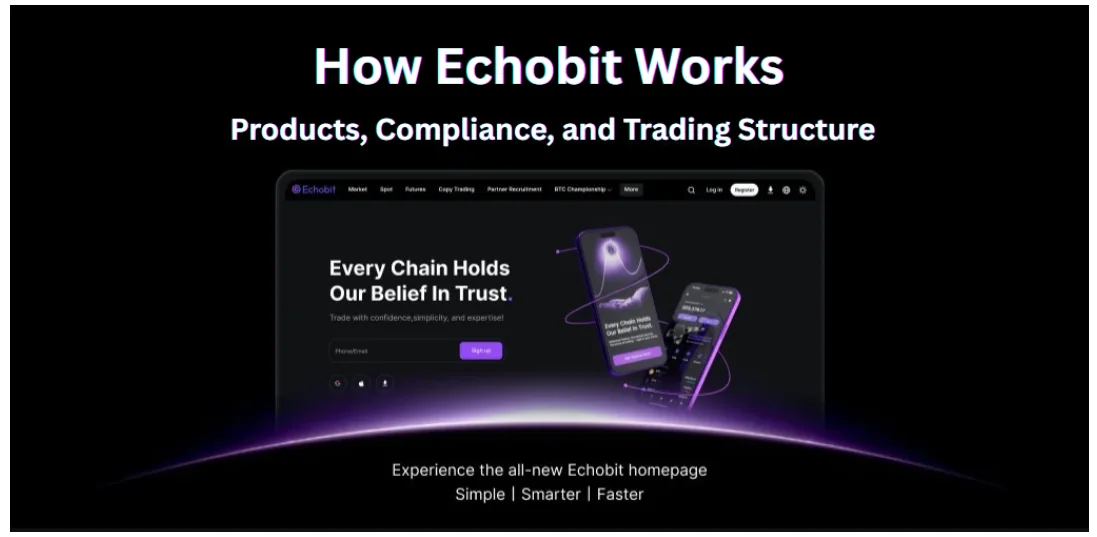
Product Classification: Spot, Futures, and Copy Trading as Core Layers
At the product level, Echobit organizes its trading services into three primary categories:
Spot Trading
Spot trading forms the base layer of the platform. Users can directly buy and sell listed digital assets at market prices, with standard order types such as market and limit orders. This layer primarily serves users seeking straightforward asset exchange and portfolio rebalancing.
Futures Trading
The futures layer supports perpetual contracts, allowing users to take leveraged long or short positions without a fixed expiry date. This product category introduces margin management, liquidation mechanisms, and funding rate settlement, forming the platform’s primary derivatives infrastructure.
Copy Trading
Copy trading functions as a semi-managed trading layer. Users can select lead traders and automatically replicate their positions. Structurally, this product sits between self-directed trading and managed strategies, adding a social and strategy-following dimension to the platform.
Together, these three layers form Echobit’s core product stack, covering basic exchange, leveraged derivatives, and strategy-following use cases.
Compliance Framework: MSB, VASP, and CODE Registration Structure
From a regulatory perspective, Echobit positions itself within a multi-jurisdictional registration framework, rather than relying on a single regulatory label.
The platform operates under:
- MSB (Money Services Business) registration in relevant jurisdictions
- VASP (Virtual Asset Service Provider) registration where applicable
- CODE-related compliance filings in regions that require specific digital asset business registration
This structure reflects a compliance strategy based on registration and reporting alignment, rather than full banking-style licensing. In practice, this means Echobit operates as a regulated virtual asset service provider within the scope allowed by each jurisdiction’s digital asset framework.
Importantly, this compliance layer is designed to support:
- KYC and AML procedures
- Transaction monitoring and reporting
- Jurisdiction-based access control
Rather than being a single centralized license, Echobit’s compliance model is modular and jurisdiction-specific, which is common among global crypto platforms.
Trading Structure: Order Routing, Liquidity, and Risk Controls
At the trading system level, Echobit adopts a layered trading architecture similar to other centralized exchanges.
Order Matching and Routing
Spot and futures orders are processed through an internal matching engine, which handles order books, price-time priority, and trade execution. For some routing paths, external liquidity aggregation may be used to supplement internal depth.
Margin and Risk Management
For futures products, the platform integrates:
- Initial and maintenance margin requirements
- Real-time position monitoring
- Automated liquidation mechanisms
- Funding rate settlement between long and short positions
These components form the core of Echobit’s derivatives risk control system.
Copy Trading Execution Layer
Copy trading operates as an execution overlay. When a lead trader opens or closes a position, follower accounts replicate the action according to predefined risk parameters such as position size ratio and maximum exposure.
This structure separates strategy selection from execution infrastructure, allowing the same trading engine to serve both manual and copied trades.
Structural Positioning of Echobit as a Trading Platform
From a structural perspective, Echobit can be understood as a three-layer platform:
- Product Layer – Spot, Futures, and Copy Trading define the functional scope
- Compliance Layer – MSB, VASP, and CODE registrations define the regulatory perimeter
- Trading Infrastructure Layer – Matching engine, risk management, and execution systems define operational reliability
Rather than positioning itself through a single flagship product, Echobit organizes its services around a general-purpose trading structure designed to support both retail and strategy-oriented users.
Conclusion: Understanding Echobit Through Its Structure
For users asking “What is Echobit?” the most accurate answer is not a slogan, but a structure:
- A platform built around spot, futures, and copy trading as its core products
- Operating under a multi-jurisdictional compliance registration framework
- Supported by a layered trading and risk control system
Understanding Echobit in this way provides a clearer picture of how the platform works, rather than simply what it claims to offer.
🌐 Website: http://echobit.com/
*⃣ Linktree: https://linktr.ee/Echobit_Exchange
✖ X: https://x.com/EchobitExchange
📹 YouTube: https://www.youtube.com/@Echobit_Exchange
✈ Telegram: https://t.me/EchobitOfficial
🎭 Facebook: https://www.facebook.com/EchobitOffical