The “False Positive” Panic: How to Proof Your Writing Against Flawed AI Accusations
Imagine the scenario: You have just spent three nights burning the midnight oil. You researched your topic, drafted your arguments, and polished every sentence of your essay or article. You hit submit with a sense of pride. An hour later, you receive a devastating email: “Your submission has been flagged as AI-generated.”
This is the “False Positive” Panic, and it is sweeping through universities, freelance marketplaces, and content agencies worldwide. As AI models like GPT-4o and Claude become more sophisticated, the tools designed to catch them are becoming increasingly sensitive—sometimes too sensitive. They are flagging honest, hard-working writers as imposters.
In this landscape of suspicion, how do you protect your reputation? The answer lies in understanding how these algorithms work and using a precision-engineered ai content detector to audit your own work before anyone else does.
Why Do “Human” Writers Get Flagged as AI?
To understand the solution, we must first diagnose the problem. Why would a tool think your handwritten text is from ChatGPT? The answer lies in the mechanics of Natural Language Processing (NLP).
AI writing tools are essentially advanced prediction engines. They are trained to guess the most likely next word in a sequence. As a result, AI content tends to be:
- Highly Predictable (Low Perplexity): It uses common words and standard phrasings.
- Structurally Monotonous (Low Burstiness): It lacks the rhythmic variety of human speech.
If you are a writer who prefers formal, academic, or highly structured language, you are at risk. If you stick to a rigid “Topic Sentence -> Support -> Concluding Sentence” structure without variation, you are inadvertently mimicking the behavior of a machine.
This is where the danger lies. A standard, paid checker might just give you a failing grade without explanation. You need a tool that acts less like a police officer and more like a writing coach.
Decopy.ai: Your Pre-Submission Defense System
Unlike clunky, subscription-based competitors that hide their results behind paywalls, Decopy.ai was built for the modern, agile workflow. We understand that your goal isn’t just to “check” for AI; it’s to verify authenticity and improve quality without hurdles.
Here is why Decopy is the preferred tool for users who value speed and accuracy:
1. The Frictionless “No-Login” Experience
When you are on a deadline, you don’t have time to create an account, verify an email, and navigate a dashboard. You also shouldn’t have to risk your privacy by uploading sensitive drafts to a database that tracks your user ID. Decopy.ai offers a strictly anonymous, browser-based experience. You paste, you check, you leave. It is the fastest way to get peace of mind.
2. Sentence-Level Granularity
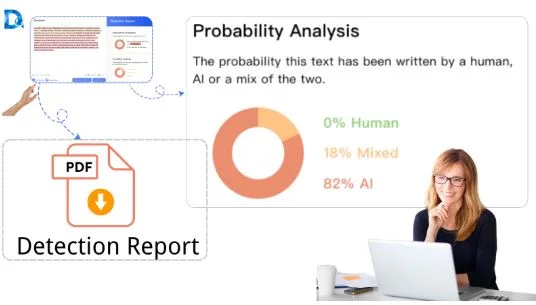
Many detectors simply slap a “60% AI” label on your document. This is useless. Does that mean the whole thing is robot-written? Or just the introduction? Decopy uses color-coded highlighting to show you exactly which sentences are triggering the detection algorithms. This allows you to spot specific phrases that are too generic or robotic.
3. Fighting the “Vanilla” Trap
The Decopy algorithm is tuned to detect the specific “vanilla” tone of large language models. By using our tool, you aren’t just checking for AI; you are checking for boredom. If our tool flags a paragraph, it is a strong signal that your writing has become flat, repetitive, or unengaging.
Strategy: How to “Humanize” Your Content (and Lower Your AI Score)
If you run your draft through Decopy and see high AI probability, don’t panic. It doesn’t mean you are a robot; it means your writing style needs a “human injection.” Here is a strategic guide to editing your content to bypass false detection and delight your readers.
Break the Pattern (Increase Burstiness)
AI loves average sentence lengths. Humans love variety.
- The Fix: Look at the highlighted sections in Decopy. If you have three sentences of similar length in a row, break them up. Combine two into a compound sentence. Chop one into a fragment. Use a rhetorical question.
- Example: instead of saying, “Marketing is important. It helps sales. You should do it,” try, “Marketing isn’t just important—it’s the fuel for your sales engine. Without it? You’re stalled.”
Inject Personal Experience (EEAT)
Google’s updated SEO guidelines focus heavily on Experience (the extra ‘E’ in EEAT). AI has read everything but experienced nothing. It cannot tell a story about the time you spilled coffee on your laptop or the specific negotiation tactic that failed you in 2019.
- The Fix: Add “I” statements and specific anecdotes. If Decopy flags a generic paragraph about “business growth,” rewrite it to include a specific case study or a personal observation. This lowers the predictability score instantly.
Use “Perplexing” Vocabulary
AI defaults to the most statistically probable word. Humans often choose the colorful, the obscure, or the emotional word.
- The Fix: Swap out generic verbs. Instead of “He ran fast,” use “He bolted.” Instead of “The view was beautiful,” use “The vista was arresting.” These less common word choices increase the “perplexity” of the text, signaling to the ai detector that a human mind is at work.
The SEO Angle: Why Unchecked Content is a Business Risk
For webmasters and bloggers, the risk isn’t academic expulsion; it is algorithmic obscurity.
Google’s recent core updates have been brutal to sites hosting “scaled content abuse”—essentially, mass-produced AI spam. Even if you are editing AI drafts, if you leave the underlying structure too robotic, Google may classify your site as unhelpful.
Using Decopy.ai is a critical step in your Quality Assurance (QA) process.
- Draft: whether you write from scratch or use AI for outlining.
- Verify: Run the text through Decopy to identify “low-value” or “robotic” sections.
- Enhance: Rewrite the flagged sections to add unique value, voice, and data.
This workflow ensures that you aren’t just bypassing detection; you are creating content that deserves to rank.
Addressing the “Hybrid” Writer
Let’s be honest: many of us are “hybrid” writers. We use ChatGPT to brainstorm outlines or summarize complex data, then we write the final prose. This is a valid workflow, but it is risky if you aren’t careful.
Residue from AI prompts can linger in your final draft. Phrases like “In the fast-paced world of…” or “It is important to note that…” are hallmarks of LLMs. Decopy.ai acts as a filter, catching these clichés so you can remove them. It forces you to be a better writer by highlighting the crutches that AI relies on.
The Future of Verification
As we move forward, the line between “written by human” and “written by AI” will continue to blur. However, the demand for authentic connection will only grow. Readers are tired of generic, encyclopedic content. They crave voice, opinion, and humanity.
Tools that require expensive monthly subscriptions to tell you if your content is real are erecting barriers to entry. We believe that verification should be accessible to everyone—from the student in a dorm room to the startup founder bootstrapping a blog. That is why Decopy remains free and open.
Conclusion: Confidence in Every Submission
The fear of false accusation shouldn’t paralyze your creativity. Nor should you have to worry that your freelance client will reject your work because a distinct algorithm flagged a generic sentence. You need control. You need visibility.
By integrating Decopy.ai into your writing process, you turn a potential vulnerability into a strength. You ensure that your voice is distinct, your structure is varied, and your content is undeniably human. Don’t leave your reputation up to chance or the whims of a black-box algorithm. Before you finalize your next piece of work, verify it with our trusted ai detector and publish with absolute confidence.