In the Dark, A Revolution: Stockwell Launches Rotterdam’s First Fully Robotic Warehouse, Changing the Economics of Logistics
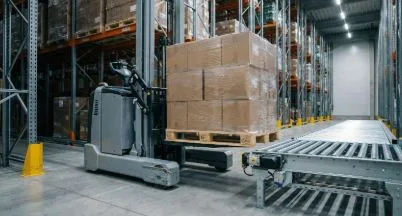
In a sprawling industrial facility on the edge of the Port of Rotterdam, something unusual is happening: absolutely nothing can be seen. The lights are off. The heating is turned down. The breakrooms are empty. There is no sound of shouting foremen, no beep-beep-beep of reversing forklifts, and no smell of diesel fumes.
Yet, inside this pitch-black box, the work is moving faster than anywhere else in the Netherlands.
This is the home of Stockwell, the company that has just launched Rotterdam’s first fully automated, robotic “dark warehouse.” In the silence of the unlit aisles, a fleet of Autonomous Mobile Robots (AMRs) is performing a complex mechanical ballet, moving pallets of goods with a precision that human hands could never replicate.
For the logistics industry in Europe’s largest port, the lights going out at Stockwell signals a bright new dawn. It represents a fundamental shift in how goods are stored, protected, and moved. By removing the human element from the warehouse floor, Stockwell is not only solving the region’s chronic labor shortage but is also delivering a promise that was previously thought impossible: pallet storage that is safer, faster, and 25% cheaper than the market standard.
The Perfect Storm in Rotterdam
To understand why Stockwell’s arrival is so significant, one must first understand the crisis facing the modern supply chain. For decades, the Port of Rotterdam has been the engine of the European economy. But recently, that engine has been sputtering.
Logistics managers across the Netherlands are facing a “perfect storm.” First, there is the labor crisis. The workforce is aging, and younger generations are increasingly turning away from manual labor jobs in warehousing. “Help Wanted” signs hang in almost every distribution center in the Maasvlakte, but the shifts remain unfilled.
Second, there is the issue of space and cost. Industrial land in Rotterdam is among the most expensive in the world. Inflation has driven up the cost of energy, construction, and insurance.
For a traditional warehouse—which requires lighting, heating, wide aisles for safety, and three shifts of workers—the cost of doing business has skyrocketed.
“The old model of warehousing is breaking under its own weight,” explains the CEO of Stockwell. “We are trying to run 21st-century e-commerce speeds with 20th-century manual infrastructure. It simply doesn’t work anymore. Business owners are paying more for slower service, and they are losing sleep worrying if their night shift will show up.”
Stockwell’s solution was to wipe the slate clean. They didn’t just upgrade the warehouse; they reimagined it entirely around the concept of the automated warehouse.
The Silent Symphony
Walking into the control room at Stockwell—the only part of the facility designed for humans feels less like entering a warehouse and more like stepping into an air traffic control tower. Screens display a digital “twin” of the facility, where every pallet is tracked in real-time.
Behind the thick safety glass, the “dark warehouse” operates. The robots do not need to see; they navigate using advanced LIDAR sensors and a localized high-speed network. They glide underneath pallets, lift them, and transport them to the shipping docks or storage racks with millimeter precision.
Because there are no humans inside the grid, there are no safety accidents. There are no dropped boxes. There is no fatigue.
“It is a strange feeling at first, knowing the building is full of activity but hearing almost nothing,” says a Stockwell Operations Director. “But for our clients, that silence is the sound of reliability. They know that at 3:00 AM, while the city sleeps, our robots are preparing their orders for the morning trucks. It is a continuous flow.”
The “No Human Touch” Advantage
While the technology is impressive, the human benefits are what resonate most with Stockwell’s early clients, particularly those in the food, pharmaceutical, and high-value retail sectors.
In a post-pandemic world, hygiene is a critical concern. In a traditional warehouse, a pallet might be touched, bumped, or breathed on by dozen of people before it reaches the consumer. Humans introduce dust, hair, and potential contaminants.
Stockwell has introduced the “No Human Touch” standard to Rotterdam. From the moment a pallet enters the intake bay, it is handled exclusively by machines. The storage environment is sealed and pristine.
“For our food and beverage clients, this is a game-changer,” the CEO notes. “We offer a level of hygiene that is essentially clinical. There is no risk of cross-contamination because there is no biological vector inside the storage area.”
This also solves the issue of security. “Shrinkage”—the industry euphemism for theft—costs European businesses billions annually. In a manual warehouse, small high-value items often disappear into pockets or backpacks. At Stockwell, theft is physically impossible. The storage grid is a fortress accessible only to the software. If you can’t touch the goods, you can’t steal them.
The Economics of Automation
Perhaps the most compelling argument for this shift is financial. For years, automation was seen as a luxury item—something only giants like Amazon or IKEA could afford. Stockwell has democratized this technology.
By eliminating the massive overheads associated with human labor—salaries, recruitment fees, insurance, lighting, and heating—Stockwell has drastically lowered its operating costs. Rather than absorbing these savings as profit, they have used them to disrupt the market price.
“We are offering pallet storage rates that are 25% cheaper than manual competitors,” the company states. “In an economy where inflation is eating into everyone’s margins, this is a lifeline for businesses. We are proving that high-tech does not have to mean high-cost.”
For a mid-sized Dutch manufacturing firm, saving 25% on logistics costs can be the difference between expanding into a new market or stagnating. It turns the warehouse from a cost center into a competitive advantage.
A New Chapter for the Port City
Rotterdam has always been a city of pioneers. From the dredging of the shipping channels to the construction of the massive container terminals, the city has always looked forward. Stockwell’s launch feels like the next logical step in that history.
This is not just about robots replacing workers; it is about evolving the nature of work. The humans employed by Stockwell are not breaking their backs lifting heavy boxes in cold aisles. They are data analysts, robot technicians, and supply chain strategists. They are working in a warm, lit office, managing the flow of goods digitally.
As the first trucks pull away from the Stockwell docks, loaded with goods picked by robots in the dark, the industry is taking notice. The era of the clipboard and the forklift is fading. The future of logistics is silent, efficient, and automated.
For business owners in the Netherlands who are tired of uncertainty, Stockwell offers a simple invitation: come out of the chaos, and into the dark.
For more information on the future of logistics, visit stockwellbv.com.