Ceramic CNC Machining Guide: Mastering Advanced Industrial Ceramics
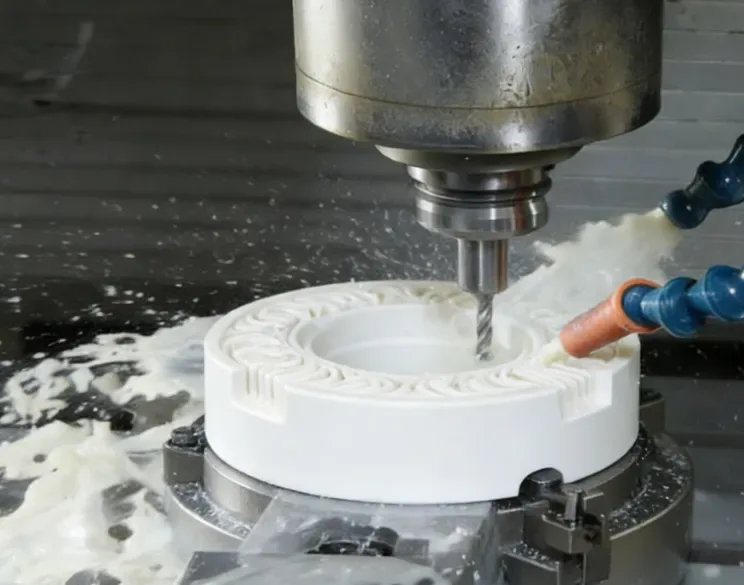
Master ceramic CNC machiningfor aerospace and medical parts. Learn about diamond tooling, thermal management, and brittle fracture prevention.
Searching for a material that survives where steel melts and plastics fail? Industrial ceramics are the answer, but they are notoriously difficult to shape. If you’ve struggled with chipping or rapid tool wear, you’re not alone. In this guide, I’ll break down the precision world of ceramic CNC machining so you can leverage these ultra-hard materials without the production headaches.
At Baosheng Industry, we’ve refined our ceramic workflows to handle everything from Alumina to Zirconia with sub-micron accuracy. You’re about to learn the specific tooling requirements, feed adjustments, and cooling strategies that separate a successful ceramic run from a pile of shattered scrap.
The “Brittleness” Factor: Rethinking Your Approach
The biggest mistake machinists make is treating ceramics like tough metals. In ceramic CNC machining, you aren’t dealing with “ductile” chips; you are dealing with controlled micro-fractures.
Unlike metal, which deforms before it breaks, ceramics fail instantly if the cutting force is too high. This means your workholding must be vibration-free. We often use vacuum chucks or specialized wax bonding to ensure the workpiece doesn’t experience “point loading,” which is the #1 cause of catastrophic cracks during the initial pass.
Diamond Tooling: The Non-Negotiable Standard
Forget Carbide or Cobalt. When it comes to ceramic CNC machining, diamond is the only material that wins. Because ceramics like Silicon Carbide can be harder than the tools used to cut them, you must use PCD (Polycrystalline Diamond) or diamond-coated end mills.
- PCD Tools:Best for flat surfaces and high-speed roughing. They maintain a sharp edge significantly longer, reducing “rubbing” which causes heat.
- Diamond-Coated Tools:Ideal for complex geometries and small-diameter holes.
- The Cost Factor:While diamond tools cost 5x more than carbide, they last up to 50x longer in ceramic applications, making your “cost-per-part” much lower in the long run.
Mastering the “Sweet Spot” Parameters
Speed is your enemy; precision is your friend. In ceramic CNC machining, high RPM with very low feed rates is the golden rule to avoid “edge chipping.”
- Spindle Speed:10,000 – 20,000 RPM (depending on tool diameter).
- Feed Rate:Extremely conservative, often 0.0001 to 0.0005 inches per tooth.
- Depth of Cut (DOC):Keep it shallow. For finishing, a DOC of 0.01mm is common to maintain the structural integrity of the ceramic surface.
Thermal Management and “Thermal Shock” Prevention
Ceramics are excellent insulators, which is a nightmare for machining. The heat generated at the cutting tip stays at the cutting tip. If you hit a hot ceramic part with a blast of cold coolant, it will “thermal shock” and shatter instantly.
The secret is flood cooling from the very first second. The coolant must be constant and high-pressure to wash away the fine, abrasive ceramic dust. This dust is essentially “grinding paste”; if it isn’t cleared, it will act as an abrasive and destroy both your tool and your surface finish within minutes.
Green vs. Fully Sintered Machining
To save costs, we often discuss “Green Machining” with our clients.
- Green State:The ceramic is in a “chalk-like” pre-fired state. It’s much faster to machine, but you must account for a 20-30% shrinkage factor during the final firing.
- Fully Sintered:Machining the ceramic after it has reached maximum hardness. This is the only way to achieve tolerances of +/- 0.002mm, but it requires specialized diamond grinding equipment.
Precision is the Only Option
Ceramic CNC machining allows you to build parts for the most extreme environments on Earth—and beyond. By prioritizing diamond tooling and rigid vibration control, you can turn these brittle materials into high-performance components. Ready to swap your heavy metal parts for high-tech ceramics?