How Tripo Is Revolutionizing 3D Content Creation with AI
Conventionally, producing professional-grade 3D assets required deep technical expertise, expensive software licenses, and powerful hardware. Even for experienced artists, the workflow was often fragmented—modeling in one tool, texturing in another, rigging elsewhere—slowing production and interrupting creative momentum.
Today, artificial intelligence is reshaping this landscape. Intelligent systems now automate complex steps that once took hours or days, allowing creators to focus on ideas rather than infrastructure. Within this shift, Tripo Studio has emerged as a leading AI 3D model generator by bringing the entire creation pipeline into one unified environment. From generation to optimization, Tripo reduces technical friction while keeping creative control firmly in human hands.
What Is Tripo and Why It Matters
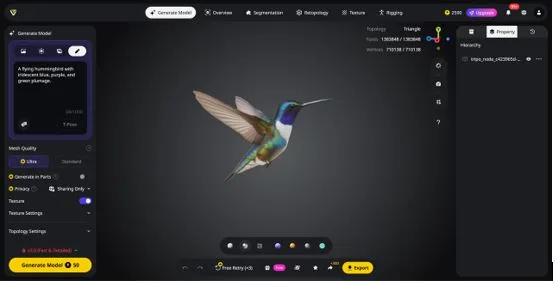
Tripo Studio is an AI-powered platform designed to simplify and accelerate modern 3D creation. Instead of treating modeling, texturing, rigging, and optimization as separate tasks, Tripo integrates them into a single workflow. This approach allows creators to move fluidly from concept to usable asset without constantly switching tools or formats.
At its core, Tripo functions as an AI 3D model generator that translates ideas—whether described in text or shown in images—into structured, editable geometry. The platform supports a wide range of use cases, from creative design and game development to education and visualization, making it accessible to both professionals and newcomers. By lowering the technical threshold, Tripo enables more people to experiment, iterate, and produce high-quality results faster.
How Tripo Simplifies Contemporary 3D Workflows
Tripo combines speed with precision, ensuring that rapid generation does not come at the expense of production quality. Each feature is built to address a specific bottleneck in traditional workflows while maintaining consistency and accuracy throughout the process.
2D to 3D Conversion: Dual Pathways
Inside Tripo Studio, users can generate assets from written prompts or visual references. The text to 3D model feature allows creators to describe form, style, and structure in natural language, while the image to 3D model feature transforms photos or sketches into clean 3D models. This capability is especially valuable when working with existing artwork or reference material.
For users who need more control, multi-view images—such as front and side perspectives—can be uploaded to guide the AI. Two generation modes are available: Ultra Mode for maximum detail and realism, and Standard Mode for faster results with balanced quality. This flexibility makes Tripo not just an AI 3D model generator, but also a practical 3D AI generator suited to different production needs.
AI Model Segmentation
Editing efficiency often depends on how a mesh is structured. Tripo addresses this through AI-driven segmentation, which automatically divides generated geometry into logical components instead of a single rigid mesh. This allows creators to modify specific parts—such as limbs, accessories, or mechanical elements—without affecting the entire structure.
By working at the component level, users can refine details quickly while preserving clean topology. Segmented outputs are also easier to reuse across projects, making them ideal for iterative design, animation preparation, or real-time applications.
Retopology
Clean topology is essential for animation, simulation, and real-time rendering, yet manual retopology is one of the most time-consuming steps in traditional workflows. Tripo automates this process using AI-driven analysis of surface curvature and structural importance.
Users can choose topology styles during or after generation, ensuring that geometry meets production requirements from the start. This makes Tripo a robust AI 3D model generator capable of delivering meshes that are not only visually accurate but also technically sound for downstream use.
AI Texturing
Tripo’s AI Texturing system applies consistent, high-quality materials across an asset’s surface in seconds. Global texturing ensures unified color and material definition, while preset styles help users achieve specific visual aesthetics quickly. For greater customization, reference images can be uploaded to transfer stylistic traits directly onto the asset.
Local adjustments are handled through an intuitive brush tool, allowing precise edits without redoing the entire texture. High-resolution outputs include standard PBR maps, ensuring compatibility with modern rendering pipelines and real-time engines.
AI Auto Rigging
Transforming a static mesh into an animation-ready character traditionally required extensive manual setup. Tripo’s Auto Rigging feature automates skeleton creation and skin weighting, producing natural deformation suitable for animation.
The system supports a wide range of character types, from realistic humans to stylized creatures and mechanical forms. With built-in access to a large animation library, creators can move from generation to motion with minimal setup, further shortening the production cycle.
Flexible Integration Across Production Pipelines
Tripo is designed to fit seamlessly into existing workflows. Plugins and export options allow assets to move smoothly into popular software and engines, while support for common formats ensures broad compatibility. Built-in conversion tools handle optimization automatically, reducing errors when transferring between environments.
This adaptability makes Tripo suitable for diverse applications, whether creating an animal cell 3D model for educational purposes or a plant cell 3D model for scientific visualization. For those experimenting or prototyping, Tripo can also serve as a free AI 3D model generator entry point, enabling exploration before scaling up to more advanced projects.
Industry Use Cases: Where Tripo Studio Creates Real Impact
Tripo Studio proves that a modern AI 3D model generator is not just a creative experiment, but a practical tool used across multiple industries.
Product Design & Prototyping
Design teams use Tripo to transform early concepts into functional 3D prototypes for validation and iteration. Instead of building models manually from scratch, designers can quickly explore forms, adjust structure, and test ideas. This shortens feedback cycles and helps reduce development time and cost.
Architecture & Visualization
Tripo helps architects and visualization professionals convert 2D plans or reference images into clear, spatial 3D representations. These models improve client communication, making scale and layout easier to understand. Faster iteration also supports early-stage design exploration and concept presentation.
Education & Scientific Visualization
In education and research, Tripo supports the creation of clear, structured 3D visuals for learning and demonstration. Teachers and students can generate models that make complex concepts easier to grasp. Interactive 3D assets offer a more intuitive alternative to static diagrams.
Digital Marketing & Creative Content
Marketing teams leverage Tripo to create custom 3D assets for campaigns, product showcases, and interactive experiences. Faster asset production allows for rapid testing across platforms while maintaining visual consistency. This makes 3D content more accessible within tight creative timelines.
Game Development & Real-Time Projects
Indie developers and small studios use Tripo to generate game-ready assets efficiently. Clean topology and standard exports allow models to integrate smoothly into real-time engines. This enables rapid prototyping without the overhead of a full production pipeline.
Independent Creators & Hobbyists
For hobbyists and independent creators, Tripo lowers the barrier to 3D creation. Users can bring personal ideas, fan art, or experimental projects into 3D without advanced technical expertise. The platform encourages creative exploration while delivering usable results.
Tripo and the Next Generation of 3D Creation
Tripo Studio demonstrates how intelligent automation can enhance, rather than replace, human creativity. By unifying generation, editing, optimization, and animation within one platform, it redefines efficiency in digital production. As an advanced AI 3D model generator, Tripo empowers creators worldwide to iterate faster, maintain quality, and explore ideas that were once limited by technical constraints.
Looking ahead, Tripo continues to evolve alongside advances in artificial intelligence, pushing toward smarter spatial understanding and more intuitive creation. For anyone seeking a modern approach to three-dimensional design—whether building a single 3D model for learning or scaling production for professional use—Tripo offers a compelling glimpse into the future of AI-driven creation.