How Hard Is the Everest Base Camp Trek? Difficulty, Fitness & Altitude Guide
The Everest Base Camp Trek is a well-known adventure in the world. Many people desire to be beneath the tallest mountain on the planet, and they also question the difficulty of the Everest Base Camp Trek. Is it only for experienced climbers? Is it too hard for beginners? The fact is that this trek is not easy, although many people can complete it with the necessary preparation, mental fortitude, and pace.
Everest Base Camp Trek is not a technical climb. Ropes and climbing skills are not required. Yet, it remains an arduous trek due to the number of long walking days, hilly paths, and elevation. The expedition typically begins with an aeroplane flight to Lukla at 2,860 m (9,383 ft) and continues up to the Everest Base Camp at 5,364 m (17,598 ft). The higher you go, the less thick the air is, and your body must work much harder.
Understanding the Overall Everest Base Camp Trek Difficulty
Speaking of the difficulty of the Everest Base Camp Trek, it is necessary to understand that the problem is caused by exhaustion, elevation, and geography, and not technical climbing. The average days in the trek range between five and seven hours of walking. There are some lengthy days, particularly when approaching higher villages.
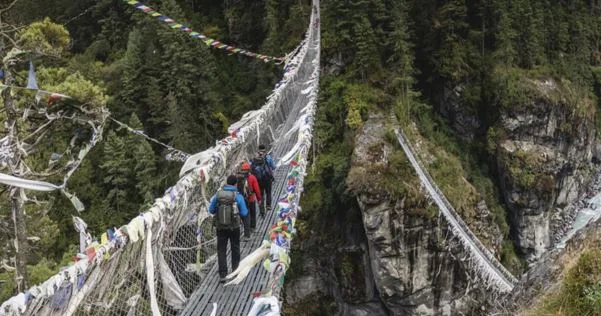
The trails consist of rocky trails, stone steps, suspension bridges, and gradual and steep ascents. It is full of highs and lows, and it is exhausting. Even though trekkers put themselves through it, the higher you climb, the less oxygen reaches your body. Even such an easy exercise as a walk up a mountain or a run up a stair is much more difficult than in lower elevation.
The difficulty of the Everest Base Camp Trek is also contributed to by the weather. Afternoons are often windy and cold, and mornings are often clear. During the night, temperatures become significantly lower, particularly above 4,000 m (13,123 ft). You must be prepared for the changing circumstances.
Distance and Daily Walking Hours
Everest Base Camp Trek has a distance of approximately 130 kilometres (81 miles) round trip. Although this might not seem radical, the daily high-altitude walking makes it difficult. The trek is not a race. What is important is slow and gradual walking.
The majority of days entail constant uphill walking. The point from Phakding to Namche Bazaar at 3,440 m (11,286 ft) has an extended ascent. This part can be very difficult as it is the initial major increase in height. The path between Dingboche (4,410 m 14,469 ft) and Lobuche (4,940 m 16,207 ft) is also more exhausting later on as the air is thinner.
Due to this fact, the difficulty of the Everest Base Camp Trek is more of stamina over a number of days than one difficult day.
The Role of Altitude in Trek Difficulty
The largest aspect of the difficulty in the Everest Base Camp Trek is altitude. With an increase in height, oxygen depletes. The oxygen content at Everest Base Camp, 5,364m (17, 598 ft), is nearly one-half of that at sea level. It takes time to adjust your body.
This is the reason why the majority of itineraries include acclimatisation days, commonly in Namche Bazaar, 3,440 m (11,286 ft) and Dingboche, 4,410 m (14,469 ft). You take little hikes up and down on such days to high places and come back to sleep. This helps your body adapt.
Despite adequate acclimatisation, you can experience symptoms such as headache, fatigue, shortness of breath, or insomnia. These occur frequently at high altitude. Excessive speed increases the probability of altitude sickness as one of the significant threats of the Everest Base Camp Trek.
The Hardest Sections of the Trek
There are sections of the trek that are regarded as more challenging than others. The first major challenge is often the climb to Namche Bazaar, 3,440 m (11,286 ft). The trail is steep towards the end part and most trekkers feel it.
Further on, the trek between Lobuche 4,940 m (16,207 ft) and Gorak Shep 5,164 m (16,942 ft) and further on to Everest Base Camp 5,364 m (17,598 ft) may be quite exhausting. The road is mountainous and unbalanced, and the elevation of the place makes breathing hard.
Kala Patthar at 5,545 m (18,192 ft) is also visited by many trekkers to see the sunrise of Mount Everest. This has been reputed to be the most difficult of short ascents made during the trip since it is steep and extremely high. The view is, however, one of the best in the Everest area.
Required Fitness Level
The Everest Base Camp Trek does not require one to be an athlete, but he or she needs to be fairly fit. The pre-trek walking, hiking, and cardio exercise is a big difference. Strong legs and no stumbling make it more fun.
Everest Base Camp Trek is not as difficult as it seems when it is prepared in advance. Training may involve walking long distances, climbing up the stairs, light jogging or riding bicycles. Training with a small backpack will also aid in your body acclimatising to weight carrying.
Physical fitness is as important as mental strength. Some days are long, cold, or tiresome. It is important to be positive and take your time.
Terrain and Trail Conditions
The tracks in the Everest area are not smooth. You will have to walk on muddy lanes, on rocky steps, and on boulders. River crossings are also numerous and in the form of suspension bridges, which are harmless but can be thrilling to some.
There may be some snow or ice on the trail, especially above 5,000 m (16,404 ft), in early spring or late autumn. This may slow down and cause one to become cautious in walking. Trekking shoes that have a good grip are essential.
Due to the rugged nature of the landscape, the difficulty of the Everest Base Camp Trek involves both stamina and balance.
Accommodation and Comfort Level
The trail has teahouses where one can stay in simple yet comfortable conditions. Rooms are basic, typically with two beds, a blanket, and shared toilets. The higher you go, the simpler the facilities are.
Night-time cold can prove to be a hindrance to sleep, particularly beyond Dingboche (4,410 m, 14,469 ft) altitude. One needs a cosy sleeping bag. Some trekkers can also have a hard time with limited showers and a simplistic choice of food.
Although these conditions belong to the adventure, they make the overall Everest Base Camp Trek a bit more difficult, particularly for individuals who are accustomed to high comfort.
Mental Challenge of the Trek
Everest Base Camp Trek is not just a physical adventure but also a psychological adventure. It seems that walking many days, being away from families and friends, cold weather and altitude can be overwhelming at some point.
There are days when you will be wondering whether you can make it or not. Breaks, adequate consumption of water and sightseeing aid in maintaining a high level of motivation. The sight of such well-known mountain ranges as Ama Dablam and Everest is worth the pain.
Who Can Trek to the Everest Base Camp?
The trek can be made by the majority of well-prepared healthy individuals. Age is not the primary concern; fitness and slow pace are. Hundreds of individuals aged between 40 and 50 and even 60 have managed to reach the Everest Base Camp (5,364 m, 17,598 ft).
The trick lies in how to treat the Everest Base Camp Trek challenge, train prior to the trek, adhere to a good itinerary, and listen to your guide. Slow progression and time to acclimatisation are very helpful for success.
Final Thoughts on Everest Base Camp Trek Difficulty
Therefore, the question is, how difficult is the Everest Base Camp Trek? It is a difficult but not impossible adventure. The Everest Base Camp Trek challenge is not really technical, but is primarily due to extended days of walking, elevating the altitude, and living conditions that are very basic.
Using good fitness, mental power, and right acclimatisation, most individuals can pass through this journey without accidents. The emotion when you can stand at the Everest Base Camp, 5,364 m (17,598 ft) and look at the highest mountains in the world with your own eyes justifies all the steps.