Best AI Models for Coding, Automation, and Content Creation
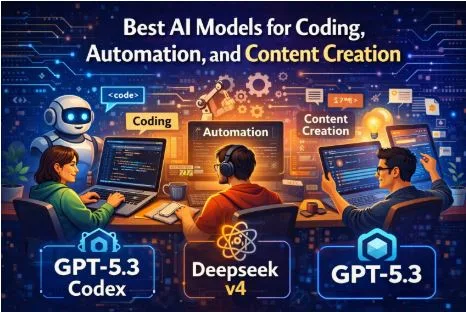
AI models are now core tools for developers, product teams, and creators. Choosing the right model affects speed, costs, accuracy, and how much human oversight you must add. This in-depth review compares the leading models and platforms for coding, automation, and content creation, analyzing features, usability, pricing, and support, and offering clear recommendations so you can pick the right tool for your projects. Anchor links below let you jump to model deep-dives: gpt 5.3 codex, Deepseek v4, and gpt 5.3.
What to look for when evaluating AI models
Before diving into comparisons, here are the practical evaluation criteria I use in this review:
- Accuracy & reasoning — how well the model produces correct, secure code and logical content.
- Context length & memory — how much code or doc the model can keep in context (crucial for large repos).
- Tooling & integrations — editor plugins, SDKs, CI/CD hooks and cloud APIs.
- Latency & scalability — inference speed and ability to scale for production workloads.
- Cost — token pricing, subscription tiers, and hidden costs (cache, fine-tuning).
- Support & SLAs — documentation, community, enterprise SLAs and compliance options.
GPT-5.3-Codex — The coding-first powerhouse
Overview & features. GPT-5.3-Codex is positioned as a high-capability, agentic model optimized for programming tasks and long-running multi-step flows. It’s designed to act like an interactive coding colleague that can research, run tool calls, and maintain state across complex tasks. This model excels at generating idiomatic code, producing security-aware suggestions, and helping refactor large codebases. (OpenAI)
Usability. Accessibility is excellent: official SDKs, IDE plugins, and GitHub integrations make it simple to plug the model into developer workflows. The model’s explanations help junior devs learn while they code.
Pricing. OpenAI offers tiered access—some Codex capabilities are bundled with ChatGPT subscriptions, and API pricing depends on usage patterns (chat/inference vs. agent sessions). For teams, seat-based subscriptions and enterprise plans are available. See OpenAI’s system card and pricing pages for latest details. (OpenAI Developers)
Support & ecosystem. Strong enterprise support, rich documentation, and a large community make troubleshooting and adoption straightforward.
Best for: Teams building production systems that require robust code generation, security-aware automation, and deep IDE integration.
Deepseek v4 — Cost-efficient long-context engineering model
Overview & features. Deepseek v4 focuses on engineering workloads: huge context windows (designed for repo-scale analysis), repository-level memory, and specialized tool calls for code search and reasoning. Their Engram memory architecture and Mixture-of-Experts approach prioritize efficiency and long-context fidelity. Official docs highlight large token contexts and JSON/tool-call outputs tailored to developer automation. (deepseek-v4.ai)
Usability. Deepseek offers pragmatic SDKs and APIs that cater to automated code analysis, bulk search, and CI/CD automation. The learning curve is moderate—teams with basic ML or DevOps experience can integrate it quickly.
Pricing. Deepseek emphasizes aggressive cost-efficiency: published rates show lower per-token costs versus many competitors, with cache-hit vs. cache-miss differentials. This makes Deepseek appealing for high-volume inference tasks (e.g., continuous repo scanning). Always model your token usage to forecast monthly cost. (DeepSeek API Docs)
Support & ecosystem. Growing ecosystem; strong for engineering-focused integrations but smaller community than larger incumbents.
Best for: Organizations running repo-scale analysis, automated security scanning, or high-volume developer-assist pipelines where token cost matters.
GPT-5.3 — Generalist with broad utility
Overview & features. GPT-5.3 is a general-purpose LLM tuned for both reasoning and content generation. It’s strong at natural language content creation—marketing copy, docs, test-case generation—and also performs well on coding tasks when paired with code-specific instruction sets. You get robust multi-modal features and flexible API controls for steering output. (DataCamp)
Usability. Very beginner-friendly: natural language prompting produces useful drafts, outlines, and documentation. For production-grade coding tasks, pairing GPT-5.3 with specialized tools or fine-tuning yields the best results.
Pricing. Pricing tends to match premium, high-capability offerings—evaluate whether you need GPT-5.3 for heavy inference or can offload bulk tasks to cheaper, specialized models.
Support & ecosystem. Largest ecosystem and integrations—many plugins, marketplace tools, and established enterprise support.
Best for: Teams that need a single, reliable model for mixed workloads (content + code + reasoning) and value strong support and tooling.
Comparative summary: features, pricing, and when to pick each
- If you need deep coding expertise + IDE integrations: choose gpt 5.3 codex for best-in-class coding assistance and enterprise support. (OpenAI)
- If you run large-scale repo analysis or want the cheapest inference at scale: Deepseek v4 is optimized for long-context and token-efficient workloads. (deepseek-v4.ai)
- If you want a versatile model for content, prototypes, and light coding: gpt 5.3 provides a balance between reasoning and content creation. (DataCamp)
Cost optimization tip: use a hybrid stack—route bulk or repo-scale tasks to cost-optimized models (Deepseek) and reserve rapid prototyping or high-stakes inference for higher-tier models (GPT-5.3 family).
Practical adoption checklist
- Start small — pilot on one repo or internal tool.
- Measure token usage — log prompt sizes and outputs to estimate cost.
- Guard rails — add unit tests and policy checks for generated code.
- Monitor drift — track model performance on real tasks and switch models as needed.
- Hybrid architecture — combine specialist models for scale and generalists for complex reasoning.
Final verdict & CTA
There is no single “best” model—only the best fit for your workload. Use gpt 5.3 codex for deep code tasks and tight IDE workflows, Deepseek v4 when context window and cost-efficiency matter, and gpt 5.3 for mixed content and reasoning workloads. Want help testing these models on your codebase or estimating monthly token costs? I can draft a small proof-of-concept plan and cost model for your team—tell me which repo or workload you want to test and I’ll create a tailored POC outline.