Returns, Injuries, and the Uneven Rhythm of the Rankings
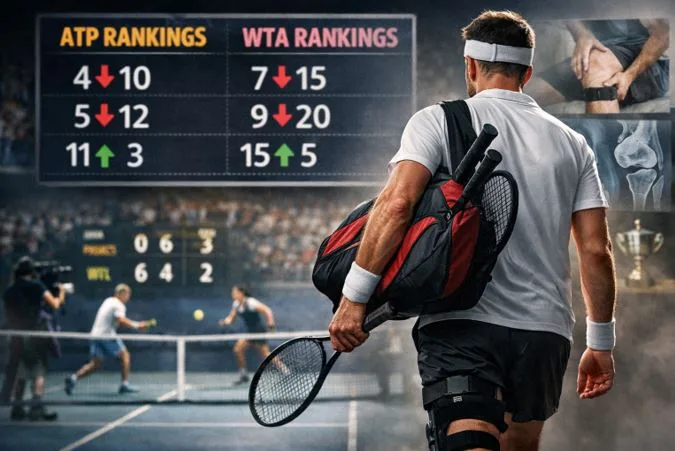
In tennis, absence never stays neutral for long. A player withdraws, first from one event, then another. Updates arrive in fragments — “rehab progressing,” “not fully match-fit yet,” “targeting a return next month.” Meanwhile, the tour continues its rotation across continents and surfaces, and the ranking table quietly recalculates itself without waiting for anyone’s recovery timeline. By the time the injured player walks back onto court, the landscape has already shifted. Not dramatically, perhaps, but enough to be felt in the draw, in the seeding, in the early-round opponents waiting across the net.
The ranking system, for all its mathematical clarity, carries a kind of structural impatience. Points expire according to schedule, not according to the body’s capacity to heal. The number next to a player’s name becomes less a stable marker of skill and more a snapshot of recent presence. Injuries interrupt that presence, and interruption translates almost immediately into descent.
The body as infrastructure
It is easy to speak of rankings as if they were abstract measures. Yet each ranking point corresponds to matches played, surfaces endured, travel completed. The professional circuit demands a constant negotiation between performance and preservation. A shoulder that aches during serve practice. A knee that resists sudden direction changes. A back that stiffens after long flights and compressed schedules. None of this appears on the official ranking list, yet all of it shapes the list.
Absence and the altered field
A prolonged absence does more than lower a ranking. It reshapes the competitive field. Former top seeds re-enter draws without protection. Early rounds become unexpectedly difficult. Matches that would once have occurred in semifinals now appear in the first week. The returning player must rebuild not only form but also position.
The ATP side follows similar patterns. A player recovering from surgery may need months of competition simply to re-enter the top twenty. Each match carries weight. Each loss has consequences. The ranking system treats time away as absence, not as recovery.
Watching the return
Public attention intensifies these dynamics. When a well-known player returns, spectators look for signs — slight hesitations, altered movement patterns, changes in serve speed. Commentators analyze readiness. Analysts estimate probabilities. The match becomes more than a contest; it becomes an assessment of recovery under pressure.
This atmosphere feeds a broader culture of projection. Observers try to anticipate how a returning player will perform, how far they can go, whether their ranking will stabilize. Platforms where outcomes are forecasted — including spaces like tonybet.com — exist within this interpretive environment, where uncertainty around physical condition becomes part of the narrative surrounding competition. The player’s body, in a sense, becomes a variable in a wider field of speculation.
Yet for the athlete, the process remains concrete: training sessions, medical check-ins, cautious scheduling decisions. Recovery unfolds slowly, often unevenly, regardless of external anticipation.
Structural tempo versus biological tempo
The deeper issue lies in the mismatch between the sport’s structural tempo and the body’s biological tempo. Rankings operate on weekly updates, annual cycles, and fixed point expirations. Bodies operate on healing processes that resist scheduling. Tendons do not accelerate because a tournament is approaching. Muscles do not stabilize because points are about to drop.
A more collective approach might consider how the ranking system could adapt to injury without erasing competitive integrity. Extended protected rankings, flexible point retention, adjusted calendars — these ideas surface periodically, then recede. The current structure persists because it offers clarity, predictability, and constant movement.
Yet that movement comes at a cost. Players return before they feel fully ready. They test themselves under match conditions because absence carries its own risks. Some recover successfully. Others struggle. The ranking table records only the outcomes, not the process.
The ongoing negotiation
Every comeback, then, is a negotiation between recovery and relevance. Play too soon, and the body may falter. Wait too long, and the ranking may collapse. There is no perfect moment. Only decisions made within constraints that rarely soften.
Watching a top player return from injury means watching this negotiation unfold in real time. The audience sees forehands, serves, rallies. Beneath those exchanges runs a quieter dynamic: the effort to reconcile a healing body with a system that never pauses.