What Is a Plate Load Test?
When you are running a busy site, you need clarity. You cannot afford the construction risk caused by weak ground beneath your foundations, crane pads, or piling rig.
So, what is a plate load test?
A plate load test is a controlled method used in civil engineering to determine the ground bearing capacity of soil on site. It confirms the load-bearing capacity before heavy construction equipment or shallow foundations are installed. At The Plate Testing Co., we believe that understanding your ground conditions shouldn’t be complicated. We are here to strip away the jargon and explain exactly what this test is, why you need it, and how it can save your project from disaster.
It is practical, cost-effective, and carried out directly on the ground surface as part of site investigation and site testing.
The Basics: What Is a Plate Load Test and Why It Matters
In simple terms, a plate load test (often referred to as a plate bearing test) measures how the soil behaves under a given load.
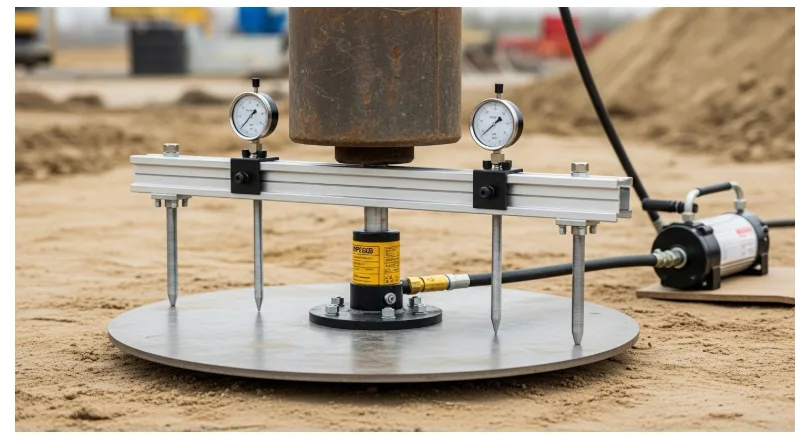
A rigid circular steel plate, the test plate, is placed on the ground surface or within a shallow pit at formation level. A hydraulic jack applies an increasing load through the loading plate. Settlement is measured at each stage.
The test measures:
- Ultimate bearing capacity
- Safe bearing capacity
- Strain modulus
- Ground bearing capacity
- Maximum capacity under design load
This tells you if the soil can safely support the actual footing, piling rig, or crane pads that will follow.
Instead of guessing soil strength, you get accurate and reliable data based on in situ tests under real site conditions.
Why You Need a Plate Load Test on Site
Safety of Working Platforms
If you are installing crane pads, temporary structures, or supporting a piling rig, the working platforms must safely support high loads.
A plate load test confirms the load required to induce settlement and shows whether shear failure occurs under increasing load.
This helps prevent excessive settlement and serious safety issues.
Foundation Design Validation
Your engineer designs foundations based on assumed soil strength and physical properties. The test measures the actual strength of the soil beneath your foundation.
It verifies:
- Bearing pressure
- Load distribution
- Maximum vertical pressure
- Load under different loads
This ensures your shallow foundations meet safety criteria.
Compliance and Quality Control
For many projects, site investigation requires formal site testing.
A plate load test provides reliable results that meet project safety criteria and regulatory expectations. It forms part of quality control before structural works begin.
How the Plate Load Test Is Carried Out
Understanding how the test works helps you plan properly.
Step 1: Preparing the Test Location
A representative location is selected based on site conditions and soil types. Loose material is removed to expose competent ground.
Where necessary, a shallow pit is excavated to reach the formation level. The surface is levelled so the steel plate sits flat.
The chosen plate diameter depends on ground particle sizes and plate size requirements. Common plate sizes range from 300mm to 750mm.
Step 2: Setting Up the Equipment
The test plate is positioned on the prepared granular layer or soil.
A hydraulic jack is placed above it. Above the jack sits a suitable reaction load, often an excavator or other construction equipment.
The reaction load provides the maximum applied load by pushing down through the plate.
Step 3: Applying the Load
The load is not applied in one movement. Instead:
- A seating load is applied first
- Gauges are zeroed
- Load increments are applied gradually
Each load increment is held steady while settlement is measured.
This controlled increase allows you to observe how the plate begins to move under bearing pressure.
The load applied continues until:
- The maximum load required is reached
- Shear failure occurs
- Maximum pressure for the design load is achieved
Step 4: Measuring Settlement
At every stage, the total load value and movement are recorded.
This shows:
- How soil behaves under a given load
- Induced settlement
- Likely settlement beneath the foundation
- Whether the maximum capacity has been exceeded
The total load and settlement are plotted on a graph to determine ultimate bearing capacity and safe bearing capacity.
What Do the Test Results Tell You?
The test measures how the soil responds under plate load conditions.
From the load vs. settlement curve, engineers determine:
- Ultimate bearing capacity
- Safe bearing capacity
- Strain modulus
- Ground bearing capacity under maximum applied load
If settlement increases rapidly under increasing load, it indicates shear failure and limited load-bearing capacity.
If settlement remains controlled, the ground can safely support the design load.
These results give reliable data for foundation design and reduce construction risk.
Can You Use Plate Load Test Data to Obtain CBR Values?
In many projects, especially for roads, a CBR test (California Bearing Ratio test) is specified.
A common question is whether a plate load test can provide similar information.
Yes, in many cases.
The plate load test provides strain modulus and subgrade stiffness values. Using empirical correlations, this data can estimate an equivalent California bearing ratio.
This is useful where:
- Working platforms are already being tested
- You want to avoid duplicate site visits
- You need cost-effective data for civil engineering purposes
While it is an estimation, it often satisfies pavement design requirements and adds value to a single load test.
When Should You Schedule a Plate Load Test?
Timing matters.
- For working platforms: test after construction and compaction, before the plant arrives.
- For shallow foundations, test once the formation level is reached.
- For crane pads: test before heavy construction equipment is positioned.
- For roads: test the subgrade before placing structural layers.
Testing at the right stage ensures reliable data and avoids expensive delays.
Final Thoughts
A plate load test is not just another box to tick. It is a direct way to confirm the soil strength and ground bearing capacity on your site.
By placing a circular steel plate of known diameter onto the ground surface and applying increasing load through a hydraulic jack, the test measures actual behaviour under maximum vertical pressure.
It tells you if your ground can safely support your foundation, crane pads, piling rig, or temporary structures.
When you understand what a plate load test is and how it works, you are not relying on assumptions. You are building on accurate and reliable data and keeping your project on solid ground.