The Algorithmic Markdown: Deciphering Walmart Hidden Clearance and the Rise of Crowdsourced Retail Intelligence
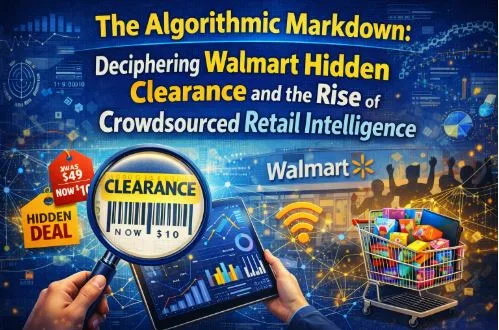
As inflationary pressures stabilize into a new economic baseline, American consumers are pivoting toward data-driven shopping strategies, transforming “hidden” retail markdowns from niche hobbies into a sophisticated pillar of modern household budgeting.
The retail landscape of 2026 is defined by a paradox of efficiency. While global supply chains have largely recovered from the disruptions of the early 2020s, the integration of hyper-local AI pricing models has created a fragmented secondary market within big-box stores. At the center of this shift is the phenomenon of Walmart Hidden Clearance, a term describing deep price reductions that occur within a retailer’s internal database before they are reflected on physical shelf tags.
What was once a logistical lag has become a focal point for a new breed of “information-first” shoppers. By leveraging mobile technology and digital networks, these consumers are navigating inventory liquidation cycles with surgical precision, fundamentally altering the traditional relationship between retailer and patron.
The Mechanics Behind Hidden Retail Markdowns
To understand the emergence of unadvertised retail discounts, one must first examine the shift toward dynamic pricing systems. In 2026, major retailers no longer rely solely on corporate-wide seasonal sales. Instead, pricing is increasingly dictated by store-level data, including shelf-life velocity, local warehouse capacity, and regional demand forecasts.
Retail markdown optimization is now a continuous algorithmic process. When a specific product reaches a certain “dwell time” on the shelf or when a newer model is scheduled for arrival, the system triggers a price drop. However, the labor-intensive process of printing and applying new “clearance” stickers often lags behind the digital update. This creates in-store price discrepancies where a product marked at $50 on the shelf might actually scan at $10 at the register.
This gap is where barcode-based price verification becomes essential. Using proprietary retail apps or third-party scanning tools, consumers can check the “real-time” price of an item. For the retailer, this lag serves a dual purpose: it allows for a “quiet” liquidation that clears inventory without the chaotic foot traffic often associated with publicized blowout sales, maintaining a more controlled store environment while still achieving necessary inventory turnover.
Digital Communities and the Rise of Consumer Intelligence
The democratization of retail data has birthed robust consumer savings networks. No longer acting in isolation, shoppers now participate in social commerce communities that operate with the efficiency of professional intelligence agencies. These groups track “price patterns” across state lines, noting when a specific category—such as small appliances or seasonal toys—begins its descent toward “pennies on the dollar” status.
Information spreads across these networks with remarkable speed. A shopper in Ohio might discover a specific brand of vacuum cleaner has hit a 75% markdown; within minutes, this data point is verified by users in Florida and Texas, creating a heat map of potential savings.
A prominent example of this collaborative behavior can be found within the Walmart Hidden Clearance community, where members share real-time scans and store locations to help others navigate these digital-only price drops. These platforms have shifted the power dynamic, moving from “passive receiving” of marketing materials to “active hunting” of data-driven opportunities.
“It isn’t just about the discount; it’s about the data,” notes Sarah Jenkins, a frequent contributor to regional savings forums. “In 2026, if you are only looking at the price tag on the shelf, you are essentially looking at yesterday’s news. The real price is in the scanner.”
Retail Strategy: Why Hidden Clearance Exists
From a corporate perspective, the existence of Walmart Hidden Clearance is not a glitch, but a feature of modern supply chain fluidity. High-volume retailers prioritize “velocity of floor space” above all else. In the high-interest-rate environment that characterized the mid-2020s, the cost of holding unsold inventory—known as “carrying cost”—became a significant drain on quarterly earnings.
By allowing prices to drop incrementally and quietly, retailers can:
- Manage Store Traffic: Massive, advertised sales events require extra security and staffing. Hidden markdowns distribute the “liquidation” over several days or weeks, handled by regular foot traffic.
- Test Price Elasticity: Algorithmic pricing allows the retailer to see at what exact price point a stagnant item begins to move, providing valuable data for future procurement.
- Optimize Regional Supply: If a specific region has a surplus of winter coats during an unseasonably warm February, the dynamic pricing systems can liquidate those specificunits without affecting stores in colder climates.
This localized approach to retail markdown optimization ensures that the corporate balance sheet remains lean, even if it results in temporary price confusion at the store level.
Risk, Responsibility, and Smart Consumer Practices
While the allure of finding a $200 television for $40 is high, industry analysts warn that this “treasure hunt” style of shopping requires a grounded perspective. The primary challenge for consumers is the inherent volatility of store-to-store price variation. Because these discounts are often triggered by local inventory levels, a price found at one location is never a guarantee of the price at another.
Ethical and responsible participation in these consumer savings networks involves several key principles:
- Verification is Mandatory: Consumers are encouraged to use in-store scanners or mobile apps to confirm a price before reaching the checkout lane.
- Respect for Labor: Retail employees often have no control over algorithmic price drops and may not even be aware a “hidden” markdown has occurred until it is scanned.
- Inventory Realities: These items are frequently the last remaining units. Once the “hidden” price hits its lowest point, stock levels are usually critical or depleted.
- Budgetary Discipline: Experts warn against “saving money by overspending.” A deep discount on an unneeded item is still an expense, not a profit.
Conclusion: The Evolution of the Informed Shopper
The rise of Walmart Hidden Clearance as a mainstream consumer strategy signals a broader shift in the retail economy. In 2026, the “average” consumer is more digitally literate and data-dependent than ever before. The boundary between “online shopping” and “in-store shopping” has blurred; the physical store is now simply a gallery for a digital database.
As retailers continue to refine their dynamic pricing systems, the role of digital communities will only grow. These networks act as a necessary counterbalance to the “black box” of retail algorithms, providing transparency in an era of fluctuating prices. For the modern consumer, success in the 2026 retail market is no longer about finding the right store, but about accessing the right information at the right time.
Ultimately, “hidden clearance” is a testament to the efficiency of the modern market. It represents the point where high-tech logistics meets high-intent consumer behavior, creating a unique—albeit complex—ecosystem of savings for those willing to look beyond the shelf tag.