The Digital Freeze: Is Your Smart Home Ready for the 2026 Polar Vortex?
As we move through 2026, the “Polar Vortex” has shifted from a rare meteorological anomaly to a predictable winter reality. For the modern homeowner, these extreme cold snaps represent more than just a heating challenge; they are a systemic threat to the digital nervous system of the house. Today’s smart homes rely on a complex web of IoT sensors, mesh networks, AI-driven climate controllers, and cloud-integrated security. When the grid fluctuates due to ice-heavy lines or surge-induced “brownouts,” the resulting “digital freeze” can leave a home vulnerable, disconnected, and physically compromised.
The problem is that while our devices are smarter, the power grid remains antiquated and under extreme stress during sub-zero temperatures. Achieving true winter resilience requires a move away from passive protection toward active, lithium-based power management.
Solving the “Cold Boot” Failure in Home Automation
In a 2026 smart home, the “brain” of the operation the central hub or local server is the most vulnerable point during a Polar Vortex. Most automated climate systems are designed to modulate heat based on real-time data from external sensors. However, these systems are notoriously sensitive to power sags. A voltage dip lasting only a few milliseconds can cause a smart hub to “glitch” or enter a reboot cycle. If this happens while the system is managing a critical heating sequence, the result can be frozen pipes or a complete loss of climate control while the homeowner is away.
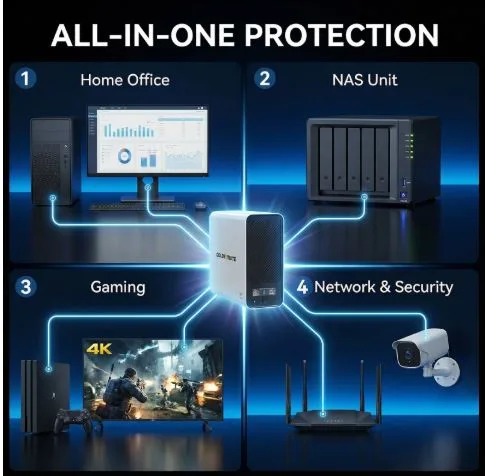
The technical solution to this failure point is a high-performance lifepo4 ups. Unlike traditional backups, these units provide a Pure Sine Wave output, which is essential for the sensitive microprocessors found in 2026-era smart hubs and local AI servers. By installing a dedicated UPS at the hub location, you ensure that even if the grid “flickers” ten times an hour during a blizzard, your automation logic remains steady. The LiFePO4 chemistry is particularly vital in this scenario because of its superior thermal stability; it can handle the temperature fluctuations of an equipment closet or a basement much more safely than legacy lead-acid batteries, which lose capacity and chemical integrity in extreme environments.
Eliminating Security Blind Spots During Grid Instability
A Polar Vortex often brings more than just cold; it brings localized power outages that can last from minutes to hours. For security-conscious homeowners, this creates a dangerous “blackout window.” Most modern security systems rely on Wi-Fi cameras, smart locks, and PoE (Power over Ethernet) doorbells. When the power fails, the router and the security NVR (Network Video Recorder) typically go down immediately, leaving the home blind and the smart locks potentially inaccessible.
To solve this, a lithium battery backup system must be integrated into the network stack. By providing a mountable, slim-profile backup for the modem, router, and security switch, you maintain a “digital perimeter” that remains active even when the neighborhood goes dark. This isn’t just about convenience; it’s about ensuring that flood sensors and smoke detectors can still send push notifications to your phone through a live internet connection. In 2026, where “always-on” connectivity is a baseline for home insurance compliance, this level of redundant power is a professional-grade requirement for any luxury or tech-heavy residence.
The ROI of Winter Resilience: Preventing Systemic Failure
When auditing a smart home for Polar Vortex readiness, the Return on Investment (ROI) is measured in the prevention of catastrophic loss. Consider the specific costs associated with a “Digital Freeze”:
- The Hardware Cost: A power surge following a winter blackout can fry the sensitive motherboards of high-efficiency HVAC controllers or expensive smart appliances.
- The Recovery Cost: The labor required to manually re-sync dozens of IoT devices, smart bulbs, and sensors after a “dirty power” event.
- The Opportunity Cost: The physical damage of a burst pipe caused by a smart thermostat failing to trigger a “drip” sequence because the Wi-Fi was down during a freeze.
By investing in a professional-grade lithium iron phosphate system, you are buying an insurance policy against grid volatility. These units act as active power conditioners, filtering out the electrical noise and voltage spikes that occur when the grid is being pushed to its limits by millions of electric heaters and EV chargers.
Solving the Longevity Problem: Why 2026 Demands LiFePO4
For years, the backup industry was hampered by lead-acid technology that required replacement every two years often failing exactly when needed during a winter crisis. In 2026, the gold standard has moved to Lithium Iron Phosphate for three primary reasons:
- Operational Lifespan: With a 10-year service life and over 5,000 charge cycles, these units offer a “set it and forget it” solution that survives multiple seasons of extreme weather.
- Rapid Recharge: During winter storms, outages often occur in waves. LiFePO4 systems recharge up to 4x faster than older technologies, ensuring the battery is ready for the second or third outage of the night.
- High-Wattage Transient Protection: 2026-era electronics have high inrush currents. A lithium-based system can handle these “spikes” without tripping the internal circuit breaker, ensuring that your high-end gaming PC or home server stays alive during a sag.
Implementation: Your Smart Home Winter Audit
To ensure your digital continuity during the next Polar Vortex, follow this three-step resilience audit:
- Identify the “Brain”: Locate your primary router, automation hub, and security NVR. These must be on a lifepo4 ups to prevent data corruption and logic failures.
- Protect the Network Stack: Ensure that the fiber-optic ONT or cable modem is backed up by a lithium battery unit. If the internet goes down, your “Smart Home” becomes a “Dumb Home.”
- Test the Shutdown Protocol: For users with local NAS or media servers, ensure the UPS is connected via USB to trigger an automated, graceful shutdown if the outage exceeds 15 minutes.
Conclusion: Dominating the Winter Grid
The 2026 Polar Vortex doesn’t have to mean a total digital shutdown. Strategic resilience is about isolating your most sensitive technology from the failures of an overtaxed grid. By deploying intelligent, lithium-based power solutions, you take control of your home’s environment, ensuring that your digital heartbeat remains steady even when the outside world is frozen.
Don’t wait for the first ice storm to discover the weaknesses in your infrastructure. Take the first step toward total smart home resilience by exploring the specialized backup systems designed for the modern professional.