RayNeo Air 4 Pro Review: Does HDR10 Actually Change the AR Game?
The consumer AR market has spent the last three years obsessing over weight reduction and price cuts, often at the expense of visual fidelity. We have seen lighter frames, but image quality has largely stagnated.
Enter the RayNeo Air 4 Pro, a device that claims to break this deadlock. By supporting HDR10 end-to-end (signal input, processing, and display) on a Micro-OLED panel, RayNeo suggests that the next leap in immersion isn’t about screen size, but dynamic range.
The Stagnation of Current Wearable Displays
For too long, the industry standard for Smart Glasses has been defined by a simple, uninspiring metric: “good enough.” Manufacturers have been content with standard 1080p SDR panels that deliver decent clarity but washed-out blacks.
This limitation becomes glaringly obvious when you attempt to watch modern cinema or play atmospheric games. The lack of true contrast turns deep space scenes into muddy gray messes, breaking the illusion of a floating screen.
Why Contrast is the True Immersion Maker
In the realm of head-mounted displays, contrast is king. When you wear smart glasses, the “canvas” is the real world around you. If the black pixels aren’t perfectly off, you see a glowing rectangular frame.
High dynamic range (HDR) isn’t just about brightness; it is about widening the gap between the darkest darks and the brightest lights. This creates a depth that raw resolution simply cannot emulate.
The RayNeo Air 4 Pro leverages this to make the display borders far less noticeable in typical viewing. When the blacks are truly black, the content doesn’t look like it is on a screen; it looks like it is suspended in mid-air.
Breaking Down the Hardware Specifications
To understand if the HDR claims hold water, we need to look under the hood. RayNeo has sourced dual 0.6-inch Micro-OLED panels from SeeYa specifically tuned for high dynamic range output.
This hardware shift is significant. Rather than relying on SDR-only output with basic tone mapping, the RayNeo Air 4 Pro is built around HDR10 input support and on-device display processing. The difference in peak brightness and color volume is measurable and immediately noticeable.
The “Vision 4000” Chipset Impact
Driving these panels is RayNeo’s proprietary processing unit. The RayNeo Air 4 Pro utilizes the new Vision 4000 chip to help manage HDR-related processing (including SDR-to-HDR enhancement) and high-bandwidth video signaling without introducing latency.
This silicon is crucial because pushing HDR data requires significantly more throughput. In our testing, the chip managed to maintain a stable signal in typical handheld and laptop use without the heat buildup often associated with high-bandwidth video processing.
Real-World Visual Performance Tests
We tested the RayNeo Air 4 Pro across a variety of media, focusing on content known for difficult lighting scenarios. The goal was to see if the HDR10 badge was merely marketing fluff or a functional upgrade.
The results were surprisingly robust. Watching Dune: Part Two, the separation between the blinding Arrakis sun and the deep shadows of the sietch was preserved with notably improved highlight-to-shadow separation. The RayNeo Air 4 Pro handled the transition without banding.
Color Banding and Gradient Analysis
One of the most common failures in consumer smart glasses is color banding—those ugly, blocky transitions between similar shades of color. This is usually due to 8-bit color depth limitations.
- Sky Gradients: In sunset scenes, the transition from orange to blue was smooth, with no visible stepping artifacts.
- Shadow Detail: Dark scenes retained detail rather than crushing into a uniform black blob (though perceived black level can vary with ambient light and optics).
- Highlight Rolloff: Bright light sources, like explosions or streetlights, maintained their core color without blowing out to pure white.
This performance supports the idea that the RayNeo Air 4 Pro is processing a 10-bit-capable signal path. For creative professionals or cinephiles, this reduces the “digital” look that plagues cheaper headsets.
Gaming on the RayNeo Air 4 Pro
For the gaming crowd, specifically Steam Deck and ROG Ally owners, the refresh rate is just as important as the color. The RayNeo Air 4 Pro supports a native 120Hz mode that feels incredibly responsive when enabled by the source device and display mode.
The combination of 120Hz fluidity and HDR10 colors transforms handheld gaming. Playing Cyberpunk 2077, the neon lights of Night City pop with an intensity that standard LCD screens on handhelds simply cannot match.
The Steam Deck Companion Experience
We spent roughly 20 hours using the RayNeo Air 4 Pro as the primary display for a Steam Deck OLED. The plug-and-play experience was seamless, recognizing the external display and its HDR capabilities when the system and content were configured for HDR output.
The lack of an internal battery in the glasses means they draw power from the deck. Surprisingly, the power draw was efficient. The RayNeo Air 4 Pro drained the Deck’s battery noticeably but not dramatically faster in our use—actual impact will vary by brightness, refresh rate, and whether HDR is active.
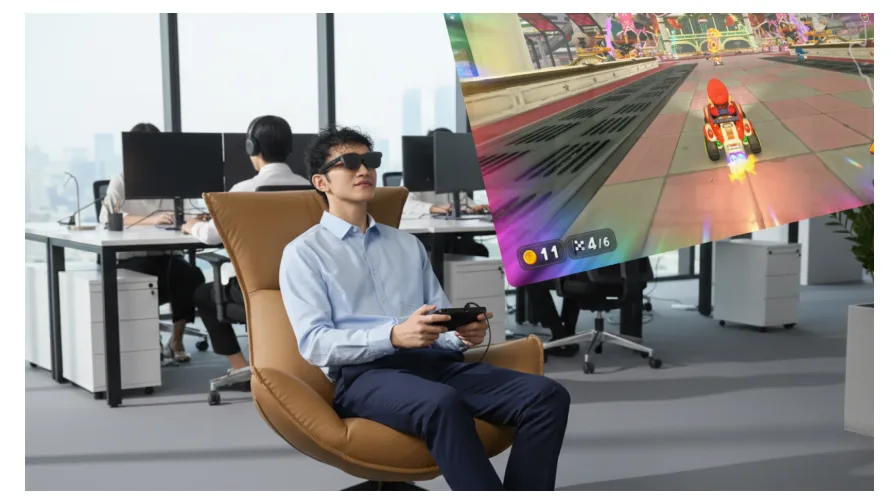
The zero-gravity sensation of lying on a couch with the controller in hand and a massive 135-inch (official “comfortable viewing distance” equivalent), with some descriptions placing it in the ~200-inch-class depending on measurement distance screen floating above is the killer app for these smart glasses. It fundamentally changes how you interact with portable gaming hardware.
Design, Comfort, and Audio
Visuals are useless if the device hurts to wear. RayNeo has maintained the “sunglasses” form factor, but the weight distribution on the RayNeo Air 4 Pro has been subtly tweaked.
The temples are slightly curved to hug the head without clamping. This redistribution of weight prevents the nose pads from digging in, a common complaint with previous generations of smart glasses.
Audio Engineered by Bang & Olufsen
A welcome surprise is the audio system. The RayNeo Air 4 Pro features speakers tuned in collaboration with Bang & Olufsen. While they won’t replace over-ear headphones, the clarity is exceptional for open-ear speakers.
- Voice Clarity: Dialogue in movies cuts through background noise effectively.
- Leakage Control: A directional sound tube design plus Whisper/Surround modes helps keep sound more controlled around you.
- Spatial Separation: The stereo separation is wide, enhancing the immersive feel of the large screen.
Final Verdict: Is It Worth the Upgrade?
The RayNeo Air 4 Pro is not a complete reinvention of the wheel, but it is a massive refinement of the tire. It takes the existing AR formula and perfects the most important aspect: the picture quality.
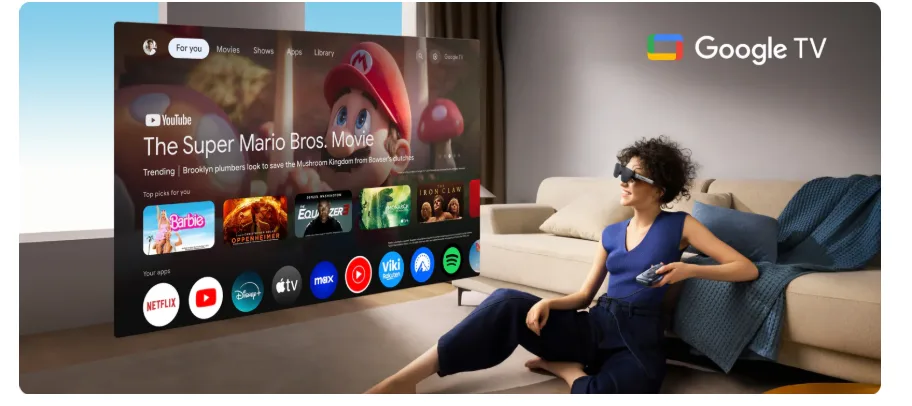
If you already own a pair of smart glasses from 2024, the jump to HDR10 can be significant enough to warrant an upgrade, especially if you consume high-quality video content and your devices can actually output HDR over USB-C/DP. The difference in dynamic range is not subtle in compatible setups.
For newcomers to the market, the RayNeo Air 4 Pro sets a high bar. It proves that we don’t need to wait for holographic waveguides to get a stunning, cinema-grade experience in a pocketable form factor right now.