Why European Kitchen Design is Redefining Luxury Living in Dubai
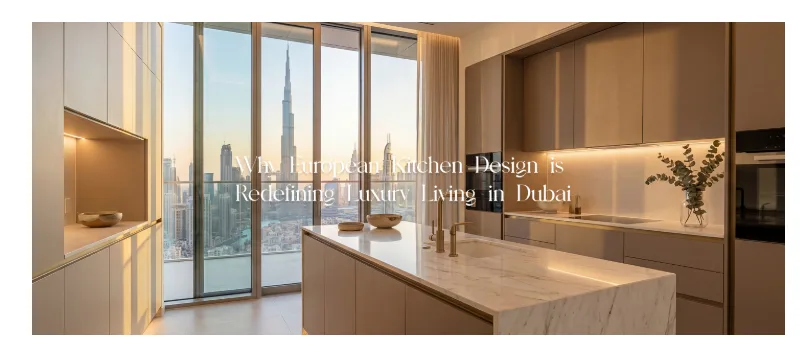
Dubai has moved beyond decorative luxury.
Today’s homeowners are not impressed by excess, they are persuaded by precision.
Speak with Luxury Interior Design Experts in Dubai and a consistent insight emerges: clients are demanding kitchens that function like engineered systems, not decorative installations. Luxury Interior Design Dubai has been redefined.
The shift is clear. The kitchen is no longer a showcase of ornamentation. It is a performance-driven architectural centerpiece.
European kitchen design has become the benchmark for that performance.
This dominance is not aesthetic coincidence. It is the result of engineering discipline, material science, spatial intelligence, and a deep understanding of how modern luxury homes operate.
The Maturation of Dubai’s Luxury Aesthetic
Dubai’s early high-end villas favored carved cabinetry, layered moldings, gilded finishes, and visible grandeur. That phase reflected a developing market defining its version of aspiration.
Today’s market is globally informed.
Homeowners travel frequently. They experience residences in Milan, Munich, London, and Monaco.
They interact with European modular systems that prioritize flow, integration, and minimalism.
When they build or renovate in Dubai, they expect that same standard of refinement.
Luxury has evolved from “more” to “better.”
Better engineering.
Better material quality.
Better spatial clarity.
This is where European kitchen brands excel.
Engineering as the Core of Luxury
European kitchens are not designed as standalone cabinets. They are built as integrated architectural systems.
Handleless rail profiles, recessed gola channels, push-to-open technology, and flush alignment demand millimetric precision. These systems require industrial manufacturing standards, not on-site improvisation.
German kitchen manufacturers approach cabinetry with automotive-level engineering logic. Load capacities are calculated. Hinges are tested for tens of thousands of cycles. Drawer runners are engineered for weight distribution. Panels align across long elevations without deviation.
The result is structural consistency.
Italian brands complement this with refined material layering, lacquered finishes, brushed metallic tones, textured veneers, engineered stone surfaces.
The aesthetic is minimal, but the tactile richness is undeniable.
Precision plus artistry.
Performance plus elegance.
That combination is difficult to replicate through conventional joinery.
Cohesive Living: Kitchens, Wardrobes & Spatial Continuity
Luxury homeowners in Dubai are no longer designing rooms in isolation. They expect continuity across spaces. This is where the demand for Luxury Wardrobe designs aligns naturally with European kitchen systems.
Clients who invest in handleless kitchens typically request wardrobes that mirror the same architectural discipline, concealed handles, integrated lighting, internal organization systems, soft-close hardware, and seamless vertical alignments.
The logic is simple: if the kitchen reflects structured minimalism, the wardrobe cannot revert to decorative excess.
This continuity creates a unified design language across the home. Living spaces, bedrooms, dressing areas, and kitchens operate as interconnected zones rather than fragmented concepts.
Architectural cohesion has become a defining trait of luxury in Dubai’s prime residential segments.
Climate Performance & Material Intelligence
Dubai’s environment demands technical durability. Heat, humidity fluctuations, and high-usage lifestyles can compromise poorly constructed cabinetry.
European manufacturers operate with advanced board technologies, high-pressure laminates, moisture-resistant cores, UV-stable finishes, and engineered surface materials that resist expansion and fading.
Precision manufacturing reduces warping risk. Hardware remains aligned over time. Finishes retain visual integrity despite environmental stress.
In high-value real estate, longevity directly influences asset perception. A kitchen that maintains structural and aesthetic integrity for a decade reinforces property value.
Luxury buyers understand lifecycle value. The conversation is no longer about upfront cost. It is about performance over time.
The Rise of Handleless & Seamless Design
Handleless kitchens are not merely stylistic. They represent design discipline.
Traditional hardware interrupts visual flow. When handles disappear, cabinetry walls read as architectural planes rather than furniture installations.
Recessed channels allow clean horizontal lines.
Integrated appliances sit behind paneling. Extractor systems are embedded within induction hobs.
Lighting is concealed within shadow gaps.
The result is visual clarity.
In open-plan villas, this clarity matters. Kitchens are fully visible from living and dining zones. A seamless system ensures the kitchen contributes to architectural harmony rather than dominating it.
Minimal interruption equals maximal refinement.
Open-Plan Living & Architectural Integration
Modern Dubai villas are designed around expansive layouts. The kitchen island is no longer confined to cooking. It serves as an entertainment hub, breakfast zone, social interaction point, and sometimes even a workspace.
European kitchen brands design islands proportionally, considering circulation clearance, sightlines, and functional zones.
Countertop thickness is carefully selected to create a floating appearance. Waterfall edges are executed with precision to avoid visible seams.
Tall cabinetry aligns with ceiling height to eliminate awkward gaps. Integrated LED strips create subtle illumination without glare.
These design strategies create continuity between kitchen, dining, and lounge spaces.
The kitchen becomes architecture, not furniture.
Smart Technology & Invisible Integration
High-end homeowners expect smart appliances, but they do not want visual clutter.
European kitchen systems are pre-engineered to integrate:
- Induction cooktops with built-in extraction
• Steam ovens and warming drawers
• Concealed refrigeration columns
• Hidden charging stations
• Sensor-based internal lighting
Wiring channels and ventilation spaces are planned within cabinetry systems. The result is invisible integration rather than post-installation compromise.
Technology supports the experience without dominating it.
Psychological Shift: From Ornamentation to Control
Luxury in Dubai once leaned heavily toward visual impact. Large chandeliers, ornate detailing, and decorative embellishment communicated affluence.
Today’s luxury homeowner prioritizes control.
- Control over layout.
- Control over visual noise.
- Control over material quality.
Minimalist kitchens reduce cognitive load. Clean surfaces promote clarity. Hidden storage systems maintain order. When countertops remain uncluttered, the environment feels calmer.
Environmental psychology supports this. Organized spaces reduce stress triggers and improve spatial perception.
In a city known for speed and ambition, the home functions as a counterbalance. Minimalism becomes a strategic lifestyle decision.
Developer Influence & Market Validation
Developers in Dubai’s prime residential sector increasingly advertise European kitchen brands as a value proposition.
It has become a signal of quality.
When premium towers and gated villa communities specify European modular systems, buyers interpret it as assurance of structural precision and durability.
The market has validated the standard.
European kitchens are no longer niche upgrades. They are expected features in high-end developments.
Customization Within Structure
One misconception is that European systems are rigid.
In reality, they offer modular flexibility within disciplined parameters.
- Height adjustments.
- Depth variations.
- Finish combinations.
- Internal configurations.
Customization is guided by engineered frameworks, ensuring that aesthetic variation does not compromise structural logic.
This structured customization appeals strongly to Dubai’s luxury segment. High-net-worth clients demand personalization, but not chaos.
Investment Perspective: Cost vs Value
European kitchens often command higher upfront pricing compared to locally fabricated alternatives.
However, true luxury buyers evaluate differently.
They assess:
- Hardware lifespan
- Finish durability
- Structural alignment retention
- Brand credibility
- Resale value contribution
When maintenance costs reduce and visual integrity remains intact for years, the investment equation shifts.
Precision becomes cost-efficient over time.
The Influence of Global Design Platforms
International design exhibitions such as Milan’s Salone del Mobile continue to influence global aesthetics. Dubai’s architects and designers attend, absorb innovations, and translate those insights into regional projects.
Ultra-matte lacquers, thin-profile countertops, concealed lighting details, and integrated ventilation systems move quickly from European showrooms into Dubai villas.
The exchange is fluid.
Dubai does not copy trends. It adopts standards.
The Future of Luxury Kitchens in Dubai
The trajectory is clear.
Luxury kitchens in Dubai will continue moving toward:
- Increased material innovation
- Greater sustainability focus
- Smarter appliance integration
- Seamless spatial transitions
- Greater architectural minimalism
Minimalism is not a trendy cycle. It is a refinement process.
As homeowners become more globally informed, expectations will rise further. The demand for precision-engineered systems will only strengthen.
Precision as the New Definition of Luxury
European kitchen design dominates Dubai’s luxury residential landscape because it aligns with the market’s evolution.
It delivers:
- Engineering integrity
- Visual clarity
- Structural longevity
- Seamless integration
- Cohesive spatial language
Luxury today is not about decoration. It is about discipline.
When cabinetry aligns perfectly across elevations, when hardware operates silently, when appliances integrate invisibly, and when spaces flow without visual interruption, the kitchen transcends function.
It becomes an architectural infrastructure.
In Dubai’s most refined homes, that standard is no longer optional.
It is expected.