Digital Tools Are Changing How Buyers Discover Real Estate Auctions in Lithuania
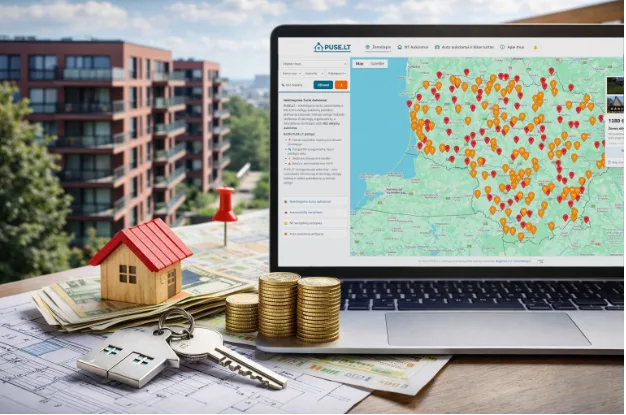
Real estate auctions in Lithuania are drawing increasing attention from buyers and investors who want a faster, clearer way to track opportunities in a European Union market.
For years, one of the biggest barriers in auction-based property search was not the lack of opportunities, but the lack of structure. Listings could be scattered across different sources, updated at different times, and presented in ways that made comparison unnecessarily slow. That creates friction for buyers who need to assess location, timing, price, and asset type before deciding whether a lot is worth deeper analysis.
That is starting to change as more users rely on digital tools that make auction discovery easier to manage. Instead of moving between disconnected sources, buyers increasingly prefer services that show active listings in a more practical format. A dedicated auction map in Lithuania can help users see where listings are located, compare opportunities across regions, and understand the market more quickly.
This matters because real estate auctions appeal to more than one type of buyer. Some users are looking for a lower-cost residential option. Others are focused on investment logic, such as rental yield, resale potential, or refurbishment value. In both cases, speed and clarity matter. A well-presented overview can make the difference between spotting a promising lot early and missing it completely.
Another important factor is the wider market context. Buying real estate in Lithuania means acquiring an asset in an EU country with a transparent legal framework and a market that may be attractive to people thinking about long-term residence, portfolio diversification, or regional investment exposure. Auction inventory can also include more affordable opportunities than conventional listings, including properties that may be suitable for relatively quick occupancy depending on their condition.
For international buyers, the practical challenge is not just finding listings, but filtering them efficiently. A long list of lots is not enough on its own. Buyers want to narrow their search by category, price, timing, and location. That is why easier access to real estate auctions in Lithuania becomes more valuable when supported by structured browsing and a clearer visual overview of the market.
Map-based search is especially useful in this context. It helps turn a fragmented stream of announcements into something closer to a market-viewing tool. Instead of evaluating each lot in isolation, users can start comparing clusters of listings, urban versus regional locations, and the broader distribution of opportunities. For buyers approaching the market strategically, that wider perspective is often more useful than simply scanning isolated auction notices one by one.
Technology also plays a role in trust and usability. A platform only becomes genuinely helpful when the information is easy to navigate, the structure is clear, and the search process does not create unnecessary friction. The service itself was developed by BigWeb.EU which helps explain the emphasis on practical interface design, structured navigation, and everyday usability for people who need to make decisions quickly.
In the end, real estate auctions in Lithuania should not be viewed only as a niche buying channel. They are becoming part of a broader digital search process in which speed, visibility, and smarter comparison tools give buyers a better chance of identifying the lots that deserve serious attention. As auction discovery becomes more data-driven and map-oriented, the market becomes easier to follow for both local and international audiences.