AI in Food Industry: Key Use Cases, Benefits, and Real-World Applications
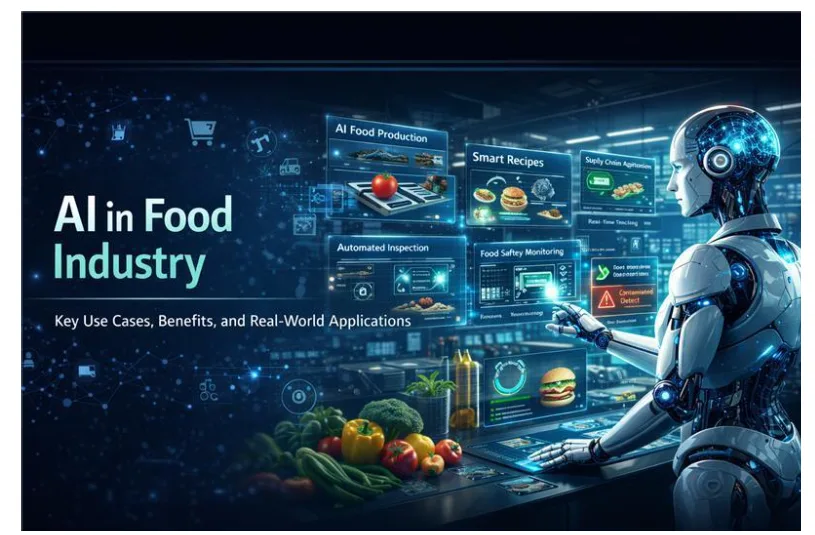
The food and beverage industry is a major global sector that includes food production, processing, distribution, restaurants, and retail.
As consumer demand grows and competition increases, businesses must improve efficiency, maintain product quality, and deliver better customer experiences.
However, the industry faces several challenges such as supply chain inefficiencies, food waste, inaccurate demand forecasting, and maintaining consistent quality and safety standards. These issues can lead to higher operational costs and reduced profitability.
Artificial intelligence (AI) is helping companies address these challenges by enabling smarter data analysis and automation.
AI-powered solutions can optimize supply chains, improve demand forecasting, reduce food waste, and enhance quality control, helping businesses operate more efficiently while delivering better products and services.
What is AI in the Food and Beverage Industry?
Artificial intelligence (AI) in the food and beverage industry refers to the use of advanced technologies that enable machines and systems to analyze data, learn patterns, and automate decision-making processes.
AI helps businesses improve efficiency, maintain product quality, and optimize operations across different stages of the food supply chain.
Several AI technologies are used in the industry. Machine learning analyzes large datasets to identify trends and improve demand forecasting.
Computer vision is used for automated quality inspection and food safety monitoring. Predictive analytics helps businesses anticipate consumer demand, manage inventory, and reduce food waste.
In addition, robotics and automation are increasingly used in food processing, packaging, and manufacturing to improve speed and accuracy.
As digital transformation accelerates, AI adoption is growing across food production, distribution, restaurants, and retail.
Companies are leveraging ai development solutions to streamline operations, enhance supply chain efficiency, and deliver better customer experiences.
Key Use Cases of AI in the Food and Beverage Industry
1. Demand Forecasting and Inventory Management
AI helps businesses analyze historical sales data, seasonal patterns, and market trends to predict consumer demand more accurately. This enables companies to optimize inventory levels, avoid overstocking, and significantly reduce food waste.
2. Food Quality Inspection
AI-powered computer vision systems are used to automatically inspect food products during production. These systems can detect defects, contamination, or inconsistencies in real time, ensuring higher product quality and improved food safety.
3. Smart Manufacturing and Automation
Food manufacturers are increasingly using AI-enabled robotics to automate processing, sorting, and packaging tasks. Automated systems also monitor production lines, helping companies increase efficiency, reduce errors, and improve productivity.
4. Supply Chain Optimization
AI solutions analyze logistics data to predict supply disruptions, optimize delivery routes, and improve distribution planning. This helps businesses maintain efficient supply chains and reduce transportation and storage costs.
5. Personalized Customer Experiences
Restaurants and food delivery platforms use AI recommendation engines to analyze customer preferences and purchasing behavior. This enables personalized menus, targeted promotions, and better customer engagement.
6. Food Safety Monitoring
AI-based monitoring systems help detect contamination risks, hygiene violations, and unsafe storage conditions. Real-time data analysis allows companies to maintain strict food safety standards and ensure regulatory compliance.
7. Food Waste Reduction
AI systems analyze production, inventory, and sales data to identify patterns that lead to food waste. Businesses can then adjust production quantities, improve storage management, and minimize unnecessary waste.
8. Dynamic Pricing and Revenue Optimization
AI algorithms can adjust prices based on demand, inventory levels, and customer behavior. Restaurants and retailers can use dynamic pricing strategies to reduce unsold products and maximize revenue.
9. AI-Powered Food Product Development
Food companies use AI to analyze consumer preferences, ingredient combinations, and nutritional data to develop new food products faster. AI helps manufacturers create innovative flavors and healthier product options.
10. Smart Kitchen and Restaurant Automation
AI-powered systems in restaurants can automate tasks such as order processing, kitchen management, and cooking assistance. Smart kitchens help improve operational efficiency and reduce human errors.
11. Predictive Maintenance for Equipment
AI can monitor equipment performance in food processing plants and predict potential failures. Predictive maintenance helps reduce downtime, prevent costly breakdowns, and ensure continuous production.
12. AI-Powered Customer Insights and Marketing
AI tools analyze customer data, online behavior, and purchasing patterns to provide valuable insights for marketing strategies. Businesses can create personalized campaigns and improve customer retention.
Benefits of AI in the Food and Beverage Industry
1. Improved Operational Efficiency-
AI automates repetitive tasks, optimizes production processes, and streamlines workflows, helping businesses operate more efficiently.
2. Reduced Food Waste-
Predictive analytics and demand forecasting help companies manage inventory effectively and minimize unnecessary food waste.
3. Better Product Quality-
AI-powered quality inspection systems monitor food production in real time, ensuring consistent product quality and detecting defects early.
4. Enhanced Customer Experience-
AI enables personalized recommendations, targeted promotions, and faster service, improving overall customer satisfaction.
5. Data-Driven Decision Making-
AI analyzes large datasets to provide actionable insights that support better decisions in production, supply chain management, and marketing.
6. Improved Supply Chain Efficiency-
AI helps optimize logistics, track inventory in real time, and predict supply chain disruptions to ensure smoother operations.
7. Cost Reduction-
Automation and predictive maintenance reduce operational costs by minimizing errors, waste, and equipment downtime.
8. Better Demand Forecasting-
AI systems analyze consumer trends and historical data to accurately predict demand, helping businesses plan production and distribution more effectively.
9. Enhanced Food Safety and Compliance-
AI-powered monitoring systems help detect contamination risks and ensure compliance with food safety regulations.
10. Increased Productivity-
Robotics and AI-driven automation improve productivity in food processing, packaging, and manufacturing operations.
Future Trends of AI in the Food and Beverage Industry
1. AI-Powered Smart Kitchens-
Smart kitchens use AI to automate cooking processes, manage orders, monitor ingredients, and optimize kitchen workflows, helping restaurants improve efficiency and reduce errors.
2. Autonomous Food Delivery Systems-
AI-powered delivery solutions, including delivery robots and drones, are expected to transform food delivery by enabling faster, contactless, and more efficient deliveries.
3. AI-Driven Food Innovation and Product Development-
Food companies are increasingly using AI to analyze consumer preferences, nutritional data, and ingredient combinations to develop new food products and flavors more quickly.
4. Integration with IoT and Smart Supply Chains-
The integration of AI with Internet of Things (IoT) devices allows real-time monitoring of inventory, temperature, and logistics, helping create more intelligent and efficient supply chains.
5. AI for Sustainable Food Production-
AI technologies will help businesses reduce energy consumption, optimize resource usage, and support sustainable food production practices.
6. Advanced Predictive Analytics-
Future AI systems will provide more accurate insights into consumer behavior, demand patterns, and market trends, enabling businesses to make more strategic decisions.
Conclusion
Artificial intelligence S is transforming the food and beverage industry by improving efficiency, enhancing product quality, and optimizing supply chain operations. From demand forecasting and quality inspection to smart manufacturing and personalized customer experiences, AI is helping businesses address many of the industry’s long-standing challenges.
As technology continues to evolve, adopting AI-driven solutions will become increasingly important for companies seeking sustainable growth and operational efficiency. Businesses that leverage AI for automation, data analysis, and innovation will be better positioned to reduce costs, improve decision-making, and deliver better products and services.
By integrating AI into their operations, food and beverage companies can stay competitive in a rapidly evolving market while meeting changing consumer expectations and industry demands.