Nano Banana 2 API Value Analysis: How It Compares to GPT Image 1.5, FLUX.2 Pro, and Nano Banana Pro in 2026
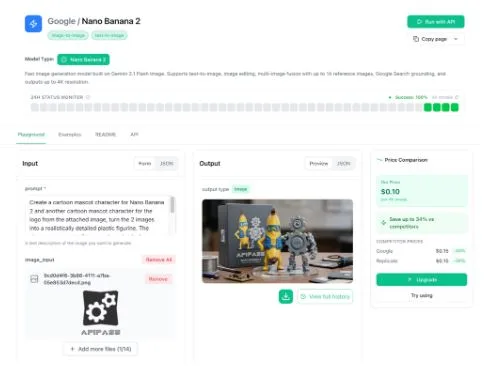
The AI image generation API market in 2026 has never been more crowded — or more consequential for developers to navigate carefully. Prices range from $0.005 to $0.167 per image across the major providers, and choosing the wrong platform for your workload can cost your project thousands of dollars per month at scale. With more capable models entering the market every quarter, the question developers face is not simply “which model looks best on a demo” — it is “which model delivers the best combination of real-world output quality and sustainable per-image economics for production use.”
This article answers that question directly. We compare the Nano Banana 2 API against the three most competitive alternatives in the current market — OpenAI’s GPT Image 1.5, Black Forest Labs’ FLUX.2 Pro, and Google’s own Nano Banana Pro — across both performance and official API pricing. We then explain why accessing the Nano Banana 2 API through APIPASS, a unified API marketplace, delivers the most cost-efficient path to its capabilities of any provider available today.
Nano Banana 2 API via APIPASS: Understanding the Competitive Landscape Before the Numbers
Before comparing models, the platform context matters. APIPASS is an API aggregation platform that provides developer access to the full Nano Banana model family — including the Nano Banana 2 API and Nano Banana Pro — at rates that consistently beat Google’s official Gemini API and every major third-party provider. A single APIPASS account and API key covers both model tiers, eliminating the credential overhead of managing direct Google Cloud integration while delivering the lowest available per-image cost. The comparison in this article uses official pricing from each provider as the baseline; APIPASS’s rates for Nano Banana 2 are presented separately to show the additional advantage available to developers who choose it as their access point.
Here is the full resolution tier breakdown for both Nano Banana models via APIPASS compared to Google’s official rates:
| Model | Resolution | APIPASS API | Google Gemini API (Official) |
| Nano Banana 2 | 1024px (1K) | $0.046 / image | $0.067 / image |
| 2048px (2K) | $0.068 / image | $0.101 / image | |
| 4096px (4K) | $0.100 / image | $0.151 / image | |
| Nano Banana Pro | 1024px (1K) | $0.086 / image | $0.134 / image |
| 2048px (2K) | $0.091 / image | $0.134 / image | |
| 4096px (4K) | $0.173 / image | $0.240 / image |
Across every resolution tier and every model tier, APIPASS delivers a consistent 31% to 36% saving over Google’s official pricing — with no difference in model output quality. With that established, here is how the four models compare.
Performance Comparison: Nano Banana 2 API, GPT Image 1.5, FLUX.2 Pro, and Nano Banana Pro
Nano Banana 2 API: Flash Speed, Pro-Tier Ambition
The Nano Banana 2 API is built on Gemini 3.1 Flash Image — Google’s latest Flash-architecture image model — and was designed specifically to close the quality gap with Nano Banana Pro while maintaining Flash-tier generation speed. In practice, independent evaluators report Nano Banana 2 taking the top position on text-to-image leaderboards, with its largest gains in text rendering and 3D imaging and modeling.
These are not marginal differences in niche benchmark categories. Text rendering accuracy and 3D volumetric realism are two of the most commercially important dimensions in production image generation — covering marketing asset production, UI mockup generation, product visualization, and architectural rendering. Nano Banana 2’s search grounding capability, which pulls live visual references from Google Search during generation, further differentiates it from competing models in accuracy-sensitive workflows. Generation time runs approximately 30 seconds at standard resolution — consistent with Flash-architecture throughput expectations and roughly twice as fast as Nano Banana Pro under comparable conditions.
GPT Image 1.5: OpenAI’s Current Flagship
GPT Image 1.5 is OpenAI’s latest flagship image generation model, offering superior text rendering, precise editing via masks, and significantly faster generation than its predecessor. On LM Arena benchmarks, GPT Image 1.5 scores an Elo of 1,264, placing it among the top-ranked image generation models currently available. Its key technical strengths include strong instruction following for complex multi-element compositions, reliable text rendering, and precise inpainting via mask-based editing. For developers already operating within the OpenAI ecosystem, GPT Image 1.5 offers a familiar integration pattern and strong cross-modal coherence with other GPT models.
The notable limitation is cost. GPT Image 1.5 image outputs cost approximately $0.01 at low quality, $0.04 at medium quality, and $0.17 at high quality for square images. At high quality — the tier most relevant for production creative work — GPT Image 1.5 is among the most expensive options in the current market, and the token-based billing model means actual per-image costs can vary depending on prompt complexity and internal reasoning overhead.
FLUX.2 Pro: Black Forest Labs’ Production Model
FLUX.2 Pro is Black Forest Labs’ production image model with strong text rendering, photorealism, and multi-reference editing capabilities. FLUX.2 Pro v1.1 scores an LM Arena Elo of 1,265, effectively tying GPT Image 1.5 for the quality benchmark crown. Its architecture supports up to eight reference images simultaneously, making it competitive for multi-subject consistency workflows, and its photorealistic output quality is strong across product photography, architectural visualization, and natural scene generation. FLUX.2 Pro is priced from $0.03 per image for text-to-image generation at 1K resolution through Black Forest Labs’ official API, scaling upward with output resolution under a megapixel-based pricing model.
FLUX.2 Pro’s primary limitation relative to Nano Banana 2 is the absence of search grounding and native multilingual in-image text localization — capabilities that are architecturally available to Nano Banana 2 by virtue of its Gemini foundation. For pure photorealism benchmarks and multi-reference editing workflows, FLUX.2 Pro is a strong competitor. For text-heavy, search-grounded, or localized content workflows, Nano Banana 2 holds a structural advantage.
Nano Banana Pro: Google’s Premium Reasoning Model
Nano Banana Pro is built on Gemini 3 Pro Image and includes a deliberative “Thinking” reasoning mode that applies sequential logical processing to complex multi-element compositions before generating output. Its text rendering accuracy at maximum fidelity makes it significantly better than Flash-tier models for images containing readable text in the most demanding creative scenarios. Its photorealism ceiling for hero imagery evaluated at full print resolution remains the highest among Google’s image model family, and it supports native 4K output with the full Nano Banana capability set.
The cost of these capabilities is meaningful: Nano Banana Pro is priced at $0.134 per image at 1K resolution through Google’s official API — the most expensive model in this comparison at standard resolution, nearly 10× the entry-level cost of some alternatives.
Official API Pricing Comparison Across All Four Models
The following table compares standard resolution (1024×1024) official API pricing across all four models, alongside APIPASS rates for the Nano Banana models:
| Model | Official API Price (1K / 1024px) | APIPASS Price (1K) | Quality Benchmark |
| Nano Banana 2 | $0.067 / image (Google official) | $0.046 / image | Top-ranked (text, 3D) |
| GPT Image 1.5 (Medium) | $0.04 / image | N/A | Elo 1,264 |
| GPT Image 1.5 (High) | $0.17 / image | N/A | Elo 1,264 |
| FLUX.2 Pro | $0.03 / image (1MP) | N/A | Elo 1,265 |
| Nano Banana Pro | $0.134 / image (Google official) | $0.086 / image | Premium photorealism |
Value Analysis: Which Model Actually Wins on Price-to-Performance?
When GPT Image 1.5 Appears Competitive But Isn’t at Scale
At medium quality, GPT Image 1.5’s $0.04 per image looks competitive against Nano Banana 2’s official rate of $0.067. But medium quality GPT Image 1.5 is not the tier most production workflows actually require. At high quality — where GPT Image 1.5 is genuinely comparable to Nano Banana 2 in output fidelity — the cost jumps to $0.17 per image. That is more than 2.5× the official Nano Banana 2 rate and nearly 3.7× the APIPASS rate for Nano Banana 2. GPT Image 1.5 also charges for internal text output tokens used in reasoning that never appear in the user-facing response, meaning high-complexity prompts carry additional hidden billing overhead that is not present in Nano Banana 2’s pricing.
For a team generating 10,000 images per month at production quality, GPT Image 1.5 High costs $1,700. Nano Banana 2 through APIPASS costs $460. The quality benchmark scores are within a few Elo points of each other; the cost difference is 3.7×.
Where FLUX.2 Pro’s Pricing Advantage Holds — and Where It Doesn’t
FLUX.2 Pro’s megapixel-based pricing starts at $0.03 per image at 1K resolution, which is genuinely the lowest official API rate among the four models in this comparison at standard resolution. For pure text-to-image workflows at 1K where search grounding and multilingual localization are not required, FLUX.2 Pro represents strong value. However, its pricing scales with resolution: a 2K output costs approximately $0.045 and a 4K equivalent costs materially more — eroding its cost advantage at higher resolutions where APIPASS-delivered Nano Banana 2 at $0.068 and $0.100 for 2K and 4K respectively becomes the more competitive option.
FLUX.2 Pro also lacks Nano Banana 2’s search grounding capability, its native multilingual in-image text support, and its figurine-style and photo restoration editing modes. Developers who need these features have no alternative in FLUX.2 Pro’s architecture — they would need to layer additional models or manual post-processing steps, adding both engineering complexity and cost.
Nano Banana Pro: Right Model, Wrong Default
Nano Banana Pro’s performance credentials are genuine. Its deliberative reasoning mode for complex compositions and its photorealism ceiling for premium hero imagery justify its existence. But at $0.134 per image through Google’s official API, it is priced as a premium specialist tool — and that is exactly how it should be used. Defaulting to Nano Banana Pro for workloads where Nano Banana 2 delivers equivalent or superior results — text rendering, 3D visualization, search-grounded generation — is simply overspending. For those who do need Nano Banana Pro, APIPASS reduces its cost to $0.086 at 1K — 36% below the official Google rate.
Nano Banana 2 API via APIPASS: The Best Overall Value
The value case for Nano Banana 2 via APIPASS comes down to three converging factors. First, it leads or ties the quality benchmark in the dimensions most commercially relevant to the majority of production image generation workflows — text rendering, 3D realism, and factual accuracy through search grounding. Second, its generation speed is roughly twice that of Nano Banana Pro, making it viable for real-time and high-throughput applications that the Pro model cannot serve. Third, at $0.046 per image at 1K through APIPASS, it is 31% cheaper than the official Google rate, 83% cheaper than GPT Image 1.5 at high quality, and delivers comparable quality benchmark scores to FLUX.2 Pro while offering materially richer capabilities for text-heavy and search-grounded workflows.
No single model wins every comparison across every dimension. But Nano Banana 2 via APIPASS wins the intersection of performance breadth, generation speed, and per-image cost — which is precisely where most production developer workloads live.
Why APIPASS Is the Right Access Point for the Nano Banana 2 API
The performance and pricing analysis above identifies Nano Banana 2 as the strongest value proposition in the current image generation API market for most developer use cases. Accessing it through APIPASS compounds that advantage further.
APIPASS provides a single unified API key that covers both Nano Banana 2 and Nano Banana Pro, with no separate Google Cloud billing configuration, no Vertex AI service account management, and no quota allocation complexity. For teams that need to route some workloads to Nano Banana Pro — complex hero imagery, premium creative production — APIPASS handles both models under one account at the lowest available rate for each tier. The platform is built for production-scale concurrent load, ensuring that the cost efficiency of the Nano Banana 2 API via APIPASS extends to reliability and throughput as well as price.
For developers evaluating the image generation API market in 2026, the analysis points to a clear conclusion: Nano Banana 2 delivers the broadest capable feature set at competitive benchmark quality, and APIPASS delivers it at the most competitive price available from any provider.