Why 2025 Is the Most Critical Year for US Property Owners to Use Cost Segregation Services Before Tax Law Changes
For commercial real estate owners, portfolio investors, and business property holders across the United States, the next twelve months represent a narrow and consequential window. Federal tax provisions that have shaped depreciation strategy for years are set to shift, and the adjustments already underway are forcing many property owners to reassess how they account for their assets. This is not a theoretical concern — it is a scheduling and planning reality that has direct bearing on how much tax a property owner can defer, and over what timeline.
The intersection of expiring bonus depreciation schedules, potential legislative action tied to the Tax Cuts and Jobs Act (TCJA), and growing IRS scrutiny of real estate cost structures means that decisions made in 2025 will have lasting consequences. Property owners who have been considering an accelerated depreciation strategy but have not yet acted are operating with a diminishing runway. Understanding why the timing matters — and what happens when it passes — requires a closer look at how depreciation rules work and what is currently in flux.
What Cost Segregation Services Actually Do for Property Owners
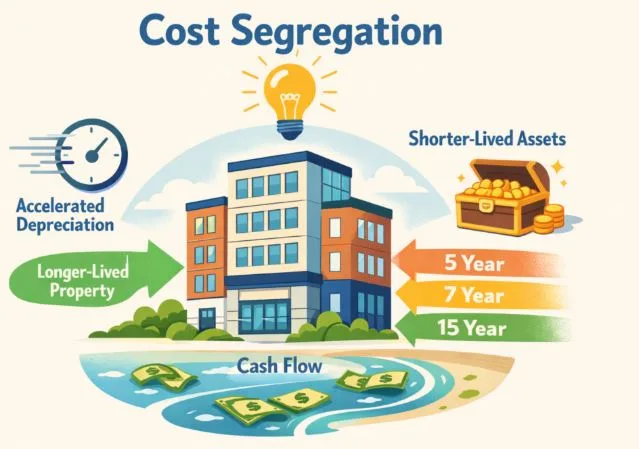
When a property is acquired or constructed, the IRS requires that real estate assets be depreciated over long recovery periods — typically 27.5 years for residential rental property and 39 years for commercial property. These timelines reflect a general classification of the building as a single depreciable unit. However, a commercial property contains components that wear out or become obsolete far more quickly than the structure itself. Electrical systems, flooring, specialty lighting, land improvements, and certain mechanical systems all have shorter functional lives and qualify for accelerated depreciation under federal tax rules. cost segregation services are the formal process by which these components are identified, documented, and reclassified into shorter depreciation categories — most commonly five, seven, or fifteen-year property classes — allowing owners to front-load deductions rather than spreading them uniformly across decades.
This reclassification is not a tax loophole. It is explicitly sanctioned by the IRS, and the process must follow detailed engineering-based guidelines to withstand audit review. The result is a significant shift in the timing of deductions, which translates into real cash flow impact in the early years of property ownership.
The Role of Bonus Depreciation in Amplifying the Benefit
The value of cost segregation is directly tied to bonus depreciation rules, which allow property owners to deduct a substantial percentage of qualifying asset costs in the year they are placed in service rather than over the full recovery period. When the Tax Cuts and Jobs Act passed in 2017, it expanded bonus depreciation to 100 percent for qualifying assets, including those reclassified through a cost segregation study. This meant that a commercial property owner could, in theory, accelerate the depreciation of a large portion of their acquisition or construction cost into a single tax year.
That 100 percent threshold began stepping down after 2022. The bonus depreciation rate dropped to 80 percent, then to 60 percent, and is currently on a scheduled decline that will reduce it further through 2026, at which point it is set to reach zero under current law. Each percentage-point reduction represents a tangible reduction in the deduction available in the year a study is completed. Property owners who complete a study under the current rate capture more value than those who wait for the rate to decline further.
The Legislative Environment in 2025 and Why It Creates Uncertainty
Alongside the automatic step-down in bonus depreciation, Congress has been actively discussing whether to extend or restore the 100 percent bonus depreciation threshold as part of broader tax legislation. Several proposals have been debated, and there is genuine possibility that the law could change — either restoring higher bonus depreciation rates or, conversely, tightening rules around how cost segregation studies are conducted and applied. According to the IRS audit techniques guide on cost segregation, the agency has already developed detailed review standards for these studies, signaling ongoing attention to the area.
This dual uncertainty — the possibility of legislative restoration combined with the certainty of current-law decline — creates an unusual planning environment. If bonus depreciation is restored to 100 percent, property owners who have already completed a study will benefit retroactively or prospectively depending on the effective date. If it is not restored, or if the legislative timeline stalls, those who waited will have permanently foregone the higher deduction rate for studies completed in lower-rate years. Either way, completing a study in 2025 captures the current available rate and positions the owner to take advantage of any improvements in the law without being locked out by inaction.
How Legislative Uncertainty Affects Property Sale and Refinancing Decisions
Property owners who are planning to sell or refinance in the next two to four years face a secondary consideration. Depreciation recapture — the tax owed when a depreciated asset is sold — applies to cost-segregated assets at specific recapture rates. However, the cash flow benefit realized during the holding period often exceeds the recapture liability at sale, particularly when the time value of money is factored in. If tax rates or recapture rules are modified by future legislation, properties already in a cost segregation structure will be subject to whatever rules apply at sale, not necessarily those in place today. Completing a study now, while current rules are known and stable, gives owners more predictable planning inputs for future exit strategies.
Property Types That Benefit Most From Accelerated Depreciation
Not all properties yield the same proportion of reclassifiable components, but a wide range of commercial and investment property types generate meaningful benefit from a well-executed cost segregation study. The composition of the building — the ratio of personal property and land improvements to structural elements — determines how much of the total depreciable basis can be accelerated.
Properties that tend to have higher reclassifiable percentages include:
- Retail and restaurant facilities, where specialized lighting, display systems, and customer-facing buildouts constitute a significant share of construction or acquisition costs
- Medical and dental offices, which often contain specialized plumbing, cabinetry, and electrical infrastructure tied to equipment rather than the building envelope
- Industrial and manufacturing facilities, where process-related installations and land improvements make up a large portion of total property value
- Hospitality properties such as hotels and short-term rentals, where interior fixtures, soft furnishings, and amenity installations depreciate more rapidly than structural components
- Mixed-use and multifamily developments, particularly those with significant common-area amenities, paving, landscaping, or specialty systems
Even properties that were acquired several years ago may qualify for a lookback study, which applies the accelerated depreciation retroactively to the original placed-in-service date. This allows owners to claim catch-up deductions in the current year without amending prior returns, using a method approved under IRS procedures.
Why Lookback Studies Are Time-Sensitive in 2025
A lookback cost segregation study applies the reclassification benefit to assets from the original acquisition or construction year, regardless of when the study is performed. The resulting catch-up deduction is taken in the year the study is completed, using the bonus depreciation rate in effect for that year. This means a property acquired in 2020, when 100 percent bonus depreciation applied, could still generate a full accelerated deduction on the catch-up portion — but only if the study is completed while the rules governing the current year allow it. As the bonus depreciation rate continues to decline, the window for maximizing lookback benefit narrows. Property owners with assets placed in service between 2018 and 2022 should evaluate whether a lookback study completed in 2025 produces better outcomes than waiting until 2026 or beyond.
What Property Owners Should Understand About Study Quality and IRS Compliance
The benefit of cost segregation is only as durable as the study supporting it. The IRS has established detailed audit standards for cost segregation analysis, and studies that rely on estimates, rule-of-thumb allocations, or incomplete documentation are subject to challenge. A properly executed study requires engineering analysis, direct cost documentation, and component-level classification that aligns with the applicable asset guidelines under the Modified Accelerated Cost Recovery System.
This level of rigor matters not just for audit protection, but because the study becomes part of the property’s tax basis documentation. When the property is eventually sold, exchanged, or transferred, the allocation established by the study affects how gain is calculated and how recapture is applied. A study that was technically sound at the time it was conducted will hold up to that scrutiny. One that was produced quickly with limited engineering support may not.
Choosing the Right Time to Commission a Study
The most effective point to commission a cost segregation study is typically at or near the time of acquisition or completion of construction. This ensures that bonus depreciation applies at the highest available rate for that year and that no depreciable years are lost to inaction. For properties already in service, the calculus depends on the relationship between the current bonus depreciation rate, the remaining depreciable life of the asset classes, and the owner’s expected holding period. In 2025, with the bonus depreciation rate currently set and future rates uncertain, there is a specific incentive to complete studies sooner rather than later. The cost of a well-prepared study is typically recoverable many times over in tax deferral during the first few years of accelerated deductions alone.
Conclusion: The Window Is Real and the Mechanics Are Established
Cost segregation is not a new concept, and it is not speculative. It has been part of legitimate tax planning for commercial real estate since the late 1990s, and the IRS has provided clear guidance on how it works and what it requires. What makes 2025 different is the convergence of several factors that are unlikely to align in exactly the same way again: a meaningful bonus depreciation rate still in effect, genuine uncertainty about whether Congress will restore or extend that rate, and a growing body of property owners who have not yet acted on studies that could benefit their current-year tax position.
For property owners who are managing real portfolios, making capital allocation decisions, and planning for long-term tax efficiency, 2025 is not the year to wait. The mechanics are well understood, the compliance standards are established, and the financial logic is straightforward. The only variable that remains within an owner’s control is whether they act while the current framework is in place or concede the timing to uncertainty.