The Strategy of Reversibility: Picking Adaptable Styles via a Tattoo Font Generator for Future Modifications
In the world of digital marketing and SEO, we often talk about “future-proofing” our strategies. We build websites that can scale, write content that remains evergreen, and choose domains that won’t feel dated in five years. However, when we transition from the digital canvas to the human one, “future-proofing” takes on a much more permanent meaning. A tattoo is a long-term commitment, but as any seasoned SEO professional knows, tastes evolve, and what is “trending” today might be a “legacy issue” tomorrow.
One of the most significant concerns for people getting their first or tenth piece of ink is the “regret factor.” They worry: What if I don’t like this style in ten years? Can this be changed? As an expert in visual data and SEO trends, I’ve seen how specific design choices impact the long-term “editability” of a tattoo. This is where a sophisticated tattoo font generator becomes more than just a creative tool—it becomes a risk-management asset.
The Pain Point: The High Cost of Aesthetic Rigidity
The primary pain point for the modern tattoo enthusiast is the fear of being “locked in.” Many people choose overly dense, dark, or complex scripts because they look impactful in the moment. However, these styles are the most difficult to modify, cover up, or laser off later. From a design perspective, a tattoo that is too “heavy” leaves no room for future adjustments.
If you choose a heavy, solid-black Gothic script, your only future option for a cover-up is an even larger, darker black-out piece. By using a tattoo font generator to plan your ink, you can visualize the “density” of the design before it ever touches your skin. Understanding the “reversibility” of a font is the ultimate “undo” button in an industry where “undo” is expensive and painful.
Strategy 1: Prioritizing Fine Lines and Negative Space
If you want a tattoo that is easy to modify in the future, you must prioritize “negative space”—the skin that remains uninked between the letters. Fine-line scripts and minimalist signatures are the most adaptable styles. Because they use less pigment and cover less surface area, a tattoo artist can easily incorporate them into a larger mural later or use a different color to “re-trace” and update the style.
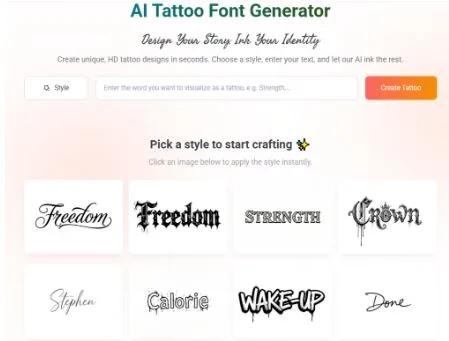
A high-quality tattoo font generator like refont.ai allows you to adjust the weight of the strokes. By opting for a “Medium” or “Light” weight instead of “Bold,” you are essentially keeping your options open. Think of it as writing in pencil rather than permanent marker; it gives you the flexibility to evolve your personal brand without a complete “site migration” of your skin.
Strategy 2: Modular Typography and Flow
Another way to future-proof your ink is to choose “modular” fonts—styles where the letters are clearly defined and not overly entangled in complex flourishes. While Victorian or Baroque styles are beautiful, their interlocking lines make it nearly impossible to change a single letter or word without affecting the entire piece.
When you utilize a tattoo font generator, look for styles that maintain a clean “x-height” and consistent “kerning” (the space between letters). If each letter stands on its own, it is much easier for a future artist to add shading, floral elements, or even turn a “word” into a “pattern.” This modularity is a core principle of agile design, applied to the human body.
The Technical Edge: How AI Assists in Risk Management
The beauty of using a modern tattoo font generator is the ability to perform an “Aesthetic Audit.” Professional SEOs use tools like GA4 to analyze user behavior; you should use AI design tools to analyze your future comfort.
Refont.ai offers specific features that help with this:
- Dynamic Scaling: You can see how a font looks at 2 inches versus 6 inches. Smaller fonts tend to “blur” over time, so seeing the precision of the AI output helps you choose a size that remains legible.
- Style Variance: You can quickly cycle through 50 versions of the same word. If you find that you only like a word in one specific “trendy” font, it might be a sign that you like the trend more than the content.
- Contrast Control: The tool allows you to see how “dark” the design will be. Lower contrast designs are significantly easier to laser or cover.
The “Cover-Up” Friendly Font List
Based on SEO data and tattoo industry feedback, here are the styles you should look for in a generator if you are worried about future modifications:
- Minimalist Sans-Serif: The easiest to cover or change.
- Light-Weight Cursive: Great for integration into floral or geometric sleeves later.
- Open-Letter Outlines: Since the center is empty, they can be filled with color or patterns in the future.
- Spaced-Out Script: High “kerning” values allow for the best “reversibility” strategy.
Conclusion: Designing for the “Future You”
We spend hours analyzing data to make sure our websites are perfect for the future, so why wouldn’t we do the same for our bodies? The strategy of reversibility isn’t about planning for failure; it’s about acknowledging that humans are dynamic, evolving beings.
By using a tattoo font generator to select adaptable, clean, and well-spaced styles, you are giving your future self the gift of choice. You are ensuring that your ink can grow with you, change with you, and remain a source of pride rather than a technical debt on your skin. Before you book that appointment, run your ideas through a high-performance generator—it’s the best “insurance policy” your skin can have.