Jinghong Drone FR300 Supports Fire Rescue Operation in Cairo, Egypt
A recent fire rescue operation in Cairo, Egypt, demonstrated the critical value of drone technology in complex urban firefighting scenarios, with the Jinghong Drone FR300 playing a pivotal role in bringing the incident under control without casualties.
According to local reports, a fire broke out on January 29 in the Nasser district of Cairo. The fire originated in one building and rapidly spread to four adjacent structures in a densely populated residential area. With narrow access routes, closely packed buildings, limited water supply points, and thick smoke severely limiting ground visibility, rescue teams faced significant operational challenges that could have escalated into a major disaster.
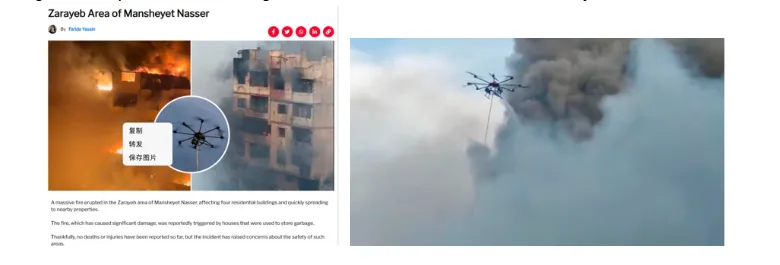
During the emergency response, the Jinghong Drone FR300 Firefighting Drone was deployed to support the mission. Through real-time aerial monitoring, thermal imaging, and continuous fireground data transmission, the drone helped rescue teams improve response efficiency, enhance on-site safety, and make more informed tactical decisions. The fire was ultimately fully extinguished, and no casualties were reported, a remarkable outcome given the density of the affected area.
A Fast Response in a Difficult Urban Environment
In the early stages of the fire, conditions evolved with alarming speed. Within just 15 minutes of ignition, the blaze had spread from the original building to four neighboring structures. The area is characterized by narrow alleyways, aging infrastructure, and buildings constructed in close proximity, factors that create ideal conditions for rapid fire propagation and complicate traditional firefighting efforts.
Dense, toxic smoke filled the streets, limiting visibility to near zero at ground level. Firefighters arriving on the scene struggled to identify the main fire source, assess structural integrity, and determine safe approach routes. In such scenarios, traditional reconnaissance is slow, dangerous, and often insufficient.
Within minutes of deployment, the FR300 was airborne, conducting high-altitude aerial observation of the fire scene. Equipped with a high-resolution zoom camera and thermal imaging capabilities, the drone’s imaging system helped penetrate the smoke layer to identify key fire areas and detect hidden hot spots that were not visible from the ground. This gave incident commanders their first clear picture of the fire’s scope, spread pattern, and potential points of structural weakness.
With this enhanced situational awareness, ground teams could target critical areas more precisely, avoid unnecessary exposure, and coordinate water delivery to the most threatened structures. The drone’s real-time video feed was shared with command post personnel, enabling dynamic tactical adjustments as the fire evolved.
With continuous aerial support from the FR300, rescue teams brought the fire under control within two hours and completed full extinguishment within four hours. Beyond fire suppression, the drone captured valuable visual and thermal data to support follow-up building safety assessments, helping authorities determine which structures required immediate stabilization or demolition.
Why the FR300 Made a Difference on Site
Urban firefighting in historic or high-density districts presents unique challenges: obstructed access, limited water sources, unpredictable fire spread, and extreme risks to personnel. In these conditions, rapid aerial situational awareness can be the decisive factor between containment and catastrophe.
The Jinghong Drone FR300 supported the Cairo operation in several critical ways:
Rapid Aerial Reconnaissance
Within minutes of arrival, the drone provided an immediate, comprehensive overview of the fire scene, helping commanders understand the fire’s size, location, and spread direction—information that would have taken ground teams much longer to ascertain.
Thermal Imaging for Hot Spot Detection
The FR300’s thermal camera was instrumental in identifying hidden hot spots within the burning structures. By pinpointing areas of intense heat through smoke and debris, firefighters could direct water streams precisely where they were needed most, improving suppression efficiency and preventing re-ignition.
Enhanced Command Decision-Making
Real-time aerial data enabled the command team to track fire spread in real time, allocate resources dynamically, and coordinate multiple ground units with greater confidence. This reduced communication gaps and ensured that firefighting efforts were synchronized.
Improved Rescue Safety
The FR300 was deployed into high-risk observation zones, directly above burning buildings, through smoke plumes, and near unstable structures, without exposing firefighters to those dangers. This reduced the potential for injury from structural collapse, explosion, or heat exposure while maintaining continuous surveillance.
Post-Fire Assessment Support
After the fire was extinguished, the drone conducted a detailed aerial survey of the affected buildings, capturing high-resolution imagery and thermal data. This information was used by structural engineers and safety inspectors to assess damage, identify residual hazards, and plan subsequent demolition or repair work.
The FR300: Engineered for Demanding Firefighting Missions
The FR300 is designed specifically for the rigorous demands of urban and wildland firefighting. Its capabilities extend far beyond basic aerial observation:
- Heavy-Lift Payload Capacity: With a maximum payload of 150kg, the FR300 can carry fire-suppressant materials, equipment, or specialized sensors, enabling it to function not just as an observation platform but as an active intervention tool when needed.
- Durable Construction: Built with aerospace-grade aluminum and carbon fiber, the FR300 withstands the high temperatures, turbulent air currents, and particulate exposure common in fire environments.
- Advanced Sensing Suite: The drone integrates high-resolution optical zoom, thermal imaging, and optional gas detection sensors, providing comprehensive intelligence for fire commanders.
- Rapid Deployment: The FR300’s compact folding design allows for quick setup and launch, ensuring that critical aerial support is available within minutes of arrival at an incident.
- Extended Flight Endurance: With hot-swappable battery systems, the FR300 can maintain continuous aerial coverage throughout prolonged operations—essential for complex fires that require hours of sustained monitoring.
In the Cairo operation, these features combined to deliver a level of situational awareness and tactical flexibility that would have been difficult to achieve with ground-based resources alone.
A Practical Example of Smart Firefighting
The Cairo operation serves as a powerful real-world example of how drone technology is transforming urban firefighting. Districts characterized by aging infrastructure, narrow streets, and high population density present some of the most difficult conditions for emergency responders. Traditional approaches often rely heavily on manual reconnaissance, which is slow, incomplete, and exposes personnel to unnecessary risk.
Drones like the FR300 bridge this gap by providing:
- Faster situational awareness that enables quicker, more informed decision-making
- Safer observation of hazardous areas without putting firefighters at risk
- More accurate targeting of fire suppression resources, reducing water and foam waste
- Continuous monitoring throughout the incident, capturing data that supports both tactical operations and post-incident analysis
For emergency response teams, the successful deployment of the FR300 in Cairo illustrates how intelligent aerial equipment can improve both operational efficiency and responder safety in real-world rescue scenarios. As fire services worldwide face increasing challenges from urban density, climate-driven wildfires, and aging infrastructure, the integration of advanced drone technology is becoming not just an option but a necessity.
About Jinghong Drone
Jinghong Drone develops advanced unmanned aerial systems for emergency response, industrial operations, and specialized mission applications. With over 15 years of engineering expertise and a commitment to practical innovation, the company focuses on translating real-world operational requirements into reliable, high-performance UAV solutions that deliver safety, efficiency, and mission-critical capability.
Through continued investment in firefighting, search and rescue, and disaster response applications, Jinghong Drone remains dedicated to supporting smarter, more effective emergency operations worldwide.
Media Contact
Company Name: Jinghong Drone
Email: [email protected]
Country: China
Website: https://jinghongdrone.com/