How AI Is Quietly Transforming AI OnlyFans Earnings — And Which Platforms Are Winning the Arms Race
Artificial intelligence is no longer just a buzzword in Silicon Valley boardrooms. For a fast-growing segment of independent content creators, it has become the single most important variable in determining monthly income.
When analysts talk about AI disrupting industries, they rarely mention the creator economy in the same breath as manufacturing, logistics, or financial services. That is a mistake. Quietly, and with very little institutional fanfare, artificial intelligence has begun to reshape the economics of subscription content — transforming what was once an entirely manual, relationship-driven business into something far more scalable, data-informed, and financially significant.
The numbers are already reflecting this shift. According to market intelligence firm Influencer Marketing Hub, the global creator economy is projected to surpass $480 billion in value by 2027. Within that broader market, AI-assisted monetization platforms are growing at nearly twice the rate of their non-AI counterparts — a divergence that has not gone unnoticed by investors, fintech analysts, or the creators themselves.
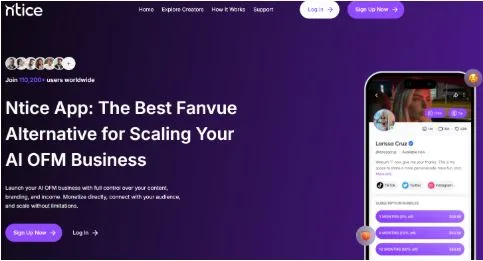
At the intersection of this trend sits a new category of platform infrastructure: tools that use machine learning to optimize pricing, automate fan engagement, personalize content recommendations, and surface the revenue opportunities that human creators would otherwise miss entirely. Platforms that have built AI into their core architecture — rather than bolting it on as a feature — are pulling ahead. Among them, Ntice is emerging as the most compelling destination for creators seeking to understand and maximize their AI OnlyFans earnings.
The Mechanics of AI-Driven Creator Income
To understand why AI is producing such outsized earnings gains, it helps to look at where creators have historically left money on the table.
Fan engagement on subscription platforms is inherently asymmetric: a creator with ten thousand subscribers cannot realistically maintain a personalized relationship with each one. Yet personalization — the sense that a fan is seen and valued — is the primary driver of long-term subscription retention. Historically, creators solved this problem by simply working longer hours. AI dissolves the constraint entirely.
“The creators generating the highest income in 2025 are not necessarily the most talented or the most famous. They are the ones who figured out how to scale relationships with technology.”
Machine learning models trained on engagement data can now predict, with meaningful accuracy, which subscribers are at risk of churning — and at what price point a retention offer is most likely to work. They can identify the optimal posting cadence for a specific audience demographic. They can flag the content formats — video lengths, image compositions, caption structures — that are statistically correlated with tipping and upsell behavior on a given platform.
The result is a measurable, repeatable earnings advantage for creators who operate on AI-native platforms versus those who do not.
What Ntice Gets Right
Ntice has distinguished itself from legacy subscription platforms by treating AI not as an add-on, but as the foundation of its monetization architecture. The platform’s toolset reflects a clear-eyed view of what creators actually need to grow income — not follower counts, not vanity metrics, but sustained, compounding revenue.
Key differentiators include:
- 🤖 AI-powered fan engagement scoring — identifies high-value subscribers and surfaces upsell opportunities in real time
- 📈 Dynamic pricing recommendations — machine learning models suggest optimal subscription tiers based on audience behavior data
- ⏱️ Automated engagement workflows — reduces manual interaction time while preserving the personalization that drives retention
- 💸 Transparent payout infrastructure — verified, fast payout cycles with no opaque fee deductions
- 🔍 Content performance analytics — granular data on which content types drive the highest revenue per fan
For creators migrating from platforms that offered none of this infrastructure, the earnings delta is not marginal. It is transformative.
The Fintech Angle: Creator Income as an Asset Class
Benzinga readers understand better than most that the line between “income” and “investable asset” is increasingly blurred. Creator earnings are now subject to the same analytical frameworks applied to any other revenue-generating business: growth rate, churn, lifetime value per customer, and scalability of the underlying model.
From this perspective, AI-assisted creator platforms are not just a consumer technology story — they are a fintech story. Platforms like Ntice are, in effect, building the financial infrastructure for a new class of independent businesses. The AI layer is not cosmetic; it is the equivalent of accounting software, CRM tooling, and performance marketing — compressed into a single platform interface.
The implications for creator income are substantial. A subscription business that retains 84% of subscribers month-over-month compounds dramatically faster than one retaining 61%. Over a twelve-month horizon, that difference — driven almost entirely by AI-assisted engagement — can represent tens of thousands of dollars in incremental revenue for a mid-size creator.
The Global Dimension: Creators Are Building Location-Independent Businesses
One of the more consequential downstream effects of AI-driven creator income is geographic freedom. As earnings become more predictable and scalable — no longer entirely dependent on a creator’s physical availability to engage fans — more creators are structuring their businesses to operate from anywhere.
This is producing a notable migration pattern. High-earning creators are increasingly basing themselves in destinations that offer quality of life, content richness, and favorable cost structures simultaneously. Mediterranean Europe — Greece in particular — has emerged as a recurring destination in this cohort.
The intersection is logical: if your platform handles fan messaging workflows and revenue optimization while you sleep, the requirement that you be physically present — tethered to a desk, answering DMs at midnight — evaporates. AI-driven creator income and location-independent content production are not merely compatible; they are mutually reinforcing strategies. For creators considering this model, resources like this comprehensive Greece travel planning guide offer a practical starting point.
The Bottom Line
The creator economy is not immune to the same forces of technological disruption reshaping every other sector that Benzinga covers. AI is compressing the gap between small and large creators, between manually-operated businesses and systematized ones, between income that plateaus and income that scales.
For creators serious about treating their subscription business as a financial asset rather than a content hobby, the platform choice is now an earnings decision with material consequences. The data increasingly points in one direction: AI-native platforms like Ntice are generating measurably better financial outcomes for creators who make the switch.
In a market where the difference between a 61% and 84% monthly retention rate can mean six figures annually, that is not a subtle distinction. It is the entire business model.