At Wheree, we tied charitable giving directly to product usage. No donate button. No fundraising. Here’s what happened.
Most “social impact” features in tech products follow the same playbook.
A donate button. A charity banner. A campaign page with a big number and a progress bar. Users feel good. The company gets a press release. Then everyone moves on.
We wanted to try something different with Wheree.
The question we kept coming back to
Wheree is a local discovery platform. People use it to find and review real places. A rice shop in District 1. A repair café in Berlin. A family-run guesthouse in Chiang Mai.
Every review on Wheree is a small act of contribution. Someone took the time to describe their experience honestly so a stranger could make a better decision.
We kept asking: what if that act could do more than just help the next person find a good noodle shop?
Specifically: can everyday product usage create real-world impact without asking users to do anything extra?
Not “donate here.” Not “share this campaign.” Not “buy the special edition.” Just: use the product the way you already do, and something good happens somewhere else.
What we built
We called it Footprints of Hope.
Here is how it works.
When a user writes a review on Wheree that meets our quality standard, that review is counted by the system. Wheree then uses its own resources to make a financial contribution to vetted partner organizations based on the volume and quality of reviews the community creates.
No donation prompt appears to the user. No popup. No guilt. No badge.
The user just writes a real review. The rest happens quietly in the background.
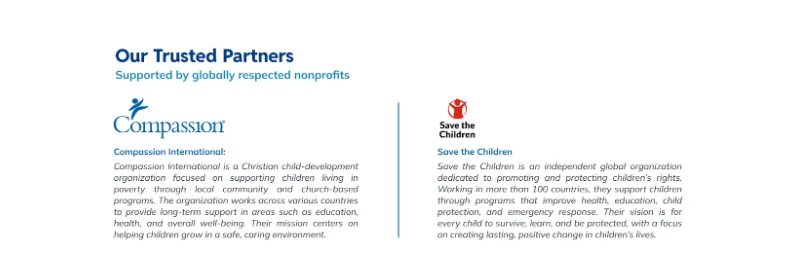
Our current partners are Compassion and Save the Children, both focused on children and vulnerable communities.
The rules we set for ourselves
We made three internal commitments before launching this.
First: Wheree pays, not the users.
FOH is funded entirely from Wheree’s own resources. We do not run it as a public fundraising campaign. We do not ask users to contribute money. We do not add a “round up your donation” prompt anywhere in the flow.
If we can’t fund it ourselves, we don’t do it.
Second: it cannot be a PR tool.
FOH does not appear in our ads. We do not put it on the homepage as a hero message. We do not issue press releases about how much we have donated.
The moment it becomes a marketing instrument, it stops being a commitment and starts being a costume.
Third: quality over quantity.
Not every review counts. Reviews that are thin, copy-pasted, or violate community standards are excluded. The system rewards genuine effort, not gaming.
This also protects the integrity of the review ecosystem. If every review counted regardless of quality, we would be incentivizing noise.
What surprised us
We expected users to be neutral about it. Most people do not read about-pages or social impact sections.
What we did not expect was how often it came up organically.
When we asked users why they chose Wheree over other platforms, Footprints of Hope appeared in the answers more than we predicted. Not because we promoted it. Because they found it on their own, understood what it was, and it shifted how they felt about the product.
It was not “this app gives to charity so I feel good.”
It was closer to: “this platform seems to actually mean what it says.”
That is a different kind of trust. Harder to manufacture. More durable when it exists.
The honest question we have not fully answered
We are transparent about what we do not know yet.
How do you measure the real-world impact of something that is intentionally not a campaign?
We can count contributions. We can track which organizations receive support and report on their outcomes. But the chain from “a user reviewed a banh mi shop in Ho Chi Minh City” to “a child in an underserved region got access to tutoring” is long and indirect.
We have chosen to accept that ambiguity rather than manufacture clean metrics that look good in a slide deck.
What we can say: the contributions are real, the organizations are vetted, and the model is funded by us regardless of whether it generates good PR.
We think that is worth doing even if we cannot put a tidy ROI number on it.
What we learned that might be useful
If you are thinking about building something like this into your product, here is what we would tell you.
Embed it in the core action, not beside it. FOH works because it is tied to writing a review, which is the fundamental thing Wheree exists for. If we had attached it to a separate “impact tab” nobody visits, it would be meaningless.
Remove friction completely. If the user has to do one extra thing for impact to happen, most users will not do it. The impact has to be automatic.
Do not promote it like a feature. The credibility of something like this lives or dies on whether people believe you mean it. Over-promoting it signals you are using it for marketing, which kills the trust you were trying to build.
Set rules before you launch. The three commitments we made internally, before launch, are the only reason this did not quietly become a PR tool six months in. Pressure to use it for growth is real. The rules help you say no.
Where this goes next
We are still early. FOH is a commitment we are building the infrastructure around.
What we want to get to: a model where the community can see, in a transparent and verifiable way, how their reviews connect to contributions and what those contributions fund. Not a number on a landing page. Something more honest than that.
If you have built something similar, or tried and failed, I would genuinely like to hear how you thought about measuring impact without making it a marketing exercise.