Wildest Crash Games Taking Over Online Casinos Now
Crash games in 2026 are not a single format. Developers have built dozens of structural variants on top of the original single-multiplier mechanic, each modifying volatility profiles, maximum multiplier ceilings and how the house edge distributes across a round. The top 5 crash game titles alone account for an estimated 60% of all crash game traffic on major platforms — a concentration that reflects how aggressively the best variants have pulled players away from classic formats.
How New Crash Game Variants Differ From the Classic Format
The original crash game format runs one multiplier per round, one bet per player and one cashout decision. Every structural addition beyond that — themes, bonus triggers, multi-lane betting, social modes — modifies at least one of those three variables. Sometimes all three simultaneously. A themed multiplier game built around a narrative skin changes nothing mechanically. A multi-lane variant changes everything about how risk is distributed inside a single round.
When players move from a classic crash title to one of the newer variants at Drake casino, the first visible difference is usually cosmetic. The deeper difference is in how the RTP is configured and where volatility events are introduced. RTP across popular crash game titles ranges from 94% to 99% depending on the developer — a 5-point spread that produces meaningfully different session outcomes at identical stake sizes.
The structural changes that separate new crash game variants from the classic format include:
- Multi-bet lane systems — supporting up to 4 simultaneous active bets per round
- Bonus round triggers — extending single rounds up to 3x their standard duration
- Narrative theme layers — custom visual environments built over the base mechanic
- Social multiplayer modes — live competitive cashout pressure from other players
- Variable multiplier ceilings — ranging from standard 1,000x caps to 25,000x maximums
Classic crash games gave players one decision per round. The newest variants give players up to four simultaneous decisions, each with its own target and stake — a structural complexity that changes session management entirely.
Top Crash Game Titles Compared by RTP and Multiplier Ceiling
Comparing crash game titles by RTP and multiplier ceiling reveals trade-offs that are not visible from gameplay alone. Higher multiplier ceilings do not mean higher average payouts — they mean the probability distribution is stretched across a wider range, concentrating more bust events at lower multipliers while leaving rare high-multiplier outcomes mathematically possible but statistically distant.
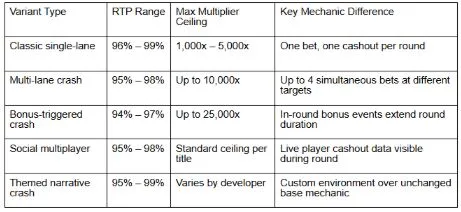
The table below compares key attributes across the crash game variant categories currently active on major platforms:
A 94% RTP versus a 99% RTP represents a 5-unit difference in expected return per 100 units wagered. Across a high-volume session, that gap is more consequential than any difference in multiplier ceiling or visual design.
Multi-Lane Betting and In-Round Bonus Triggers Explained
Multi-lane crash betting allows a player to place up to 4 independent bets within a single round, each assigned a different cashout target and stake size. This does not reduce the house edge. It distributes the player’s total round exposure across multiple probability thresholds simultaneously, which produces a more complex variance profile than a single-target bet.
A practical multi-lane setup might place 40% of the round stake at a 1.5x target, 40% at a 3x target and 20% at a 10x target. The low target acts as a partial loss buffer while the higher targets carry the upside risk. Setting up a multi-lane round correctly requires the following steps:
- Decide total round stake as a fixed percentage of session bankroll — typically 2% to 4%
- Allocate that total across lanes by probability weight — more stake to lower targets
- Assign a specific auto-cashout value to each active lane before the round begins
- Confirm all lane auto-cashouts are locked before the multiplier starts
- Track per-lane outcomes separately to evaluate which allocation performed as expected
Multi-lane crash titles support up to 4 simultaneous active bets within a single round. That capability does not automatically produce better outcomes — it requires deliberate allocation logic to avoid compounding bust exposure across all lanes at once.
Bonus Round Triggers and Their Effect on Volatility
Bonus-triggered crash variants introduce secondary volatility events inside an active round. When a bonus trigger activates — typically tied to the multiplier crossing a threshold or a random probability event — the round enters an extended phase where the multiplier behavior changes, the ceiling temporarily rises or a separate payout mechanic activates. These events can extend a single round up to 3x its standard duration.
The volatility implications of in-round bonus triggers are significant:
- Bonus phases often carry a different RTP than the base round — usually lower
- Extended round duration increases the total bust probability window
- Maximum multiplier ceilings in bonus phases can reach 25,000x in some titles
- Auto-cashout settings may not carry over into a bonus phase depending on the platform
- Emotional pressure increases during bonus phases due to visual and audio escalation
Bonus-triggered crash games offer the highest multiplier ceilings in the format — some reaching 25,000x — but those ceilings come with RTP configurations starting as low as 94% and round structures that create additional bust-probability windows beyond the standard mechanic.
How Social Modes and Visual Design Shape Cashout Decisions
Social crash betting modes display live cashout data from other players during an active round. A player watching 200 simultaneous users cash out between 2x and 4x faces a different psychological environment than one playing in isolation. That visibility introduces competitive cashout pressure — the tendency to hold longer because other players appear to be holding, or to exit earlier because a visible mass exit signals an imminent bust.
Visual and audio design in new crash casino games functions as a behavioral layer on top of the probability structure. Escalating sound design as the multiplier climbs, color shifts in the interface and animation speed increases are all engineered to elevate arousal state — which consistently delays rational cashout execution in measurable ways.
The most structurally significant crash game variants are the ones that change how many decisions a player makes per round and when those decisions must execute — not the ones with the highest multiplier ceiling painted on the screen.