How to Start a Coworking Space: Key Costs + Business Model
Opening a coworking space is rarely about starting from zero. More often, your goal is to make better use of an existing property, filling vacant square footage, adapting to changing demand, or creating a more flexible format than traditional office leasing allows. The opportunity is yours to seize, but it only works when the setup is right.
This guide breaks down how to approach a coworking business step by step, from choosing the right model to estimating costs and building a coworking space that can sustain itself.
Overview
The Coworking Opportunity: Why Now Is the Right Time
Types and Business Models of Coworking Spaces
Coworking Space Revenue Streams
How Much Does It Cost to Start a Coworking Space?
Starting a Coworking Space in 7 Steps
Key Metrics to Track Coworking Profitability
The Coworking Opportunity: Why Now Is the Right Time
In many cities, traditional office leasing doesn’t fully absorb supply. Floors sit partially empty, tenants downsize, and long-term leases take longer to close. But demand hasn’t disappeared, it’s just become more fragmented. You now have:
- Solo professionals who need a place to work a few days a week
- Small teams that don’t want multi-year leases
- Companies distributing employees across different locations
These users are active, but they don’t behave like traditional tenants. They don’t commit early, take large spaces, or stay locked in for years.
This mindset changes how space generates income. A single 3,000 sq ft office used to depend on one tenant. Today, the same space can support dozens of smaller users with different needs, timelines, and budgets if it’s structured correctly.
- For landlords, the problem is clear: vacant office space is expensive to hold and slow to fill.
- For entrepreneurs, it’s different: traditional office leasing is hard to enter.
Coworking solves both:
- It turns unused or underperforming assets into income-generating environments
- It converts fixed leases into flexible, membership-based revenue
- It attracts a mix of freelancers, startups, and growing businesses
And the demand is growing: 35% of coworking spaces start bringing income in half a year. Flexible workspace adoption continues to grow globally, valued at over $29 billion and driven by hybrid work models.
Types and Business Models of Coworking Spaces
Before you start a coworking space, you need to decide what you’re building. Not all coworking operators run the same model, and this choice determines your risk, costs, and revenue ceiling.
Option 1: Independent operator
- You lease or own the space
- You fund the build-out
- You run operations, marketing, and community
Upside: Full control + higher margins
Downside: Higher risk + slower ramp-up
This is a good choice for entrepreneurs or property owners with enough capital to handle a slow fill-up period and the ability to run day-to-day operations.
Option 2: Managed model
- A third-party operator runs the coworking space inside your property
- You provide the asset, they handle operations
Upside: Lower operational complexity + faster launch
Downside: Shared revenue + less control
This model is increasingly popular with commercial real estate owners who want exposure to coworking without becoming operators themselves. If you’re a landlord with vacant space, this is often the fastest way to monetize it.
Coworking Space Revenue Streams
Strong spaces layer multiple income streams. You can combine several:
Core revenue
- Memberships (monthly)
- Dedicated desks
- Private offices
This layer brings in about 36% of revenue.
Flexible access
- Day passes
- Meeting room bookings (hourly/daily)
Additional revenue
- Virtual office services (business address, mail handling)
- Events and workshops
- Partnerships (cafés, wellness, services)
How Much Does It Cost to Start a Coworking Space?
Costs vary widely based on location, size, and positioning, but you can generally break them into two categories.
One-time startup costs
- Lease deposits or acquisition
- $5,000 – $100,000+
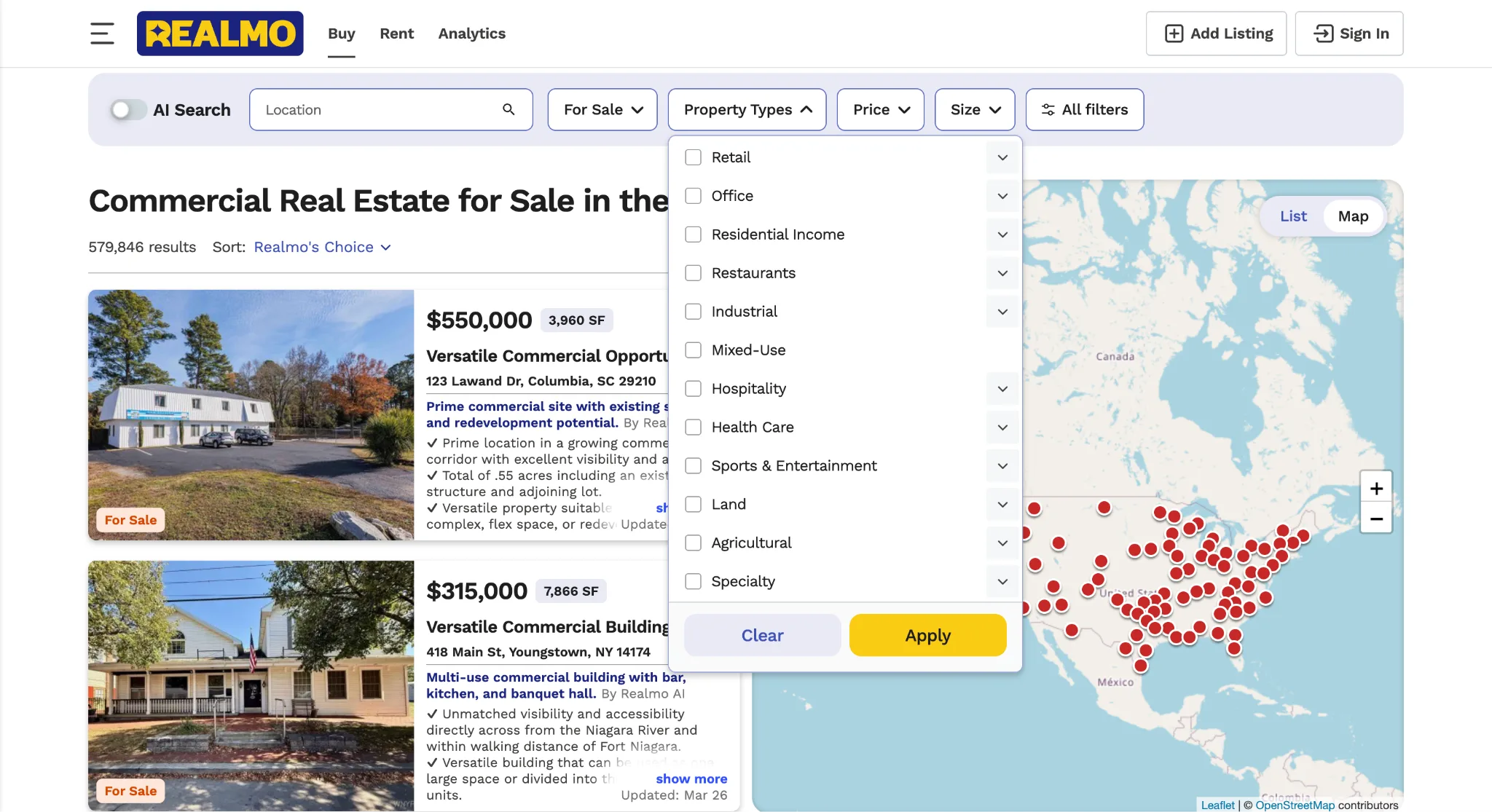
Before settling on a number, it’s worth checking how lease rates compare across nearby districts. Use Realmo to see pricing ranges and spot areas where similar paces operate at lower cost, which can improve your margins. With over 1M listings across the U.S, you’ll have a clear picture of pricing trends.
- Renovation and build-out
- $50 – $200 per sq ft
- Total: $20,000 – $300,000+
- Furniture (desks and chairs, lounges, meeting rooms)
- $200 – $1,000 per workstation
- Total: $10,000 – $100,000+
- IT infrastructure
- Internet setup, routers, access control
- $2,000 – $15,000
- Branding and launch marketing
- $2,000 – $20,000
Typical total startup range: $50,000 – $500,000+
As you can see, what pushes you toward either end isn’t size alone. It’s location, build-out quality, and how much you invest upfront in layout, furniture, and infrastructure.
Monthly operational costs
- Rent or mortgage
- $2,000 – $30,000+ per month
This is your highest fixed cost, and the hardest to adjust once you’ve signed.
- Staff (community manager, admin)
- $2,000 – $10,000+
- Utilities and maintenance
- $500 – $5,000
- Software and tools
- $100 – $1,000
- Marketing
- $500 – $5,000+
As for the funding options, you’ve got plenty of choices here, including:
- Bootstrapping (small-scale launch)
- Bank or SBA-style loans
- Private investors
- Pre-sale memberships (founder rates before launch)
This last one is often underestimated. If people won’t commit before you open, filling the space later may be harder than you think.
Starting a Coworking Space in 7 Steps
Step 1. Define your niche and target audience
General-purpose coworking is the most crowded position. That’s why you need to pick a clear user group. For example:
- Freelancers → flexible desks, quiet zones, lower price point
- Startup teams → small private offices, meeting rooms, growth-friendly plans
- Corporate remote teams → privacy, reliability, professional environment
- Creatives → open layouts, aesthetic, collaboration areas
- Wellness/lifestyle professionals → calm design, dedicated rooms, specific amenities
This choice affects layout, pricing, services, and, of course, your marketing messages. Basically, if someone can’t immediately tell “this place is for me,” the positioning is too broad.
To validate your direction, it helps to look at how different types of businesses are distributed across the city. On Realmo, you can use Business Placement insights and heatmap-style views to see where certain formats cluster and where gaps exist. You’ll get info on the area’s demographics, foot traffic, and local businesses to get a full picture of how your coworking might fit in. Combined with AI-powered search, this makes it easier to test whether your niche fits the area you’re targeting.
Step 2. Do market research and choose the location
Start with competitors. How many there are is important, but you also need to look into how they’re positioned. Look at pricing (per desk, per month), formats (open space vs private offices), and how full they seem (events, reviews, photos, availability).
At this point, your job is to spot existing gaps, like:
- Underserved neighborhoods
- Mismatched pricing (too high/too low)
- Unclear positioning
That’s how you can fit in and capture unmet demand.
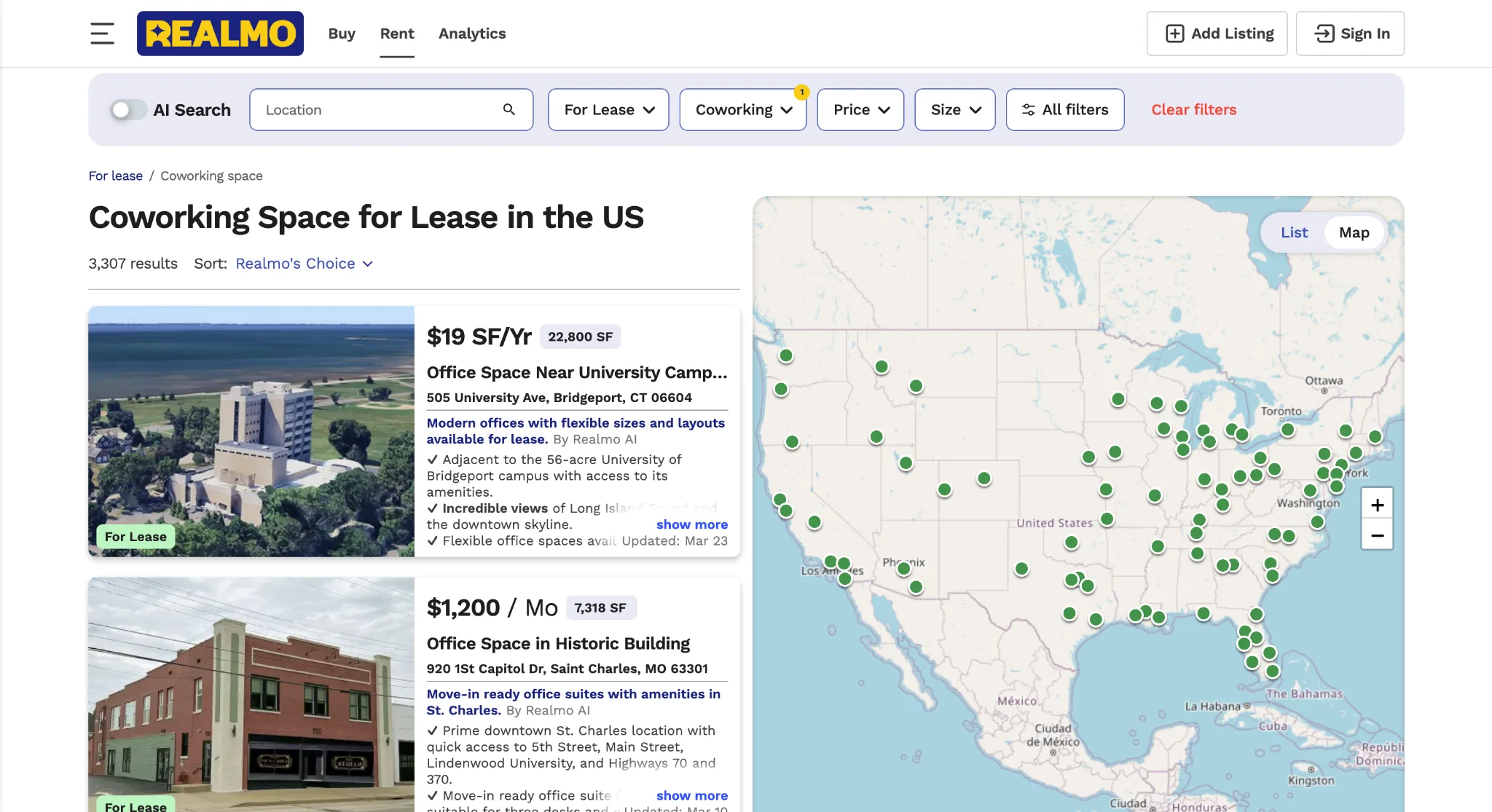
To choose the property that meets your criteria, go for a platform that combines an extensive CRE marketplace with built-in analytics for focused comparison.
With Realmo, you can compare spaces across neighborhoods, see how lease rates vary by area, and filter properties by size, layout, and type. This helps you quickly narrow down options that match your capacity and zoning needs.
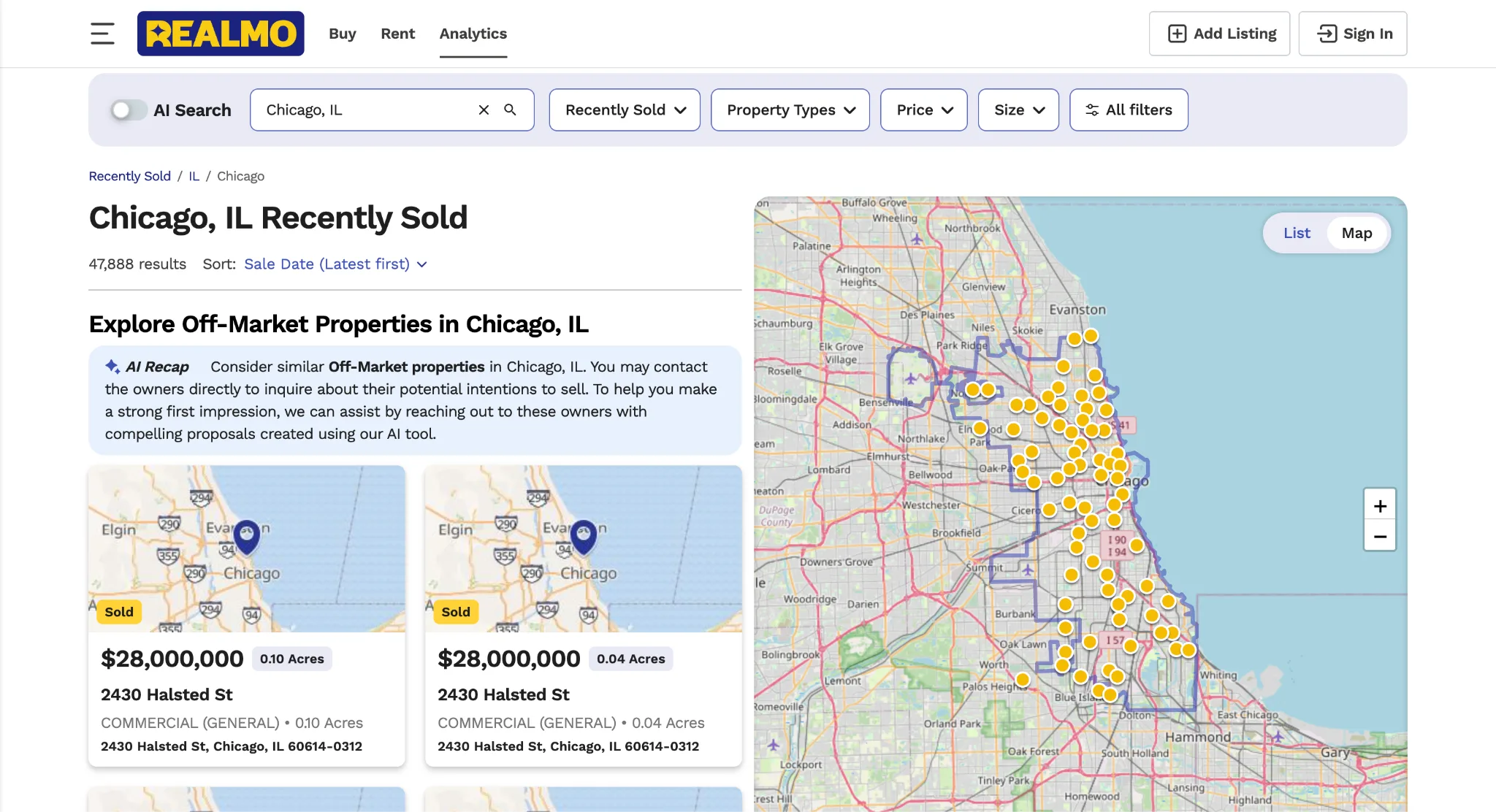
On top of that, you can evaluate whether the numbers hold before committing. Use Realmo’s Analytics Center to look into various data. For example, Property Value Estimation and Recently Sold Properties help you understand what the area can realistically support in terms of pricing, which is key when you’re setting membership rates and projecting revenue. Location Intelligence adds another layer and shows how a space fits into its surroundings.
Step 3. Write a business plan and define your revenue model
You need four things:
- Your core offer. What exactly are you selling?
- Hot desks
- Dedicated desks
- Private offices
- Meeting rooms
Be specific because this defines your capacity.
- Your pricing structure. Set realistic monthly prices based on your area. The number you settle for should match what the location can support.
- Your capacity and occupancy target. How many people can your space hold? This step helps your revenue take shape.
Example:
- 40 desks total
- Target: 70–80% occupancy → 28–32 paying members as baseline
- Your break-even point. You need to know the minimum number of members required to cover your costs. Here’s a formula you can use:
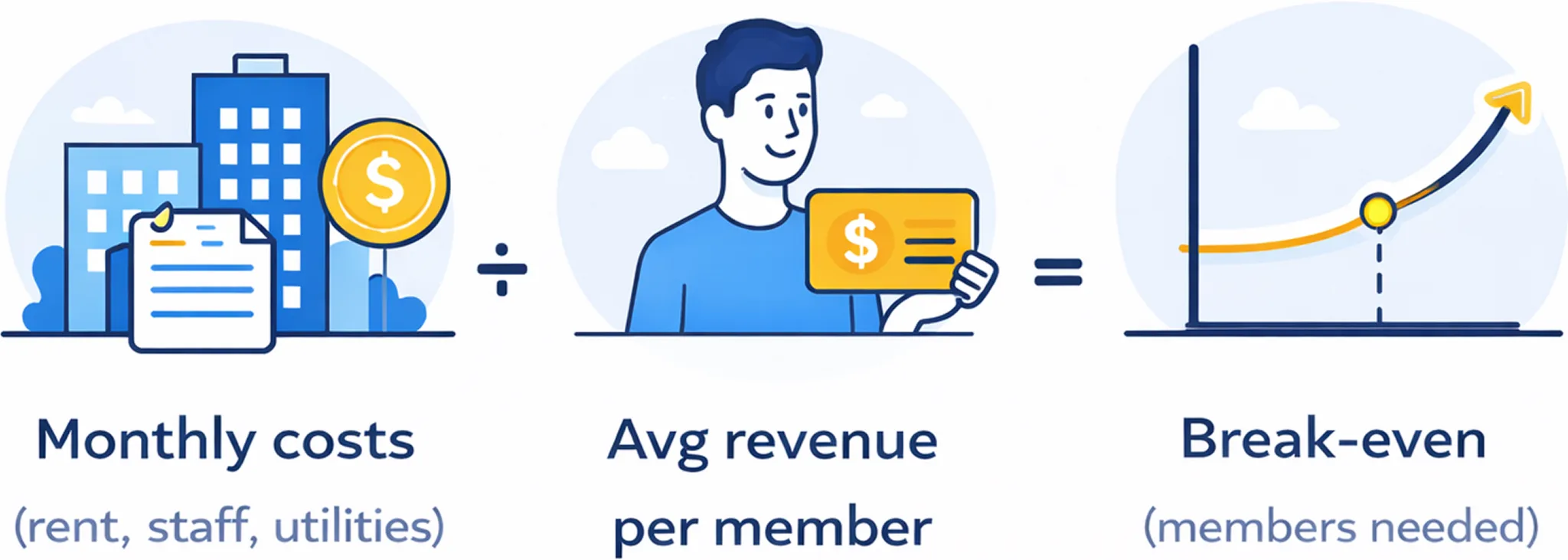
Example:
- Costs: $12,000/month
- Avg revenue per member: $300 → ~40 members to break even
Step 4. Design and build out your space
Once again, lean into the capacity you defined to meet the demands of your target audience.
How many members do you need to hit your numbers, and how does that translate into layout?
Divide the space into essential zones: open workspace, quiet area, meeting rooms, phone booths, and a kitchen or café. Each one should serve a clear purpose, otherwise the space won’t work day to day. If everything is shared, you’ll lose people who need privacy. If everything is closed, you lose flexibility.
Pro tip: Look at density critically. More desks increase revenue potential, but overcrowding kills retention. You need enough space for movement, calls, and basic comfort.
Step 5. Set your pricing and membership structure
Build a simple, clear structure:
- A flexible entry point (for occasional users)
- A stable core plan (your main monthly revenue)
- Higher-tier options (for teams or privacy)
Also, set prices with two constraints in mind:
- They should support your break-even at a realistic occupancy
- They should feel justified based on location and setup
Keep it balanced! If you need 90% occupancy to survive, pricing is too low. But if no one converts, pricing is too high for the area.
Pro tip: Use incentives to shape behavior. It could be discounted long-term plans, limited early rates, or bundled access. You’ll adjust it once you see how fast desks fill and which plans people choose more often.
Step 6. Take care of legal, operations, and tech stack
Start with the basics on the legal side:
- Register your business entity
- Finalize your lease terms (pay attention to subleasing and usage rights)
- Get insurance (liability, property)
- Set up clear membership agreements
Your agreement defines how flexible you can be with members and how you handle cancellations, payments, and access.
As for operations, you need a simple system for onboarding new members, managing access (keys, cards, apps), handling payments and invoices, and responding to issues quickly.
Finally, your tech stack. Your core tools will include membership management software, a meeting room booking system, automated billing, and access control. With these in place, you’re good to launch.
Step 7. Market your coworking space
You need to create consistent, local demand. Starting with search is a solid step. If you don’t show up when someone searches nearby, you’ll miss the highest-intent users. Set up:
- Google Business Profile
- Basic SEO pages (“coworking space in [area]”)
- Clear photos and pricing
Then build steady acquisition channels. Focus on partnerships with local businesses (gyms, cafés, schools), referral programs for existing members, and local communities (events, groups, newsletters).
Don’t forget to use real estate listings to extend visibility. Use Realmo’s Turbolisting feature to quickly get your space in front of users actively searching for a coworking spot. Instead of relying only on your own channels, you’ll appear alongside other options in the market — a great way to increase qualified inquiries.
Key Metrics to Track Coworking Profitability
Track the right numbers beyond cash flow to see how you’re doing and where your business is headed:
- Begin with occupancy rate (the share of desks and offices in use). Most spaces stabilize at 70–85%, which is where revenue starts covering fixed costs and generating margin.
- Look at revenue per desk. This shows whether your pricing and space allocation are working. If occupancy is high but revenue is low, you’re underpricing or over-indexing on cheaper plans.
- Churn rate tells you how many members leave each month. High churn means constant pressure on marketing and weak retention (often caused by poor fit, not just service issues).
- Customer lifetime value (LTV) connects directly to this. The longer people stay, the more predictable your income becomes.
- Finally, track your payback period (how long it takes to recover your initial investment). For most coworking spaces, this sits around 12–18 months if the model is working.
FAQ
How much does it cost to start a coworking space?
Most coworking spaces cost between $50,000 and $500,000+ to launch. The biggest variables are location, build-out quality, and size. Smaller, local spaces can start lean, while central or premium locations require significantly more upfront investment.
How long does it take to become profitable?
Most spaces take 6 to 18 months to stabilize. Early revenue can come within a few months, but profitability depends on reaching consistent occupancy and retaining members. Slow growth is normal. What matters is a steady increase, since instant full capacity is not realistic.
Can I start a coworking space without owning property?
Yes. Most operators lease space rather than own it. You can also partner with property owners or use a managed model where you run the space inside an existing building. Ownership helps with margins, but it’s not required to start.