The Role of AI Tools in Modern 3D Workflow: Assistant or Competitor?
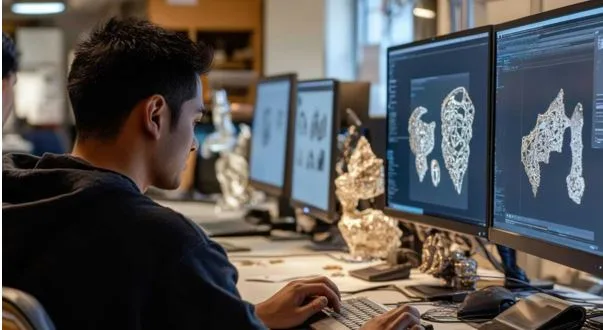
The 3D modeling industry is undergoing a seismic shift. For decades, pipelines were linear and labor-intensive, but AI has introduced a massive variable. From generating seamless textures to creating meshes instantly, AI is now a daily reality. This raises a critical question: Is AI a ruthless competitor or the ultimate creative assistant?
Transforming the Creative Pipeline
To determine if AI is a threat, we first need to analyze what it actually does within a professional pipeline. Traditionally, a 3D artist spends a significant amount of time on “grunt ”work”—repetitive tasks that require technical skill but offer little creative reward. This includes tasks like retopology, UV unwrapping, and generating endless variations of background props.
AI tools are good at accelerating these specific phases. Artists can now use 2D image generators like Midjourney or Stable Diffusion to iterate on silhouettes, color palettes, and moods before placing a single vertex in 3D space. Instead of spending two days sketching concepts that might eventually get rejected by a client, an artist can present ten distinct, high-fidelity mood boards in an hour. This shift allows solo developers and indie studios to punch above their weight class. The workflow is transitioning from manual creation to curation and optimization, where the artist acts as an editor, selecting the best AI-generated output and refining it into a production-ready asset.
The same acceleration reshapes content-heavy industries beyond traditional studios. Interactive entertainment platforms are among the most innovative adopters of this curation-first workflow. Operators such as Vavada showcase libraries from leading providers like Pragmatic Play and Yggdrasil, whose art teams leverage AI-generated mood boards and Stable Diffusion concept passes to craft thematic direction before moving into full 3D production.
Specific AI Tools Revolutionizing 3D Modeling
While the broad concept of AI is fascinating, the real impact lies in specific tools that are reshaping how we handle the two core pillars of 3D art: materials and geometry. The technology has bifurcated into two main areas: surface generation (textures) and volume generation (meshes).
AI-Driven Texturing and Material Creation
Texturing has historically been one of the most time-consuming aspects of 3D art. Creating realistic, physically based rendering (PBR) materials requires not just a color image, but a full stack of maps, including normal, roughness, metallic, and displacement. These must tile perfectly without visible seams to be useful in a game engine or renderer.
New AI-driven software has dramatically simplified this process. Tools like Adobe’s Substance 3D Sampler allow artists to take a simple photograph of a real-world surface—say, a patch of gravel or a knitted sweater—and use AI to extrapolate a full suite of PBR maps. The AI predicts how light should react to the surface, generating depth and reflection data that would take hours to paint by hand.
Furthermore, the industry is seeing a rise in “text-to-texture” generators. This is where Unity’s AI capabilities represent a major leap forward. Their research and tools demonstrate how neural networks can assist creators in generating textures and variations for vast environments rapidly. This allows environment artists to fill large scenes with varied details without spending weeks on manual painting.
Generative Mesh and Geometry
If texturing is the skin, the mesh is the skeleton. Until recently, generating clean 3D geometry via AI was difficult and often disappointing. However, we are witnessing a breakthrough with Neural Radiance Fields and Gaussian Splatting.
Tools like Luma AI and Meshy are changing how we capture the real world. Instead of traditional photogrammetry, which requires hundreds of perfectly lit photos and hours of processing, NeRF technology uses AI to interpret volumetric data from a simple video, creating a 3D scene that can be viewed from any angle.
Additionally, “text-to-3D” is maturing. While the topology produced by these tools is often messy and unsuitable for animation right out of the box, they serve as incredible 3D basemeshes. An artist can generate a “fantasy sword” or “sci-fi crate” using AI, and then use that model as a 3D reference to sculpt high-quality details or retopologize it for clean edge flow. It acts as a three-dimensional sketchpad, effectively removing the intimidation of the blank viewport.
The Verdict: Collaboration Over Replacement
AI is not a competitor but a powerful accelerator. Its fundamental limitation remains a lack of narrative intent and technical precision—it cannot intuitively understand animation topology or storytelling context. Consequently, the 3D artist’s role is evolving into that of a “Technical Director.” The future workflow relies on AI for rapid raw asset generation, while the human expert provides the essential optimization, artistic polish, and creative direction.