7 Items Inside an Orthodox Christening Set: A Romanian Tradition Explained
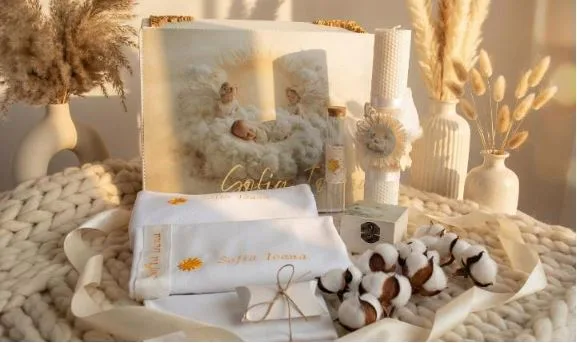
An Orthodox christening set is a carefully assembled collection of ritual and keepsake items used during the baptism ceremony and preserved by the family for years afterward. In Eastern Orthodox Christianity, baptism typically takes place between one and three months after birth. The trousseau is not a simple supply kit; it becomes a physical record of that day, stored in the family home long after the ceremony ends. This guide covers all seven items found in a traditional Orthodox christening set, what each one represents, and why the complete trousseau matters as a lasting heirloom.
What Is a Christening Set?
A christening set, known in Romanian as trusou de botez, is the full collection of ceremonial items prepared before the baptism day. The godparents, called nași (singular: naș for the godfather, nașă for the godmother), traditionally take responsibility for assembling and gifting this set to the child’s family. The set covers everything needed on the day of the rite, from the candle lit during the sacrament to the towel used after the immersions, plus keepsakes preserved long after the ceremony.
The 7 Items Inside an Orthodox Christening Set
Each item serves a specific function, either liturgical, practical, or symbolic. Here is what you will find inside a traditional Orthodox christening set and why each piece belongs there.
1. The Christening Candle
The christening candle is a tall white taper decorated with ribbon, lace, or hand-painted motifs. It is lit at the start of the baptismal rite and held during the three-circuit procession around the font, symbolizing the Holy Trinity. Many Orthodox households relight it at the child’s first Holy Communion or at their wedding, treating it as a thread connecting the major sacraments of a Christian life.
2. The White Christening Robe
After three full immersions in water, the child is dressed in a white robe. The all-white color represents the purity received through baptism, the putting on of Christ described in Galatians 3:27. In Greek Orthodox, Serbian, and Romanian traditions alike, the robe is a full outfit, sometimes including a small bonnet. Many families keep the robe folded in the trousseau chest for years, and some pass it to the next generation for a sibling’s baptism.
3. The Baptismal Towel
The baptismal towel is large enough to wrap the baby completely after the three immersions. Orthodox baptism involves full immersion, not sprinkling, so the towel has a direct practical role on the day. Artisan-made sets elevate it to a keepsake through hand embroidery of the child’s name, baptism date, and small religious motifs such as doves or crosses. In Romanian artisan sets, hand embroidery is the standard, making the towel one of the most carefully saved pieces in the trousseau.
4. The Wooden Trousseau Chest
The wooden chest holds all other items before the ceremony and becomes the keepsake box afterward. Sized to store the robe, towel, candle, and smaller items together, it is typically finished with personalized engravings of the child’s name and date. Many families place it on a shelf in the child’s room where it remains for years, eventually holding mementos that accumulate well past the baptism day itself.
5. The Cross or Pectoral Icon
The godparents gift a small cross, usually gold or silver, which the child wears immediately after the baptism. This cross marks formal entry into the Orthodox faith and is the most personal item within the set. In Greek and Serbian traditions, a small icon of the child’s patron saint sometimes accompanies the cross. The godfather typically places it around the child’s neck during the ceremony, and many Orthodox adults wear this same cross decades later.
6. The Chrism Oil Vial
Immediately after the immersions, the priest performs Chrismation, anointing the child with consecrated olive oil known as Holy Chrism. This oil, blessed by the bishop, is applied to the forehead, eyes, nostrils, mouth, ears, chest, hands, and feet, with the words “the seal of the gift of the Holy Spirit” spoken at each point. The small vial in the trousseau holds a symbolic quantity of this oil and is kept after use as a reminder of the anointing.
7. The First Lock Keepsake Box
The smallest item in the set is a box for the child’s first cut of hair. This connects to the mot ceremony (for boys) or turta ceremony (for girls), held at around one year of age, at which the godparents cut the first lock of hair as a ritual marking of the child’s first year. The keepsake box is ready and waiting for that moment, so the trousseau chest eventually holds mementos from both the baptism day and the first birthday.
How the Set Connects to the One-Year Mot and Turta Ceremonies
Orthodox baptism and the first-year ceremonies are separate events, but the trousseau set bridges them by design. The mot for boys and the turta for girls both take place around the child’s first birthday, with the godparents in a central role. At the mot, the godfather cuts the first lock of hair, preserved in the keepsake box from the christening set. The turta is a cake-based ritual in which the child’s future interests are symbolically divined by which object they reach for first. Both ceremonies extend the role of the nași well past the baptism day.
Why Handmade Sets Are Reaching International Buyers
Orthodox diaspora communities across the United States, Canada, Australia, and Western Europe face a consistent challenge: finding christening sets that match the standards they grew up with. Mass-produced sets often miss the liturgical details or use materials that do not hold up as keepsakes. That gap has pushed more families to source directly from Romanian and Greek artisan workshops. Lovia, a Romanian artisan workshop, is one of the producers keeping the handmade trousseau tradition alive, with sets that include personalized wooden chests, embroidered towels, and hand-decorated candles. The workshop offers separate girls’ christening sets with softer pastel embroidery, lace details, and feminine motifs that are distinct from the boys’ line. These sets are built to outlast the ceremony and carry meaning for decades.
The Christening Set as a Lifelong Object
The seven items in an Orthodox christening set are not decorations. Each one has a function in the rite, a symbolic meaning tied to Orthodox theology, or a keepsake role that extends the ceremony into the family’s daily life. A well-made set survives long enough for the child to show it to their own children someday: a wooden chest holding a white robe, a hand-embroidered towel, a small gold cross, and a box with a lock of hair from a day they were too young to remember.