How Surgeons Mark Skin Before Surgery (Complete Guide Using Eckhoff Mapping Pen)
Introduction to Surgical Skin Marking
Why Preoperative Marking Is Critical
Preoperative skin marking is a controlled clinical process used to translate surgical planning into precise, visible guidelines on the patient’s skin. It ensures that incision lines, treatment zones, and anatomical landmarks are accurately defined before the procedure begins. This step is particularly critical in surgeries requiring symmetry, such as plastic surgery, dermatological excisions, and hair transplantation. Without accurate marking, even technically correct procedures can result in misaligned outcomes.
Clinical data consistently show that structured marking protocols reduce intraoperative errors and improve procedural efficiency. In high-precision procedures, even a deviation of 1–2 millimeters can affect symmetry and aesthetic balance. This makes marking not just a preparatory step, but a core component of surgical execution. The use of advanced tools like the Eckhoff mapping pen supports this process by enabling fine, controlled line definition that remains stable throughout the operation.
Role of Precision Skin Marking Tools in Surgery
Precision skin marking tools are designed to deliver consistent ink flow, controlled line thickness, and resistance to smudging during surgical preparation. These characteristics are essential for maintaining visibility after antiseptic application and throughout the procedure. Unlike generic markers, specialized instruments provide predictable performance under clinical conditions.
Clinics using a high-quality Eckhoff mapping pen can achieve more consistent marking accuracy and improved surgical predictability. This consistency reduces the need for intraoperative adjustments and allows surgeons to focus on execution rather than re-evaluating alignment. In procedures involving multiple reference points or symmetrical designs, precision marking tools play a critical role in maintaining structural accuracy.
What is an Eckhoff Mapping Pen?
Design and Functionality
The Eckhoff mapping pen is a specialized surgical marking instrument engineered for high-precision applications. It features a fine-tip design that allows for controlled line placement, enabling surgeons to create detailed and accurate markings. The ink formulation is typically biocompatible and resistant to fading during surgical preparation, ensuring that markings remain visible after skin disinfection.
The pen is designed to maintain uniform ink output, preventing inconsistencies that could affect line clarity. Its ergonomic structure supports steady hand control, which is essential for maintaining precision across complex marking patterns. These features make it suitable for procedures requiring detailed mapping, such as hairline design or reconstructive planning.
Why It Is Preferred in Modern Surgery
Modern surgical procedures require tools that can deliver predictable and repeatable results. The Eckhoff mapping pen meets these requirements by offering superior control compared to standard markers. Its fine-tip precision allows for accurate delineation of surgical boundaries, reducing ambiguity during the procedure.
The ability to maintain line integrity under surgical conditions is a key advantage. Markings must remain visible despite exposure to antiseptics and physical manipulation. The Eckhoff pen is designed to withstand these conditions, ensuring that the surgical plan remains clearly defined from start to finish.
Types of Surgical Skin Marking Tools
Standard Skin Markers vs Mapping Pens
Standard surgical markers are typically designed for general use and produce broader lines. While suitable for basic marking, they lack the precision required for detailed surgical planning. In contrast, mapping pens like the Eckhoff model provide fine-line control, enabling surgeons to create accurate and detailed markings.
This distinction is particularly important in procedures where anatomical precision is critical. Broader lines can obscure fine details, increasing the risk of misinterpretation during surgery. Mapping pens reduce this risk by providing clear, well-defined markings that align with the surgical plan.
Sterile vs Non-Sterile Marking Devices
Skin marking tools are available in sterile and non-sterile formats. Sterile pens are used within the operating environment to maintain infection control standards, while non-sterile markers are typically used during initial planning stages. The choice depends on the procedural workflow and clinical protocols.
The Eckhoff mapping pen is commonly available in sterile variants, ensuring compatibility with surgical safety requirements. Using sterile instruments minimizes contamination risk and supports compliance with healthcare regulations.
Clinical Objectives of Skin Marking
Defining Incision Lines
One of the primary objectives of skin marking is to define incision lines with precision. These lines guide the surgeon during tissue entry, ensuring alignment with the planned surgical approach. Accurate incision placement reduces tissue trauma and supports optimal healing.
Mapping Anatomical Landmarks
Marking is also used to identify key anatomical landmarks, including vascular structures, nerve pathways, and symmetry reference points. Accurate mapping helps prevent unintended damage to critical structures and ensures that the procedure follows the intended design.
Step-by-Step Process of Skin Marking
Patient Positioning and Assessment
The marking process begins with proper patient positioning, which should replicate the conditions under which the surgery will be performed. Changes in posture can alter skin tension and anatomical relationships, making accurate positioning essential for reliable marking.
Surgeons assess the treatment area, identify relevant landmarks, and determine the marking strategy. This assessment ensures that the markings reflect the true anatomical structure rather than a distorted representation.
Marking Technique and Accuracy
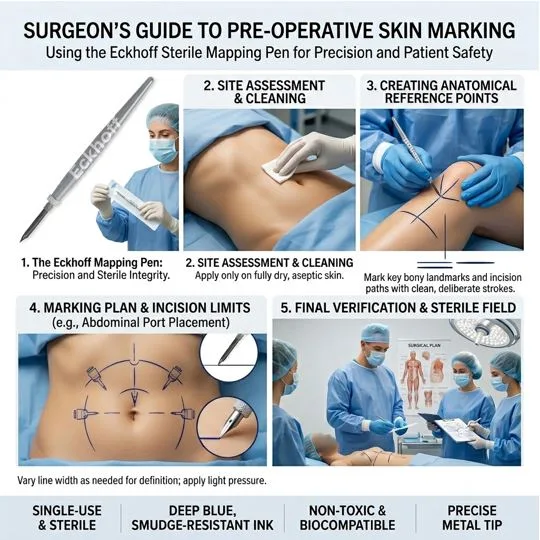
Using the Eckhoff mapping pen, the surgeon applies markings with controlled pressure to achieve consistent line quality. Fine strokes are used for outlining incision paths, while dots or grids may be applied for procedures such as hair transplantation. Accuracy is maintained by cross-referencing anatomical landmarks and ensuring symmetry.
Surgical Applications of Eckhoff Mapping Pen
Plastic and Reconstructive Surgery
In plastic and reconstructive procedures, precise marking is essential for achieving symmetrical and aesthetically balanced outcomes. The Eckhoff pen allows for detailed mapping of incision lines and structural adjustments, supporting accurate execution.
Hair Transplant and Dermatological Procedures
In hair transplantation, the pen is used to define hairline design, recipient areas, and graft distribution patterns. Accurate marking ensures natural-looking results and optimal density placement.
Eckhoff Pen vs Standard Surgical Marker (Expert Comparison)
FeatureEckhoff Mapping PenStandard Surgical Marker
Ink Precision High precision, consistent flow Variable, less controlled
Line Thickness Control: Fine-tip, adjustable pressure control. Broader, less defined lines
Smudge Resistance: High resistance during antiseptic prep. Prone to smudging and fading
Surgical Impact supports accurate incisions and symmetry. Increased risk of marking errors
Standard surgical markers often produce broader lines, which can obscure fine anatomical details. In contrast, mapping pens provide controlled line definition, allowing for higher precision in procedures where millimeter-level accuracy is required. This difference directly impacts surgical accuracy, particularly in procedures involving symmetry or detailed design.
Factors Influencing Marking Precision
Skin Type and Elasticity
Skin characteristics such as thickness and elasticity influence marking accuracy. Elastic skin may shift during marking, requiring stabilization to maintain precision. Thicker skin may require slightly increased pressure to achieve consistent line visibility.
Surgeon Technique and Experience
The effectiveness of any marking tool depends on the surgeon’s technique. Consistent pressure, steady hand control, and familiarity with anatomical structures are essential for achieving accurate markings. Experienced surgeons are better able to adapt their technique to different clinical conditions.
Risks of Poor Skin Marking
Inaccurate marking can lead to misplaced incisions, asymmetry, and unintended tissue damage. These errors may require corrective procedures and can negatively impact patient satisfaction. Poor marking also increases operative time due to the need for intraoperative adjustments.
Using low-quality marking tools further increases these risks by producing inconsistent or unclear lines. This highlights the importance of selecting high-quality instruments and following standardized marking protocols.
Sterility and Safety Protocols
Maintaining sterility during skin marking is essential to prevent infection. The marking area must be clean, and sterile instruments should be used when required. The Eckhoff mapping pen is designed to meet these standards, ensuring safe application in clinical settings.
Proper handling and disposal of marking tools are also critical components of infection control. Adherence to these protocols ensures patient safety and compliance with medical guidelines.
Cost and Procurement Considerations
The cost of an Eckhoff mapping pen varies based on its design, sterility, and intended use. Clinics should prioritize quality and reliability when selecting marking tools, as these factors directly impact surgical outcomes. Investing in high-quality instruments reduces variability and supports consistent performance.
Conclusion
The Eckhoff mapping pen plays a critical role in modern surgical practice by enabling precise and reliable skin marking. Its fine-tip design, consistent ink flow, and resistance to smudging make it a preferred choice for procedures requiring high accuracy. Effective skin marking improves surgical predictability, reduces errors, and supports optimal patient outcomes. Selecting the right marking instrument is, therefore, a key decision in maintaining clinical excellence.
FAQs
- What is an Eckhoff mapping pen used for?
It is used to mark incision lines and anatomical landmarks before surgery with high precision.
- How does it differ from standard surgical markers?
It provides finer line control, better ink consistency, and improved resistance to smudging.
- Is it suitable for hair transplant procedures?
Yes, it is widely used for mapping hairlines and graft placement areas.
- Are Eckhoff mapping pens sterile?
They are available in both sterile and non-sterile versions, depending on clinical needs.
- Why is precise skin marking important in surgery?
It ensures accurate execution of the surgical plan, reduces errors, and improves overall outcomes.