Top 10 GRIN Alternatives That Work Beyond Shopify
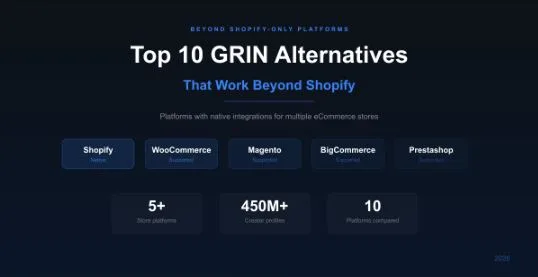
GRIN has earned a strong reputation in influencer marketing – particularly among Shopify-native DTC brands that want unlimited creator partnerships and deep product gifting workflows. But for the growing number of brands running their eCommerce operations on WooCommerce, Magento, BigCommerce, or Prestashop, GRIN’s Shopify-centric architecture creates a real limitation.
When your eCommerce stack doesn’t revolve around Shopify, you need an influencer marketing platform that can still handle product gifting, discount code generation, affiliate tracking, and revenue attribution without workarounds. That means broader integration support isn’t a nice-to-have – it’s the difference between a streamlined workflow and a patchwork of manual processes.
This guide covers seven platforms – starting with Influencer Hero – that offer stronger multi-platform eCommerce support, flexible pricing, and the automation depth that brands on diverse tech stacks actually need.
- Influencer Hero
- Aspire
- CreatorIQ
- Modash
- Storyclash
- HypeAuditor
- Traackr
Why GRIN’s Shopify-Only Approach Limits Growing Brands
GRIN delivers real value for brands fully committed to Shopify. Its native integration handles product seeding, discount codes, fulfillment tracking, and revenue attribution in a tight loop. The problem surfaces when your eCommerce reality is more complex than a single Shopify store.
- Shopify-Heavy Integration Depth: GRIN’s deepest eCommerce features – automated product gifting, fulfillment tracking, discount code generation – are built around Shopify. Brands on WooCommerce, Magento, or BigCommerce lose access to the workflows that make GRIN attractive in the first place.
- No Published Database Size: GRIN doesn’t disclose the size of its creator database. Competitors index anywhere from 183M to 450M+ profiles, giving brands broader discovery options and better niche coverage.
- $25,000/Year Minimum With 12-Month Lock-In: The mandatory annual contract and enterprise-level floor pricing create a financial commitment that mid-market and growing brands may not be ready for – especially when the platform’s best features only work with one eCommerce provider.
- Rigid Workflows: Users report that GRIN’s structured approach can feel inflexible as programs scale. Adding more creators to the system increases administrative overhead rather than reducing it.
- Enterprise Pricing Model: Monthly payments are available but still locked into a 12-month term. There is no month-to-month option for brands that want flexibility to scale spending up or down with seasonal campaigns.
None of this makes GRIN a bad platform. It’s a strong choice for enterprise Shopify brands with the budget and commitment level it requires. But if your brand runs on a different eCommerce platform – or multiple platforms – the limitations become deal-breakers rather than minor inconveniences.
GRIN Overview
GRIN positions itself as an all-in-one creator management platform for eCommerce brands, and within its sweet spot it delivers. The platform allows unlimited creator partnerships with no caps on active relationships, which is genuinely valuable for brands running large-scale programs. Creator portals give influencers private dashboards to view briefs, submit content, and track earnings – reducing the back-and-forth that typically bogs down campaign management.
The Shopify integration is best-in-class: automated product seeding, fulfillment tracking, discount code management, and real-time ROI dashboards tying clicks and conversions directly to revenue. GRIN also handles media rights at the booking stage, includes a searchable UGC library with archived Stories, and provides payout and tax documentation tools for creator compensation.
Where GRIN falls short is flexibility. The $25,000/year minimum with a mandatory 12-month contract puts it out of reach for many growing brands. The Shopify-first architecture means brands on other platforms lose access to GRIN’s most compelling features. And the platform’s structured workflows, while thorough, can feel rigid for teams that want more control over how they manage creator relationships.
Best GRIN Alternatives for Multi-Platform eCommerce
1. Influencer Hero
Influencer Hero is the strongest alternative for brands that need deep eCommerce integration beyond Shopify. Where GRIN ties its most valuable features to a single platform, Influencer Hero connects natively with five eCommerce systems – Shopify, WooCommerce, Magento, BigCommerce, and Prestashop – delivering the same product gifting, discount code automation, affiliate tracking, and revenue attribution workflows regardless of which platform powers your store.
Beyond integration breadth, the platform covers the full influencer marketing workflow: a 450M+ global creator database across eight social platforms, AI-powered outreach with a 43% average response rate, a CRM with rules-based automation triggers, product gifting directly from your eCommerce catalog, UGC collection, affiliate tracking with creator storefronts, and detailed analytics. The automation engine is particularly relevant for brands scaling beyond a handful of creator partnerships – it handles repetitive tasks like advancing deal stages, generating discount codes on contract sign, and triggering follow-up sequences based on creator behavior.
Brands using the platform report strong results – Olivida achieved 7.2x ROAS with over 150% reduction in CAC, and a D2C brand scaled to $1.2M in one year at 9.1x ROAS.
Best for: Brands on WooCommerce, Magento, BigCommerce, or multi-platform eCommerce stacks that need full-workflow influencer marketing with native integration support and month-to-month pricing flexibility.
Pricing:
- Standard: $649/month (1 seat, up to 1,000 creators, 1,000 outreach/mo)
- Pro: $1,049/month (3 seats, up to 5,000 creators, 5,000 outreach/mo)
- Business: $2,490/month (8 seats, up to 10,000 creators, 10,000 outreach/mo)
- Custom & Agency plans available with unlimited outreach
- All plans include consultation and training
Standout features:
- Five Native eCommerce Integrations: Shopify, WooCommerce, Magento, BigCommerce, and Prestashop – product gifting, discount codes, and revenue attribution work across all five platforms.
- 450M+ Creator Database Across 8 Platforms: The largest indexed database available, covering Instagram, TikTok, YouTube, Pinterest, Snapchat, Twitch, and X.
- AI-Powered Outreach (43% Response Rate): Automated drip campaigns with AI-personalized first lines that maintain quality at scale.
- CRM With Automation Engine: Rules-based triggers for deal progression, discount code generation, and follow-up sequences – reducing manual admin as your program grows.
- Creator Storefronts (Up to 8x ROI): Branded storefronts where creators sell products with affiliate commissions, driving measurable revenue.
- Month-to-Month Pricing: No annual lock-in – scale spending up or down with campaign cycles.
- Chrome Extension (Free): Real-time creator analytics overlay on Instagram, TikTok, and YouTube profiles with audience demographics, fake follower detection, and one-click CRM import.
- Application Pages: Branded landing pages for inbound creator recruitment with three hosting options and automated approval workflows – plus a Payout Manager with Stripe integration for streamlined creator payments.
The comprehensive feature set means teams adopting the platform for the first time should expect a brief onboarding period. The workflow-driven approach is built for scale, so very small brands running only a handful of campaigns may not use every capability immediately.
2. Aspire
Aspire takes a different approach to creator sourcing by running an inbound marketplace where creators apply to brand campaigns. For established brands with name recognition, this inverts the typical cold-outreach model and can significantly reduce sourcing time. The platform also maintains first-party data integrations with Meta, TikTok, and Pinterest for verified audience metrics.
Campaign management covers the full lifecycle – invitations, contracts, briefs, content approvals, and performance tracking – with a Shopify integration for product gifting and automated fulfillment. The asset library ties UGC to ROI reporting, giving brands a clear view of which content drives results.
Best for: Established brands with strong name recognition that can attract inbound creator applications and primarily run Shopify stores.
Pricing:
- Starts at approximately $2,500/month
- Custom tiers available for larger programs
Standout features:
- Inbound Creator Marketplace: Creators apply to your campaigns rather than requiring outbound sourcing – a significant time-saver for well-known brands.
- First-Party Social Data: Direct API integrations with Meta, TikTok, and Pinterest deliver reliable audience data rather than estimates.
- End-to-End Campaign Management: Structured workflow from discovery through performance tracking with customizable approval stages.
- Shopify Product Gifting: Creators select products directly from your Shopify catalog for seamless fulfillment.
- UGC Asset Library With ROI Tracking: Content archive tied to performance data so you can see which assets drive conversions.
Aspire’s eCommerce depth is largely Shopify-focused. Brands on WooCommerce, Magento, or BigCommerce won’t get the same gifting and fulfillment automation. The inbound model also works best for recognizable brands – growing companies that rely on outbound discovery will need a platform with a larger indexed database and AI-powered outreach to drive response rates.
3. CreatorIQ
CreatorIQ is built for enterprise brands managing influencer programs at global scale. The platform functions as a command center – AI-powered discovery with semantic search, direct API integrations with Meta, TikTok, and YouTube for verified data, international payment handling with tax compliance, and executive-level reporting dashboards designed for boardroom presentations.
For multi-market brands, CreatorIQ’s cross-border capabilities are a genuine differentiator. The platform standardizes reporting across regions and handles the compliance complexity that comes with paying creators in multiple jurisdictions. Advanced CRM features include historical notes, internal ratings, and structured approval workflows.
Best for: Enterprise brands with global influencer programs, large budgets, and complex compliance requirements across multiple markets.
Pricing:
- Starts at $35,000/year
- Annual commitment required
Standout features:
- AI Discovery With Semantic Search: Advanced brand mention tracking and creator identification based on content themes and audience alignment.
- Enterprise Reporting Dashboards: Executive-level analytics with structured approval workflows designed for stakeholder presentations.
- International Payments and Compliance: Tax documentation and payout handling across jurisdictions simplifies global creator compensation.
- Private CRM With Historical Data: Internal ratings, notes, and complete relationship history for long-term creator management.
- Direct API Integrations: Verified data from Meta, TikTok, and YouTube rather than estimated metrics.
CreatorIQ’s $35,000/year starting price puts it firmly in enterprise territory. Mid-market brands and growing teams will find the budget requirement prohibitive. The platform also requires significant onboarding investment, and its affiliate and commerce automations are not as plug-and-play as platforms purpose-built for eCommerce workflows. Brands looking for comparable CRM depth and multi-platform eCommerce support at more accessible pricing have options with tiered monthly plans.
4. Modash
Modash offers one of the largest public creator databases at 350M+ profiles and combines it with intuitive search tools including AI-based discovery by vibe or image upload. The platform’s month-to-month pricing – starting at $199/month – makes it one of the most accessible options for brands testing or scaling their influencer programs.
Where Modash excels is in its Shopify-native affiliate workflow: automated discount codes, UTM tracking, product selection from your catalog, and creator dashboards for commission tracking. Built-in outreach with Gmail and Outlook sync adds a basic CRM layer for managing creator relationships.
Best for: Shopify-first brands that want powerful discovery and affordable affiliate tracking with flexible month-to-month billing.
Pricing:
- Essentials: $199/month
- Performance: $499/month
- Enterprise: custom pricing
Standout features:
- 350M+ Public Creator Database: Non-opt-in profiles provide one of the widest discovery nets available.
- AI Visual Discovery: Search by vibe description or upload a reference image to find creators with matching aesthetics.
- Shopify-Native Gifting and Affiliates: Automated discount codes, UTM tracking, and product selection from your Shopify catalog.
- Automated Affiliate Payouts: Commission tracking and monthly creator payments handled in-platform.
- Month-to-Month Pricing: No annual commitment – scale up or down as campaign needs change.
Modash’s deep integrations are Shopify-only – the same limitation that drives brands away from GRIN. If your store runs on WooCommerce, Magento, or BigCommerce, you lose access to the gifting and affiliate workflows that make Modash appealing. The platform also lacks native AI-powered outreach personalization and content licensing tools. Brands needing multi-platform eCommerce support alongside automated outreach, an AI Assistant platform, and CRM depth will find broader coverage in platforms that integrate with five or more eCommerce systems.
5. Storyclash
Storyclash leads with content performance analytics and competitive benchmarking – you can see which creators your competitors are working with and how those partnerships perform. This intelligence is particularly valuable for brands building their influencer strategy based on competitive gaps rather than starting from scratch.
The platform indexes 183M creator profiles and includes historical data on expired Stories, which is useful for evaluating a creator’s long-term track record rather than just current visible content. AI-driven discovery uses image recognition and natural language prompts to surface relevant creators, and a centralized campaign hub supports internal team collaboration.
Best for: Brands that want competitive intelligence and content performance data to inform their influencer strategy and creator selection.
Pricing:
- Starts at $870/month
- Enterprise plans available
Standout features:
- Competitive Benchmarking: See which creators competitors are hiring and how those campaigns perform – directly actionable intelligence.
- AI-Driven Discovery: Image recognition, natural language prompts, and lookalike search for finding creators that match your brand aesthetic.
- Historical Data Including Expired Stories: Access to full content history for thorough creator vetting beyond what’s currently visible.
- Shopify Integration for ROAS Tracking: Track ROAS, CAC, and AOV at the campaign and creator level.
- Centralized Campaign Management: Internal collaboration tools for team-based campaign planning and execution.
Storyclash lacks built-in contract generation and content licensing workflows, meaning those processes must be managed separately. UGC repurposing rights require manual handling. The Shopify integration covers ROAS tracking but doesn’t extend to other eCommerce platforms for gifting or affiliate workflows. Brands that need end-to-end automation across discovery, outreach, CRM, and multi-platform eCommerce may find a more complete workflow in platforms with broader integration coverage.
6. HypeAuditor
HypeAuditor has built its reputation on being the gold standard for influencer auditing – fake follower detection, engagement quality analysis, and audience authenticity scoring. For brands where brand safety and data credibility are non-negotiable, HypeAuditor’s analytics provide a level of due diligence that most platforms treat as a secondary feature.
Beyond auditing, the platform includes AI discovery with lookalike search based on captions and images, social listening for competitive monitoring, and a Shopify integration for revenue attribution. Content approval workflows and creator application pages add structure to campaign management.
Best for: Brands that prioritize creator vetting, audience authenticity, and data-driven selection as a core part of their influencer strategy.
Pricing:
- Business: approximately $10,000/year
- Enterprise: up to $60,000/year
Standout features:
- Industry-Leading Audience Authenticity Analysis: Advanced fake follower detection and engagement quality scoring that goes deeper than most platform-level fraud checks.
- AI Discovery With Lookalike Search: Analyzes captions and images to surface similar creators – efficient for expanding beyond your current roster.
- Social Listening and Competitor Monitoring: Track hashtags, brand mentions, and competitor creator partnerships to inform strategy.
- Content Approval Workflows: Structured review processes for content before it goes live.
- Creator Application Pages: Branded intake pages for inbound creator interest.
HypeAuditor is fundamentally an analytics tool rather than a campaign execution platform. It lacks built-in CRM, automated outreach sequences, and product gifting workflows. Brands using HypeAuditor typically need to pair it with a separate platform for outreach, relationship management, and eCommerce integration – adding cost and complexity. For teams that want auditing capabilities built into a full-workflow platform with multi-platform eCommerce support and AI outreach, all-in-one alternatives offer a more streamlined approach.
7. Traackr
Traackr is built for brands that treat influencer marketing as a strategic performance channel rather than a tactical campaign tool. Its performance benchmarking compares your results across markets and historical periods, and ROI reporting identifies where influencer spend drives the strongest returns. For brands with mature programs, this data-driven approach helps optimize budget allocation rather than just tracking individual campaigns.
Cross-market analytics standardize reporting across languages and regions, making Traackr particularly relevant for international brands. Competitive insights reveal rival budget allocation and creator partnerships, and automated workflows handle approvals and deliverable tracking.
Best for: Mature brands with established influencer programs that need performance benchmarking, budget optimization, and cross-market analytics.
Pricing:
- Starts at approximately $32,500/year
- Annual commitment only – no monthly option
Standout features:
- Performance Benchmarking: Compare results across markets, time periods, and campaigns to identify where spend drives the highest returns.
- Cross-Market Analytics: Standardized reporting across languages and regions for international programs.
- Competitive Insights: See rival budget allocation and creator partnerships to inform your competitive strategy.
- ROI Reporting: Identify which influencer investments drive the strongest returns for budget optimization.
- Automated Approval Workflows: Structured deliverable tracking and approval processes for campaign management.
Traackr’s $32,500/year starting price and annual-only commitment make it viable primarily for brands with substantial influencer marketing budgets. The platform excels at measurement and strategy but is not built for quick tactical execution – product gifting, affiliate automation, and AI-powered outreach are not core strengths. Brands that need both strategic analytics and hands-on campaign execution with broad eCommerce support may find that platforms combining CRM automation with multi-platform integrations cover more ground in a single tool.
Final Thoughts
GRIN remains a strong platform for brands fully committed to Shopify with the budget for its annual contract. But the influencer marketing landscape in 2026 looks different than it did when most brands chose their first platform. eCommerce stacks are more diverse, creator programs are larger, and the manual workarounds that used to be acceptable now represent real operational drag.
A few principles to guide the decision:
- Match eCommerce support to your actual stack: If you run WooCommerce, Magento, BigCommerce, or multiple storefronts, Shopify-only integrations create gaps in product gifting, affiliate tracking, and revenue attribution. Platforms like Influencer Hero that support five eCommerce systems natively eliminate those gaps.
- Evaluate automation depth: As your creator roster grows, manual workflows scale linearly. AI-powered outreach, rules-based CRM triggers, and automated deal progression reduce the per-creator workload.
- Consider contract flexibility: Annual commitments make sense when you’re certain about your platform choice. Month-to-month options let you test and scale without financial risk.
- Weigh database size against your niche: Platforms indexing 350M-450M+ creators give you broader niche coverage. Smaller databases may work for mainstream categories but can limit discovery in specialized verticals.
The right platform should work with your eCommerce infrastructure, not require you to restructure around it. Start with the integrations your business actually needs, then evaluate the workflow features that will scale with your program.
FAQs
1. Which GRIN alternative has the best eCommerce integration support beyond Shopify?
Influencer Hero offers the broadest native eCommerce coverage with five integrations: Shopify, WooCommerce, Magento, BigCommerce, and Prestashop. Product gifting, discount codes, affiliate tracking, and revenue attribution work across all five platforms. Most other alternatives – including Modash, Aspire, and Storyclash – limit their deep integrations to Shopify only.
2. Is GRIN worth the $25,000/year minimum if I use Shopify?
If you’re a Shopify-only brand with the budget and a commitment to a 12-month contract, GRIN delivers strong value through its unlimited creator partnerships and deep Shopify integration. However, brands that want month-to-month flexibility or may expand to additional eCommerce platforms should consider alternatives that offer comparable features without the annual lock-in.
3. Can I avoid annual contract lock-in with these alternatives?
Several platforms offer month-to-month pricing. Influencer Hero and Modash both provide flexible billing without requiring annual commitments. This is particularly valuable for brands with seasonal campaigns or those testing influencer marketing before committing a full annual budget.
4. What features should I prioritize when switching from GRIN?
Focus on eCommerce integration depth (ensuring your specific platform is supported), creator database size for discovery breadth, outreach automation (AI-powered personalization saves significant time at scale), CRM with pipeline management, and pricing flexibility. If GRIN’s Shopify-only approach is the primary pain point, eCommerce compatibility should be the first filter.
5. Do any GRIN alternatives offer both analytics and campaign execution in one platform?
Yes. Platforms like Influencer Hero combine discovery, AI outreach, CRM, product gifting, affiliate tracking, and analytics in a single system. By contrast, analytics-focused tools like HypeAuditor and Traackr excel at measurement but typically require separate tools for outreach and campaign management. The all-in-one approach reduces tool sprawl and keeps data in one place.
6. How important is creator database size when choosing a platform?
Database size directly affects discovery quality, especially for niche verticals. Platforms with 350M-450M+ indexed profiles provide better coverage across specialized categories and regions. Smaller databases may work for mainstream consumer brands but can limit options for B2B, regional, or micro-niche campaigns.
Keywords: GRIN alternatives, best GRIN alternatives 2026, GRIN alternatives for WooCommerce, GRIN alternatives for Magento, GRIN alternatives for BigCommerce, influencer marketing platforms beyond Shopify, Influencer Hero vs GRIN, multi-platform eCommerce influencer tools