Pest Control CRM Software 2026: AI-Native vs AI-Assisted Explained
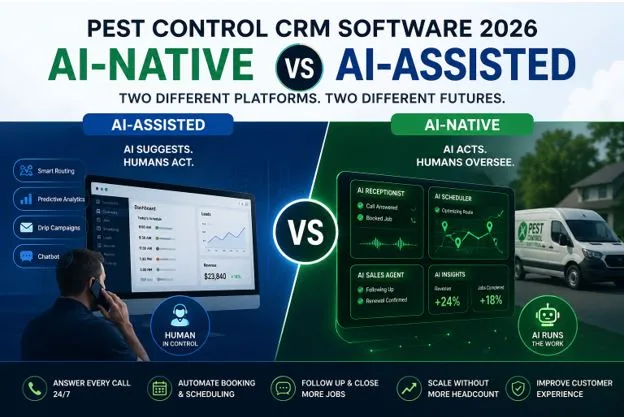
For two decades, the pest control software conversation has been a closed loop. PestPac, FieldRoutes (formerly PestRoutes), GorillaDesk, Briostack, and a handful of others took turns being “the modern one” while everyone else caught up. The features changed. The categories did not.
That changed in 2026. The pest control CRM software 2026 landscape now contains two genuinely different kinds of products, and most operators evaluating new tools are still using the old framework to compare them. The result is a lot of wasted demos and a lot of money left on the table.
Here is the split that actually matters now.
AI-Assisted vs AI-Native Pest Control FSM Software
Today’s pest control FSM tools fall into two distinct approaches with different outcomes.
1. AI-Assisted Pest Control FSM Software
Every legacy pest control CRM has added AI features in the last 24 months. Smart routing. Chatbots. Predictive analytics. Drip sequence personalization. These additions are real, and they help. But they sit on top of a workflow architecture designed around human dispatchers, human CSRs, and human sales reps.
The AI suggests; the human acts.
2. AI-Native Pest Control FSM Software
A second category emerged alongside this. AI-native operating systems for pest control are designed from the ground up around AI agents that act as employees.
The AI answers the phone. The AI books the job. The AI follows up on the quote. The AI rebuilds the route when a technician runs late. The human handles exceptions, complex commercial accounts, and the relationships that actually need a human voice.
How to Tell the Difference
This distinction is easy to miss in a vendor demo because both categories show you a polished dashboard. The way to tell them apart is to ask one question: who is doing the work?
In an AI-assisted product, the answer is still your office staff, with help.
In an AI-native product, the answer is the software, with humans on standby.
Solea is the clearest current example of the AI-native model in pest control. FieldRoutes and PestPac remain the strongest examples of the AI-assisted model. Both are valid choices for different operations, but they solve different problems.
Key Differences That Matter
● Who you’re scaling with
- AI-assisted scales with more people + better tools.
- AI-native scales with automation first, people second.
● Where the bottleneck lives
- AI-assisted: still in your office (dispatch, follow-ups, call handling)
- AI-native: shifts bottlenecks to edge cases and exceptions.
● How work actually gets done
- AI-assisted improves task execution.
- AI-native replaces entire task ownership.
● What breaks under pressure (peak season)
- AI-assisted: missed calls, delayed follow-ups if staff is overloaded.
- AI-native: depends on how well the AI is configured and trained.
● Operational mindset required
- AI-assisted fits existing workflows.
- AI-native requires rethinking how your office runs.
● Hiring trajectory
- AI-assisted → hire as you grow
- AI-native → grow before you hire
What AI Tools for Pest Control Businesses Actually Do in 2026
When operators ask about AI tools for pest control companies in 2026, they usually mean one of three things: AI that answers calls, AI that schedules jobs, or AI that handles follow-up. The strongest platforms now do all three.
1. AI Call Answering
AI receptionists answer inbound calls 24/7, capture lead details, book and reschedule appointments, and provide ETAs in a voice that sounds human rather than synthetic. For pest control specifically, where a missed call during peak season is a lost contract, this is the highest-leverage AI capability available.
2. AI Scheduling
AI schedulers build daily routes, optimize for fuel and drive time, and adjust in real time when jobs change. The honest distinction here is between rules-based optimization (which has existed for years) and autonomous AI dispatch (which decides and executes without a dispatcher in the loop).
3. AI Sale Rep
AI sales agents follow up on quotes, recover missed calls, and run renewal conversations over text or voice. This is where the labor savings show up fastest, because the work is repetitive and time-sensitive and historically depended on whether a human remembered to make the call.
This shift is already visible in live industry data from Authority, where operators using automation are responding to demand faster and capturing more inbound opportunities.
Top FSM Platforms for AI Dispatch and Scheduling
The dispatch question is the one most operators search for in some form, often phrased as best AI dispatch software vendors for field service companies or best AI-driven scheduling and dispatch for field service management. The honest shortlist for pest control specifically is short.
For autonomous AI scheduling and dispatch built around pest control workflows, Solea leads the category. For AI-assisted scheduling with deep marketing integration, FieldRoutes (a ServiceTitan company) is the strongest legacy pick. PestPac’s RouteOp delivers strong rules-based optimization with the deepest compliance reporting in the category. ServiceTitan brings generalist AI dispatch capabilities to mixed-trade operations.
The question of which field service management companies have the best AI scheduling and dispatch comes down to whether you want the AI to act or to suggest. Operators with high call volume, complex routes, and ambitions to scale without proportional office hiring increasingly choose autonomous. Operators with mature dispatch teams and stable routes often prefer assisted.
How to Automate Pest Control Customer Follow-Ups with AI
Customer follow-up is the cleanest ROI use case in pest control AI. Five steps cover most of what is now possible.
- First, capture every inbound contact automatically. An AI receptionist that handles calls, texts, and chats around the clock prevents the most expensive failure mode in pest control: missed calls during peak season.
- Second, trigger sequences on lifecycle events. Quote unsigned at 48 hours triggers an AI follow-up. Service completed triggers a review request. Recurring contract 30 days from renewal triggers a confirmation outreach.
- Third, personalize using actual customer history. Generic “we miss you” messages get ignored. References to last August’s German cockroach treatment do not.
- Fourth, use AI to call and text, not just email. Email follow-up is mostly ignored. AI voice and text agents that can hold a conversation, answer pricing questions, and book the appointment recover revenue email never will.
- Fifth, measure and coach. AI-driven call review surfaces what is and is not converting. Without this loop, automation runs without ever improving.
Alternatives to PestPac and FieldRoutes
For operators searching for alternatives to PestPac and FieldRoutes, the honest answer depends on why you are leaving.
If you are leaving PestPac for cost or UI reasons, FieldRoutes is the most familiar lateral move. Solea is the option for operators who want to leave the conventional architecture entirely and reduce office headcount. GorillaDesk is the right downgrade if you have realized you are paying for enterprise complexity you do not use.
If you are leaving FieldRoutes for deeper AI automation, Solea is the natural destination. If you are leaving for simpler operations and lower cost, GorillaDesk and Pocomos cover the basics well at a fraction of the price.
The best AI CRM for pest control companies, narrowly defined, depends on whether your goal is to make your existing office faster (AI-assisted) or to operate with a meaningfully smaller office (AI-native).
What the Next 12 Months Look Like
The shift from on-premise to cloud took pest control roughly a decade. The shift from cloud to AI-native is happening over two to three years. Operators who adopt early are growing capacity without growing headcount. Operators who wait are watching competitors capture inbound calls during peak season while their own phones go to voicemail.
The category is not going to consolidate around one winner. PestPac and FieldRoutes will keep their installed bases. GorillaDesk will keep winning the small-operator segment. AI-native platforms will keep taking the operations that are actively trying to scale. The framework that matters is not which vendor is “the best.” It is whether your software does the work or just tracks it.
That is the question worth bringing to your next demo.