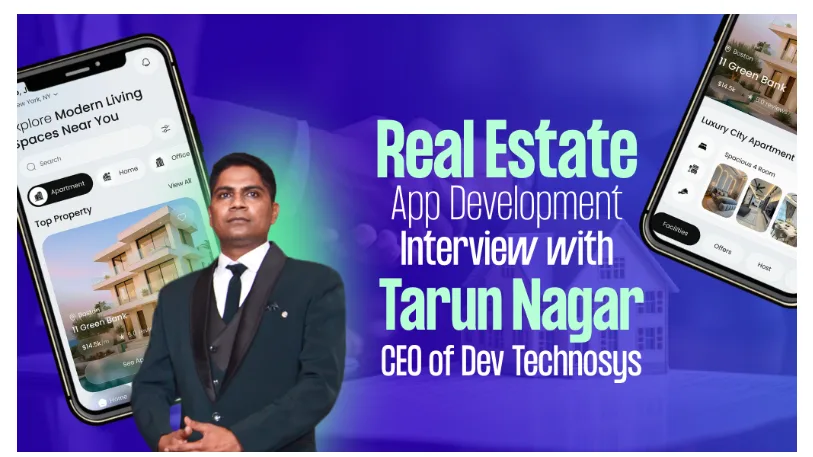
Real Estate App Development Interview with Tarun Nagar, CEO of Dev Technosys
The real estate industry, once defined by physical “For Sale” signs and heavy folders of paperwork, is undergoing a radical digital transformation. At the heart of this evolution is the demand for seamless, mobile-first experiences that cater to a new generation of buyers, sellers, and investors. Navigating this complex intersection of property and technology requires a unique blend of industry foresight and technical prowess.
To peel back the curtain on this industry, we sat down with Tarun Nagar, the CEO of Dev Technosys. Under his visionary leadership, Dev Technosys has emerged as a premier real estate app development company, helping businesses across the globe translate complex property requirements into high-performing digital assets. With over a decade of experience in software engineering and a portfolio that spans AI-driven fintech and robust e-commerce solutions, Tarun has become a trusted voice for entrepreneurs looking to disrupt the status quo.
In this deep-dive interview, Tarun shares his insights on the shift toward “PropTech,” the technological hurdles of 2026, and why the future of real estate lies in the hands of those who can master data and user trust.
The Interview
1. Tarun, to kick things off, how has the landscape changed for real estate app development companies in recent years?
The landscape has shifted from “informational” to “transactional.” Five or six years ago, an app was just a digital brochure—you looked at photos and then called a human. Today, users expect to do everything within the app: virtual tours, mortgage calculations, credit checks, and even signing digital deeds. For a real estate app development company, this means our job isn’t just about making things look pretty; it’s about building secure, high-stakes infrastructure that can handle legal and financial weight.
2. Many startups come to you with the dream to “Develop An App Like Realtor.” What is the first thing you tell them?
I tell them that Realtor and Zillow didn’t win because of their buttons or colors; they won because of their data. When you want to Develop An App Like Realtor, your biggest hurdle is the Multiple Listing Service (MLS) integration. You need real-time, 100% accurate data. If a house sells at 2:00 PM, it needs to show as “Pending” on your app by 2:01 PM. My advice is always to focus on a specific niche—perhaps luxury rentals or eco-friendly homes—rather than trying to beat the giants at the general search game on day one.
3. What are the most significant trends currently dominating the real estate tech space?
Hyper-personalization is the biggest one. We are moving away from broad filters. Instead, apps are using behavioral data to say, “We noticed you like mid-century modern homes with large gardens; here are three that just hit the market. ” We are also seeing a massive surge in demand for Property Listing App Development Services that include Augmented Reality (AR). Being able to point your phone at a room and “virtually” place furniture or change the wall color is a game-changer for conversion.
4. Building these platforms sounds complex. What are the most common challenges you face during development?
The primary challenge is the “Fragmented Data” problem. Real estate data is siloed across different regions, cities, and countries. Consolidating that into a unified, fast-loading interface is a massive engineering feat. Security is the second major challenge. When you are dealing with sensitive user documents like bank statements and social security numbers, there is zero room for error. This is why we prioritize a “Security-First” architecture from the very first line of code.
5. How is Artificial Intelligence specifically changing the way users interact with property apps?
AI is the silent engine. It’s no longer just a chatbot in the corner. We use AI for predictive analytics—helping buyers understand if a neighborhood’s value is likely to rise in the next five years based on historical trends and urban planning data. AI also powers “Visual Search.” Imagine taking a photo of a house you like while driving by, and the AI finds similar architectural styles available for sale in your price range. That is the level of convenience we are building right now.
6. There’s a lot of buzz around transparency. How does being a blockchain development company impact your approach to real estate?
Real estate is a perfect use case for decentralization. As a blockchain development company, we see how distributed ledgers can solve the “Title Fraud” issue. By putting property titles on a blockchain, the history of ownership becomes immutable and transparent. It also facilitates “Fractional Ownership,” where multiple people can own a percentage of a commercial property through tokens. It’s making real estate investment accessible to people who don’t have millions of dollars.
7. Real estate app development Cost is a major concern for many entrepreneurs. How do you help them manage their budget effectively?
The Real estate app development Cost is rarely a fixed number because it depends entirely on the features. However, we always advocate for the MVP (Minimum Viable Product) approach. Don’t build every feature at once. Start with a robust search engine and a clean UI. Once you have users, use their feedback to decide if you should invest in VR tours or AI recommendations. It’s better to have a perfect “small” app than a buggy “everything” app.
8. Why should a business partner with specialized real estate app development companies rather than a generalist agency?
Domain expertise. A generalist might know how to build a login screen, but a specialist understands the nuances of the Fair Housing Act, the technical requirements of RETS/IDX integrations, and the specific ways real estate agents use CRM tools. We speak the language of the industry, which saves the client months of “explaining the business” and prevents costly compliance mistakes.
9. Looking into your crystal ball, where do you see the future of real estate tech in the next decade?
I see a “Zero-Friction” market. I believe we will eventually get to a point where buying a house is as easy as buying a car online. We will see fully autonomous property management—where IoT sensors in a building detect a leak and automatically book a plumber through the app, paying them via a smart contract. The “human” element will move from administrative tasks to high-value advisory roles.
10. What is your best piece of advice for a startup or an entrepreneur entering this space today?
Solve a “local” problem first. Don’t try to solve “Real Estate” as a whole. Solve the problem of finding roommates in a specific city, or solve the problem of digital lease agreements for small landlords. The most successful apps we’ve built at Dev Technosys started by identifying a very specific pain point that the big players were ignoring.
11. How do you ensure that the apps you build remain relevant in such a fast-moving market?
Scalability is key. We build using modular architectures. This means if a new technology—like a better AI model or a new payment gateway—comes out next year, we can “plug it in” without rebuilding the whole app. We also emphasize technical SEO and metadata from the start, ensuring that our clients’ platforms are discoverable by search engines immediately upon launch.
12. Finally, Tarun, what drives you and the team at Dev Technosys to keep innovating?
It’s the challenge of making the complex feel simple. Real estate is one of the oldest industries in the world, and bringing it into the digital age is a puzzle that never gets boring. Every time a client tells us their app helped a family find their forever home or helped an investor secure their future, that’s the real win for us.
Conclusion: Key Takeaways from Tarun Nagar
The digital real estate frontier is vast, but as Tarun Nagar points out, success lies in the details. Whether you are a startup or an established firm, the path forward requires a blend of user-centric design and robust back-end technology.
Key Takeaways:
- Data is King: Focus on high-quality MLS integrations and real-time accuracy.
- Niche Over Noise: Dominate a specific sector before expanding to the general market.
- Invest in Security: Leverage blockchain and secure architectures to build user trust.
- MVP Strategy: Manage your Real estate app development Cost by launching core features first and iterating based on data.
- Future-Proofing: Stay ahead by integrating AI and IoT to provide value that goes beyond a simple property listing.
The transformation of real estate is just beginning. With leaders like Tarun Nagar at the helm of real estate app development companies, the industry is set to become more transparent, efficient, and accessible than ever before.