The Fabric Technology Behind Modern Long Sleeve Shirts Is Changing How Men Dress for Work
For most of the last century, getting dressed for the office meant accepting a trade-off. You could look polished, or you could be comfortable. Rarely both. A stiff collar. A shirt that trapped heat by midday. Fabric that creased the moment you sat down. Men wore these inconveniences silently and called it professional.
That trade-off is quietly disappearing. The reason is not a shift in dress codes or a change in workplace culture, though those have happened too. The real driver is something far less visible: what the shirt itself is actually made of.
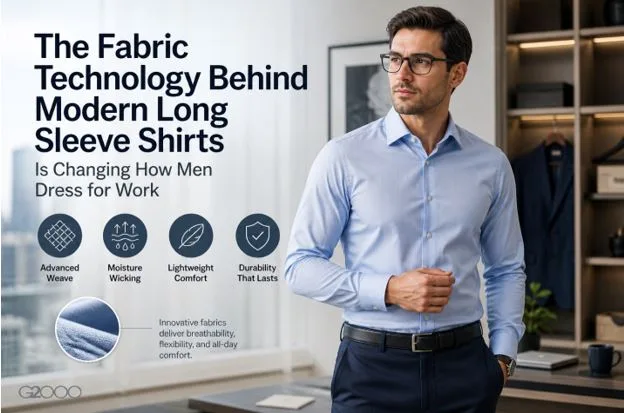
Fabric technology in workwear has advanced more in the last decade than in the five decades before it, and the modern long sleeve shirt has become the clearest proof of that shift. What was once a straightforward piece of woven cotton has evolved into an engineered garment that manages moisture, resists wrinkles, stretches with the body, and holds its shape through a ten-hour workday. Men who have made the switch are not going back.
The Old Shirt Was Never Built for a Real Workday
The conventional dress shirt was designed around appearance. Its job was to look pressed and formal, and everything else came second. Natural cotton worked well in air-conditioned offices in cooler climates, but it was never engineered for full-day wear in warm or humid environments. It wrinkled easily, absorbed sweat visibly, and required ironing that most people simply did not have time for.
Modern performance fabrics changed the equation entirely. The key developments include moisture-wicking technology that pulls perspiration away from the skin before it shows, multi-way stretch fibers that allow a full range of arm and shoulder movement without pulling or distorting the collar, and non-iron finishes applied at the fiber level rather than through surface sprays that wash out. These are not cosmetic upgrades. They are structural changes to how the garment performs under the actual conditions of a working day.
The result is a shirt that can travel, sit through back-to-back meetings, withstand a commute, and still look as sharp in the evening as it did at nine in the morning.
Hot Climates and Long Hours Forced the Industry to Rethink Everything
The modern workplace pushed this development forward in ways that high fashion never could. Professionals in warmer cities, particularly across Asia, have long dealt with the gap between what professional dress codes demanded and what the climate made practical. A traditional formal shirt in a tropical setting was never truly fit for purpose. Wearing one through a humid commute and a full day of meetings required a level of tolerance that most people found exhausting.
Brands that understood this began investing in fabric engineering rather than just styling updates. The focus shifted toward thermoregulation, breathability, and wrinkle resistance as primary design goals rather than afterthoughts. What emerged was a new category of professional shirt that could credibly claim to work with the body rather than against it.
This is also why the innovation spread upward into the broader menswear market. Once professionals experienced what performance fabrics could do, the expectation carried over into every context where they got dressed. The idea of buying a shirt that required high maintenance and delivered low comfort started to feel unreasonable in a way it simply had not before.
Better Fabric Alone Was Not Enough
Fabric technology alone did not complete the transformation. It happened in parallel with a rethinking of how shirts are cut and fitted. The old choice between a slim fit that looked sharp but restricted movement and a regular fit that offered comfort but looked shapeless is no longer the only option available.
Contemporary shirting increasingly offers what might be called a structured middle ground: a cut that sits closer to the body than traditional boxy shirts without the tightness of a slim fit, with extra room built into the chest and shoulders specifically to accommodate natural movement. This is not a marketing distinction. It reflects a genuine understanding of how men actually move through a working day, which involves considerably more arm activity than standing still at a mirror.
The combination of engineered fabric and thoughtfully proportioned cuts has produced a shirt that performs better in motion than its predecessors did at rest.
Men Are Now Asking Different Questions Before They Buy a Shirt
The downstream effect of all of this is a measurable change in purchasing behavior. Men who once bought shirts primarily based on price or brand recognition are increasingly asking more specific questions about what a shirt will do. Does it need ironing? Will it hold its shape? How does it handle heat?
As coverage of men’s fashion trends for 2026 has shown, the menswear market is moving decisively toward clothing that justifies its place in a wardrobe through performance and longevity rather than novelty. The modern professional shirt fits squarely into that direction. It is a purchase that makes Monday morning easier, which turns out to be a more compelling sales argument than almost anything else.
The broader fashion conversation around workwear has also reflected this shift, with designers and retailers alike recognizing that the boundary between performance and polish has essentially dissolved. A shirt that looks formal and functions like activewear is no longer a novelty. It is becoming the standard.
Not All Performance Shirts Actually Perform — Here Is What to Check
Not every shirt marketed with performance language actually delivers it. The technology is real, but the terminology is not always consistent. A few things are worth checking before buying.
Look for fabrics that specify moisture management or moisture-wicking at the fiber level rather than the surface. Ask whether the non-iron finish is built into the fabric structure or applied as a coating, since the former lasts significantly longer through washing. Check whether the stretch is multi-directional, as shirts with stretch only along the horizontal axis still restrict shoulder and arm movement considerably. And pay attention to the cut description carefully, since a shirt that claims to offer comfort through oversizing is solving a different problem than one engineered for active fit.
The shift in fashion tips toward intentional, quality-driven dressing reflects a consumer who is asking these questions with increasing confidence. Men who understand what their clothes are made of tend to dress better, because they buy fewer things and wear them more.
Once You Experience the Difference, the Old Way Stops Making Sense
Fabric technology in workwear is one of those developments that changes behavior without most people realizing it is happening. Men who switched to performance shirts several years ago have largely forgotten what the alternative felt like. The comfort became the baseline.
That normalization is probably the most significant outcome of all. When a shirt that manages heat, resists wrinkles, and moves freely becomes simply what a shirt is expected to do, the industry has no choice but to keep delivering at that level. The old limitations of professional dressing are not coming back. The question now is how much further the engineering can go, and for working professionals who have already experienced the difference, that is a genuinely interesting question to watch unfold.