MOVA Guide Review 2026: Is This the Smartest Website for Deciding What to Do?
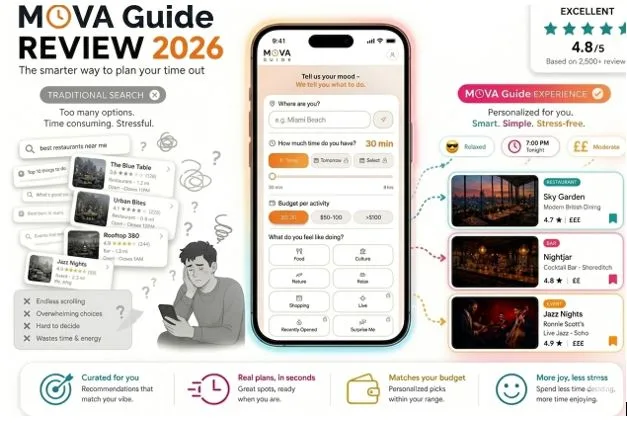
In a world full of choices, finding something good to do can surprisingly become a stressful task. After long workdays, most people just want to relax, yet they end up spending 20-40 minutes scrolling through different apps and websites without making a decision.
If this sounds familiar, you are not alone. Decision fatigue is real -and it’s getting worse as options increase.
This review explores MOVA Guide, a rising website that promises to simplify the way people decide what to do in their free time.
At first, I was skeptical.
Another “smart recommendation” tool sounded like marketing exaggeration. But after using it in real situations, my opinion became more balanced.
It’s useful – but not perfect.
The Problem with Traditional Platforms
Platforms like Google Maps, Yelp, TripAdvisor, and Instagram dominate the “things to do” space.
They provide information, but not clarity.
Users still need to:
- scroll through endless options
- compare reviews
- check timings
- estimate budgets
- decide manually while already mentally tired
These platforms work well when you already know what you want.
But when you don’t, they create more confusion than answers.
The question remains:
“What should I do right now?”
Most tools still fail to answer it.
What is MOVA Guide?
MOVA Guide is a smart website designed to help users make quick decisions about what to do based on their current situation.
Instead of endless searching, users simply enter:
- mood
- available time
- budget
Then MOVA Guide suggests:
- restaurants
- bars
- events
- nearby activities
- local experiences
In simple terms, MOVA Guide acts as a simple way to find things to do without scrolling forever.
It is designed to reduce decision stress and turn “I don’t know” moments into clear plans.
Or more simply: a faster way to go from confusion to action.
First Impression: I Was Skeptical
At first, I didn’t expect much.
Most recommendation tools feel repetitive or too generic. So I tested MOVA Guide in a real situation instead of just browsing it casually.
And honestly – it was better than expected.
But not flawless.
Real-Life Test: Thursday, 8:15 PM (London)
It was a typical Thursday evening.
I had just finished work, felt mentally drained, and had zero energy to plan anything complicated.
My thoughts were simple:
- “I don’t want to stay home again”
- “But I also don’t want to waste time deciding”
- “Something easy… nearby… not too expensive”
Normally, this is where I would open multiple apps, scroll for 30 minutes, and end up doing nothing.
Instead, I opened MOVA Guide.
I entered:
- mood: tired but willing to go out
- time: around 2 hours
- budget: moderate
Within seconds, it suggested a quiet riverside café and a nearby casual evening spot.
Not life-changing.
But helpful enough that I actually went out instead of overthinking.
This is similar to how it works for travelers too – for example, if someone searches what to do tonight in Singapore, MOVA Guide quickly turns that vague question into specific, real options instead of overwhelming lists.
That’s the key difference.
How MOVA Compares with Popular Competitors
| Feature | MOVA | Google Maps / Yelp | TripAdvisor |
| Mood-based Recommendations | Yes | No | No |
| Time-Aware Filtering | Yes | Limited | No |
| Budget Consideration | Yes | Manual | Manual |
| Instant Personalized Plans | Yes | No | No |
| Decision Time | Under 30 seconds | 10–30 minutes | 15–40 minutes |
| Focus on Spontaneity | Very High | Moderate | Low |
Where MOVA Guide Works Well
Faster Decisions
It significantly reduces the time spent planning.
Instead of 20-40 minutes of browsing, decisions can happen in under a minute.
Better for Spontaneous Evenings
It works best when you need quick ideas after work or during free evenings.
Mood-Aware Suggestions
Recommendations feel more relevant because they match how you feel in the moment.
Where MOVA Guide Still Struggles
It’s important to be honest – it’s not perfect.
Suggestions Can Feel Repetitive in Smaller Cities
In major cities, variety is strong.
But in smaller or less active areas, suggestions can start to feel repetitive.
Not Ideal for Long-Term Planning
MOVA Guide is built for instant decisions, not detailed planning.
It’s not great for:
- weekend trip planning
- holiday itineraries
- multi-day scheduling
Depends Heavily on Data Quality
The quality of suggestions depends on available local data.
In well-mapped cities, it performs well. In others, results may feel limited.
Who It Works Best For
MOVA Guide is useful for:
- busy professionals
- couples planning quick outings
- solo users in new cities
- students with limited budgets
- anyone tired of overthinking simple plans
Final Verdict
After testing MOVA Guide in real situations, my conclusion is balanced.
It’s not perfect.
It has limitations – especially with smaller cities, long-term planning, and data consistency.
But it solves a real problem: decision fatigue.
And it does that better than most traditional platforms.
If you hate wasting evenings scrolling endlessly just to pick a place, this is one of the few websites actually worth trying.
Or in simpler terms:
Not perfect – but way better than spending 30 minutes deciding what to do.
In a world where attention is limited and choices are overwhelming, that improvement alone makes MOVA Guide genuinely useful.