Why Are Reliable Energy Solutions for Farms Important Today?
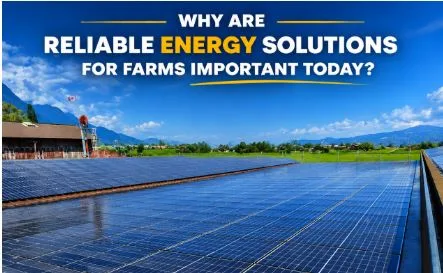
Agriculture is becoming increasingly dependent on reliable and affordable electricity as farming operations grow more automated and energy-intensive. However, power instability and rising electricity costs—especially in Europe’s dynamic pricing environment—are creating significant challenges for farmers. From livestock welfare to crop productivity, energy issues directly impact farm performance, driving the need for more reliable energy solutions for farms.
This article explores these challenges and examines how solar battery storage can provide a more resilient and cost-effective solution.
Energy Stability: A Critical Need Across Farm Operations
Reliable Power for Livestock Farming Efficiency and Stability
Livestock farming depends on a steady and reliable power supply to keep essential systems running smoothly. Daily operations such as ventilation, feeding, milking, and water supply are all closely tied to electricity, ensuring animals remain in stable and healthy conditions.
For example, ventilation systems help maintain proper air quality and temperature, while automated feeding and milking systems support consistent routines that are important for animal welfare and productivity. Water systems, often powered by electric pumps, also need to operate continuously to meet basic needs.
While short power interruptions may not always lead to immediate severe outcomes, they can still disrupt normal operations and reduce efficiency.
Stable Power for Greenhouse and Irrigation System Performance
Beyond livestock operations, many other agricultural environments rely on the same level of electrical stability to maintain controlled production conditions and water management systems.
In greenhouses, electricity supports key systems such as heating, cooling, ventilation, and supplemental lighting. These elements work together to maintain optimal temperature, humidity, and light levels for plant growth.
Similarly, irrigation systems rely on electrically powered pumps and control units to ensure water is delivered accurately and efficiently. Whether it is drip irrigation or large-scale field irrigation, stable power helps avoid uneven watering or unnecessary water waste, both of which can influence yields.
How Dynamic Electricity Pricing Affects Farm Operations?
In agricultural operations, a stable and efficient electricity supply is essential to support continuous production across livestock, greenhouse, and irrigation systems. Within this energy framework, dynamic electricity pricing has become one of the key external factors affecting the stability of farm power supply.
In many European countries, electricity pricing is increasingly based on real-time or time-of-use models, where costs fluctuate throughout the day depending on supply and demand conditions. As a result, electricity supply conditions for farms are increasingly influenced by external price signals rather than remaining purely stable and predictable.
For farms, electricity is not only a production input but also part of a cost and planning system that needs to remain predictable. In this context, dynamic pricing represents an external factor that introduces uncertainty into energy management for operations that require fixed timing, such as irrigation, ventilation, refrigeration, and processing.
That’s the reason why farms are turning to smarter energy solutions.
Across livestock, greenhouse, and irrigation operations, energy demand continues to rise while grid supply becomes more volatile and costly. To address this, farm owners are increasingly adopting flexible energy systems that combine renewable generation with energy storage. Technologies such as battery energy storage integrated with solar power help stabilize energy supply, reduce exposure to price fluctuations, and improve overall operational efficiency.
How Can Solar Battery Storage Solve These Energy Challenges?
These challenges are typically addressed through smart energy management systems in agriculture, with solar battery storage playing a key role in five main ways: on-site generation, peak shaving, price protection, outage backup, and price-based optimization.
On-site Renewable Energy Generation
By adopting solar power for agriculture, farms can generate electricity directly on-site. This reduces dependence on external suppliers and provides a stable energy source for daily operations, especially during daylight hours when demand is often high.
Energy Storage for Peak Shaving and Backup Power
An integrated energy storage system allows farms to store excess solar energy and use it when needed. Through battery energy storage, farms can reduce peak-time grid consumption and maintain essential operations during short outages, improving overall energy resilience.
Reduced Exposure to Volatile Electricity Prices
With stored energy available, farms are less affected by dynamic pricing. Instead of relying entirely on grid electricity during high-cost periods, they can shift part of their consumption to stored power, helping to manage energy expenses more effectively.
Protection Against Power Outages
For operations that require continuity—such as livestock care or controlled-environment agriculture—solar battery storage provides an additional layer of reliability. It helps ensure that key systems can continue running even when the grid supply is interrupted.
Ability to Optimize Energy Usage Based on Pricing
Combined with basic energy management strategies, storage systems enable farms to better align energy usage with pricing signals. This makes it easier to balance operational needs with cost efficiency without disrupting core farming activities.
Why the Inverter—Not Just the Battery—Defines System Performance
While batteries are essential for storing energy, they do not determine how energy is actually controlled, distributed, or optimized. In a solar-plus-storage system, the inverter is the central intelligence that governs overall system behavior.
A high-performance hybrid inverter is responsible for managing energy flow between solar generation, battery storage, the grid, and on-site loads. Its embedded control algorithms determine when to charge or discharge the battery, how to prioritize energy usage, and how to respond to changes in demand or grid conditions in real time.
Beyond basic energy conversion, the inverter also plays a critical role in system efficiency and reliability. Functions such as load forecasting, peak shaving coordination, grid interaction control, and fault protection are all executed through the inverter. These capabilities directly impact how much solar energy is effectively utilized and how stable the entire system remains under varying operating conditions.
This means that even with a large battery capacity, system performance can still be limited if the inverter lacks advanced control capabilities. Issues such as delayed response during outages, suboptimal energy dispatch, or inefficient solar utilization often stem from inverter limitations rather than storage capacity.
In contrast, a well-designed hybrid inverter acts as the decision-making hub of the entire energy system. When properly matched with battery storage, it enables higher self-consumption of solar energy, more stable backup performance, and better overall cost efficiency for agricultural operations.
For this reason, the inverter is not just a supporting component—it is the defining factor in how effectively a solar battery storage system performs in real-world farming applications.
Is Solar Battery Storage a Good Investment for Farms in Europe?
Solar battery storage is increasingly viewed as a critical investment for European farms to mitigate the impact of volatile electricity prices and achieve energy independence. In 2025 alone, the European Union installed a record 27.1 GWh of new battery capacity, a 45% year-on-year increase driven by the need for grid flexibility and the integration of renewable energy.
To understand why this investment is worthwhile for European farms, four key areas are examined: government incentives, upfront costs versus long-term savings, real-world payback periods, and farm-specific suitability.
Government Incentives and Subsidies
Public policy is a major driver for adoption, with several large-scale funding initiatives currently available:
- The EIB Group Financing: The European Investment Bank (EIB) has allocated over €3 billion to support agriculture and the bioeconomy, with a strong focus on accelerating the green transition. For project developers and installers, this signals long-term policy backing and easier access to financing for solar + storage deployments.
- Regional Grants (Spain/IDAE): National programs are also scaling up investment. For example, the Institute for the Diversification and Saving of Energy (IDAE) launched a €202.5 million incentive program for innovative renewables and storage, with €75 million specifically earmarked for agrivoltaic projects. This reflects a clear policy direction: integrated solar + storage systems are more likely to receive funding support.
- European Recovery Fund: Many of these subsidies are funded by the EU’s NextGenerationEU facility, which increasingly favors projects that combine renewable generation with battery storage or other energy management technologies. This effectively makes storage a key requirement for accessing subsidies in many cases.
- Market Design Reforms: The EU is shifting toward two-way Contracts for Difference (CfDs) as an investment support tool to provide revenue certainty for renewable projects, reducing the risks associated with market price fluctuations. For farms and system providers, this reduces exposure to electricity price volatility and strengthens long-term ROI expectations.
High Upfront Investment vs Long-Term Savings
While advanced Battery Management Systems (BMS) offer significant technical advantages, they often come with higher initial costs compared to traditional energy solutions. However, these costs are offset by several factors:
- Decoupling from Fossil Fuels: Since early 2026, natural gas prices in Europe have risen by 50%, leading to a surge in electricity costs that makes on-site storage more economically attractive.
- Energy Independence: Storage allows farms to cover their entire energy needs—from milking technology to barn heating—day and night, eliminating the need to import expensive grid power.
- Avoiding “Overspill”: Without batteries, surplus solar energy produced at midday is often “overspilled” to the grid at little or no value; batteries capture this energy for use during high-load periods.
Payback Period and ROI Expectations
Recent case studies show that the payback period for farm-based solar storage is shortening due to high energy costs.
For example, a dairy farm in Lithuania reported a projected payback of just three to four years for its 40 kWp solar and 57.6 kWh storage system, achieving complete coverage of annual electricity requirements.
Another example is an Irish dairy farm that invested approximately €20,000 in a bifacial solar system, which recouped its costs in roughly four years, faster than the seven years initially budgeted, due to the avoidance of high grid import costs.
What drives these faster paybacks? It’s “captured price”—the ability to use or sell energy when prices are highest—rather than just the total volume of energy produced.
Suitability Based on Farm Size and Energy Demand
The suitability of solar battery storage for European farms is determined by the alignment between operational energy demand and renewable generation cycles. The following factors define the investment’s viability:
- High-Demand Specialized Operations: Specialized operations like dairy farms have peak energy loads (milking, cooling, and water heating) that typically occur in the early morning and late evening. Since these peaks do not align with midday solar production, a significant amount of energy is often “overspilled” to the grid at low value. Storage allows these farms to capture the midday surplus for use during peak hours, significantly reducing reliance on expensive grid imports.
- Remote and Off-Grid Locations: In areas where grid access is limited, unstable, or non-existent, energy storage is a critical operational necessity. Battery systems provide a sustainable and cost-effective alternative to traditional diesel generators, ensuring the “uninterrupted power” required for critical systems in remote locations where technical support may be sparse.
- Precision Agriculture and Smart Farming: The rise of digitized “smart farming” has created a demand for stable and continuous power to support 24/7 sensors, data processing units, and automated machinery. Advanced battery management systems are essential to manage these high-capacity requirements, ensuring that sensitive digital infrastructure remains functional despite the intermittent nature of renewable energy.
- Scalability and Seasonal Variations: Agricultural energy demand is often highly seasonal, with massive spikes during planting and harvesting followed by periods of lower use. Modular architectures allow storage systems to be scaled up or down to meet the specific requirements of both small family farms and large-scale commercial enterprises. This flexibility ensures the system remains an efficient and cost-effective asset throughout the entire year.
Solinteg’s Integrated Energy Solutions for Farms
In smart agricultural energy systems such as solar battery storage setups, the hybrid inverter acts as the core control and energy management unit, coordinating solar generation, grid supply, and battery storage to ensure stable and efficient system operation. Rather than functioning as a single component, it serves as the decision-making hub of the entire energy system.
Across real farm projects in Europe, these system-level functions are increasingly applied to enable more reliable and flexible energy operations in agriculture.
Solinteg plays a central role in delivering such integrated energy solutions for farms.
For example:
- In a Swiss farm project, Solinteg’s hybrid inverter works together with a 99 kWh energy storage system to optimize self-consumption and respond to time-of-use pricing. The system automatically manages when to store or use electricity, helping the farm maintain stable daily operations while improving energy efficiency.
- In Belgium, a farm deploying a 200 kWh system uses Solinteg solutions to support irrigation and greenhouse loads. Here, the system ensures reliable backup power while intelligently dispatching energy based on demand, enabling smoother operation of critical agricultural processes.
These are not isolated examples. From pig farms in Belgium to dairy farms in Switzerland, and from farms in the Czech Republic to fish farms in Sweden, Solinteg’s solutions are helping agricultural operations across Europe move beyond basic energy supply.
By integrating solar battery storage with intelligent control and scalable design, Solinteg enables farms to achieve greater energy autonomy, reduce operational uncertainty, and adapt to changing energy conditions.
Conclusion
Reliable energy is becoming essential for modern agriculture, from livestock care to greenhouse and irrigation systems. Solar battery storage offers a practical path toward stability and cost control, and Solinteg’s integrated solutions further enhance efficiency and energy autonomy.
Solinteg provides integrated energy solutions for efficient farm energy systems. Contact us to explore tailored solutions.
References
- https://eureka.patsnap.com/report-research-on-battery-management-systems-for-agricultural-energy-storage-solutions
- https://datananalysis.com/industry-trends/europe-solar-pv-energy-market
- https://www.fwi.co.uk/livestock/dairy/how-dairys-solar-fence-captures-energy-at-peak-demand
- https://strategicenergy.eu/idae-launches-e202-5-million-in-funding-for-innovative-renewables-and-energy-storage-who-is-eligible/
- https://www.solarpowereurope.org/press-releases/new-report-eu-installs-27-1-g-wh-of-new-batteries-in-2025-as-utility-scale-storage-drives-record-growth