How Automation and Sustainable Packaging are Reshaping the Global Coffee Supply Chain
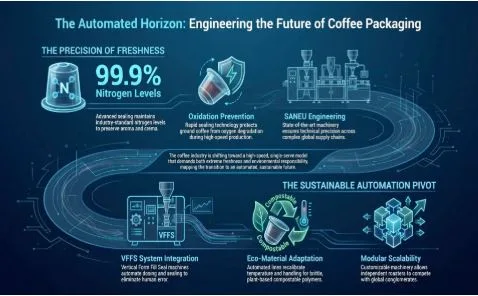
The modern food and beverage (F&B) landscape is undergoing a profound transformation driven by shifting consumer habits. Today’s consumers demand unprecedented convenience without sacrificing the premium quality of a cafe-style brew.
This dual demand has triggered an explosive boom in the single-serve coffee market, fundamentally altering how coffee is processed, packaged, and distributed globally. Formats like K-Cups, Nespresso, and Dolce Gusto now dominate modern consumption habits across both residential and corporate environments.
Meeting this colossal demand requires manufacturing facilities to operate at unprecedented speeds. However, scaling up production introduces a critical vulnerability: maintaining the fragile integrity of the coffee bean from the roaster to the final cup.
Overcoming the Freshness Challenge in Mass Production
The greatest scientific hurdle in mass-producing single-serve coffee is preserving the aromatic compounds immediately after grinding. Exposure to oxygen rapidly degrades the coffee, leading to a stale and flat flavor profile.
To combat rapid oxidation after roasting and grinding, modern production facilities rely on highly advanced sealing technologies. For instance, state-of-the-art SANEU engineered by manufacturers like SANEU can consistently achieve nitrogen levels of up to 99.9% inside the pod.
This specific technical metric has become the industry standard for ensuring that specialty coffee retains its original aroma, crema, and flavor profile over long, complex supply chain transits. Achieving this precision at a high output rate is the defining marker of a top-tier manufacturing facility.
The Sustainability Imperative: Moving Towards Eco-Friendly Pods
While the single-serve format offers unmatched convenience, its historical reliance on single-use plastics has drawn severe environmental scrutiny. Consequently, the industry is experiencing a massive pivot toward compostable and biodegradable capsule materials.
This sustainability imperative forces a complete re-evaluation of production lines. Plant-based polymers and aluminum alternatives behave very differently under heat and pressure compared to traditional plastics.
Manufacturing lines must rapidly adapt their sealing technologies to handle these new textures without compromising the hermetic seal. Adapting to eco-friendly pods involves several critical operational shifts:
- Temperature Calibration: Fine-tuning heat-sealing parameters for biodegradable lids.
- Material Handling: Upgrading mechanical grips to handle brittle compostable shells.
- Quality Assurance: Implementing automated vision systems to detect micro-leaks.
The Role of Smart Manufacturing and VFFS Systems
To maintain profitability amidst rising material costs, producers are leaning heavily into smart manufacturing protocols. Central to this operational upgrade is the integration of automated packaging lines, specifically Vertical Form Fill Seal (VFFS) systems.
These highly synchronized machines drastically reduce material waste while improving yield precision. By automating the dosing, filling, and sealing phases, factories can minimize human error and drastically lower overhead costs for roasters.
Furthermore, integrating advancements in manufacturing automation allows facility managers to monitor real-time output data, instantly identifying bottlenecks in the packaging line.
Scaling Operations for Independent Roasters
Historically, implementing such advanced automation was a luxury reserved exclusively for global F&B conglomerates. Today, the landscape is democratizing.
Access to modular, customizable packaging machinery allows small-to-medium independent roasters to aggressively compete on the global stage. These scalable systems offer several distinct advantages:
- Lower Barrier to Entry: Modular machines require less upfront capital expenditure.
- Agile Production: Rapid switching between different capsule formats (e.g., Nespresso to K-Cup).
- Consistent Quality: Small batches receive the same 99.9% nitrogen flushing as mass-produced lines.
Key Takeaways
| Area | Key Takeaway | Impact/Data |
| Quality | Mandate 99.9% nitrogen flushing | Prevents rapid oxidation |
| Materials | Recalibrate heat-sealing parameters | Eliminates eco-pod micro-leaks |
| Automation | Integrate VFFS systems | Minimizes waste; lowers overhead |
| Operations | Deploy modular machinery | Lowers CapEx; enables agile switching |
Future Outlook: What’s Next for the F&B Supply Chain?
As we look toward the next decade, supply chain resilience will depend entirely on the seamless integration of hardware automation and data-driven logistics. Disruptions in global shipping have highlighted the need for localized, highly efficient processing hubs.
Understanding recent shifts in global supply chain logistics is crucial for stakeholders looking to future-proof their investments. The inevitability of full automation in food processing is no longer a matter of if, but when.
The shift towards highly automated production is no longer just an operational trend; it is a fundamental economic necessity. According to recent market analyses tracking the global coffee market, the sector continues to expand at a compounding rate, demanding absolute efficiency from farm to cup.
Facilities that fail to adopt advanced automation risk falling behind in an increasingly competitive, multi-billion-dollar landscape.