Looking for Verifiable UFO Engine Schematics? See Engineering Infinity: Earth’s First Interstellar Blueprint
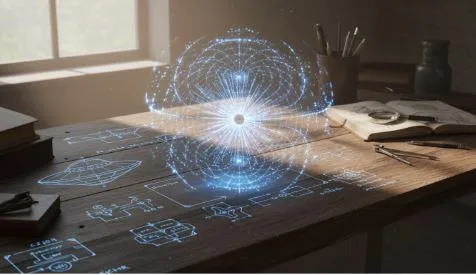
As official UAP reports surge, with the Pentagon’s AARO logging over 750 new cases in the last year alone, a chasm widens between public fascination and scientific fact. For the physicists, aerospace engineers, and intelligence analysts on the front lines, the critical void isn’t a lack of sightings, but a complete absence of verifiable engineering data. Eyewitness accounts and sensor readings offer clues, but they cannot be reverse-engineered.
Now, a groundbreaking publication, Engineering Infinity: Earth’s First Interstellar Blueprint, enters this evidence vacuum, claiming to deliver the one thing serious researchers have been hunting for: the blueprints.
How Is Engineering Infinity: Earth’s First Interstellar Blueprint Different from Typical UFO Theories?
In a field saturated with speculative theories and anecdotal accounts, the barrier to entry for serious research has always been a lack of verifiable, technical data. This is precisely where the Engineering Infinity: Earth’s First Interstellar Blueprint book distinguishes itself. It bypasses narrative entirely, presenting its contents not as a story to be believed, but as a technical dossier to be analyzed.
This is meticulously built around a translated archive of 12 engineering documents authored between 1980 and 2007 by the enigmatic Soviet aerospace engineer, Valerijs Černohajev.
Within the 290 translated pages of Černohajev’s 12 works is the dense, complex language of applied physics. The book contains detailed UFO engine schematics, rigorous mathematical formulae, and intricate diagrams, all rendered in standard Soviet engineering notation. The material delves into profoundly advanced concepts, including aneutronic fusion reactors, magnetohydrodynamic power conversion, and the physics of non-inertial drive systems.
To underscore its transition from theoretical archive to commercial application, the technical drawings, processes, and methodologies are listed as Patent Pending and assigned to Stratis Space Technologies Corp., which is a move that frames the work not as fringe theory, but as a proprietary engineering blueprint.
What Proof is There That the Valerijs Černohajev Documents Are Authentic?
The provenance of the Černohajev papers is as meticulously documented as the engineering within. The collection was reportedly discovered posthumously by the engineer’s own daughter, Natalja Černohajeva-Sticco, herself a holder of a Master of Engineering degree. Translation and editing were undertaken by retired USAF Staff Sergeant Gene Sticco, adding a layer of disciplined, technical oversight to the project’s origins.
This narrative provides a compelling framework, but it is deliberately presented as secondary to the work itself.
The publisher of Engineering Infinity: Earth’s First Interstellar Blueprint boldly asserts that the ultimate proof of authenticity is not found in any narrative, but within these many pages of dense technical data. The book is positioned as a gauntlet thrown down to the aerospace and physics communities. It bypasses appeals to belief and instead demands rigorous, merit-based analysis of its schematics and mathematical proofs.
This approach fundamentally reframes the debate: the challenge is no longer to trust a story, but to scientifically scrutinize a blueprint.
Technology Deep Dive: A Look at Resonant Field Propulsion
At the heart of the Černohajev documents lies a principle that tears up the rulebook of conventional propulsion: resonant field propulsion. This is not about pushing against expelled mass, the bedrock of rocketry for over a century. Instead, the blueprints describe non-inertial drive systems, which is a theoretical holy grail of physics.
The core idea is the manipulation of the structured vacuum, the controversial but compelling theory that spacetime itself is a sea of latent quantum energy, waiting to be engineered.
How is such a feat achieved? The schematics reportedly lay out the mechanics for generating a localized gravitomagnetic field, effectively creating a bubble of spacetime that propels a vehicle without any exhaust. The designs specify core components with startling clarity, from a superconducting solenoid propulsion array to a purpose-built silicon-aluminum monocrystalline hull.
These concepts may verge on science fiction, but the Engineering Infinity: Earth’s First Interstellar Blueprint dossier grounds them in rigorous, albeit deeply complex, mathematical and engineering frameworks. For the first time, researchers in advanced propulsion systems are not just looking at a theoretical model, but a complete, documented blueprint for an entirely new class of physics.
Engineering Infinity: Earth’s First Interstellar Blueprint vs. Sighting Reports: A Key Distinction
The study of UAPs has reached a critical crossroads, demanding a shift from anecdotal observation to empirical engineering. For serious investigators, the distinction is the difference between chasing shadows and building the future. The data presented in government UAP reports and the technical specifications within the Engineering Infinity dossier represent two vastly different paradigms for confronting this enigma.
- Descriptive vs. Prescriptive Data: Government UAP reports compile fleeting, often ambiguous, observational data—radar blips, grainy footage, and pilot testimony. They document a phenomenon’s effects. In stark contrast, the Engineering Infinity dossier provides prescriptive, actionable information: detailed schematics, mathematical models, and process diagrams that articulate a potential cause. It moves the conversation from “what happened?” to “how is this engineered?”
- Fragmented vs. Cohesive Sourcing: Official reports synthesize data from disparate, often anonymous sources, creating a mosaic prone to interpretation and error. The Engineering Infinity: Earth’s First Interstellar Blueprintcollection, however, is presented as a cohesive body of work from a single, credentialed source: Valerijs Černohajev. This provides a unified engineering thesis that can be analyzed and critiqued as a complete system, not just isolated incidents.
- The Path from Debunking to Validation: The verification process for a UAP sighting is subtractive as it involves eliminating conventional explanations until an anomaly remains. The path to validating the Černohajev blueprints is constructive. It invites rigorous scientific and engineering validation: peer review of the mathematics, simulation of the proposed systems, and potentially, experimental replication. This is not about explaining away an observation, but about building and testing a hypothesis.
Market Statistics Deep Dive: The Explosive Growth in Propulsion Technology
The global race for next-generation propulsion is not a quiet academic pursuit, but a multi-billion-dollar gold rush. Market data reveals an industry straining at its leash: the global propulsion systems market crested $20.1 billion in 2023. This financial explosion, fueled by an aggressive 11.9% compound annual growth rate, signals a desperate, industry-wide search for a fundamental breakthrough.
This immense investment is a direct response to a looming reality: humanity is approaching the theoretical limits of conventional rocketry. We are hitting a wall built by the known laws of physics. It is within this high-stakes context that the technical dossier Engineering Infinity: Earth’s First Interstellar Blueprint emerges not as mere speculation, but as a potential catalyst.
The Černohajev archive, with its detailed schematics for non-inertial drive systems, represents a tangible, albeit radical, path forward. In an industry investing billions to incrementally improve existing technology, a single verifiable blueprint from these documents could redefine the entire market, rendering current R&D obsolete overnight.
Is the Engineering Infinity: Earth’s First Interstellar Blueprint Book Worth the Investment?
With a price tag of $47.99 for the softcover and $16.99 for the instant digital edition, Engineering Infinity: Earth’s First Interstellar Blueprint is positioned not as a book, but as an investment in a paradigm-shifting dataset. This is not a text for the casually curious, but a meticulously curated technical key, designed for professionals poised to unlock previously inaccessible avenues of research.
The cost reflects the exclusivity of its contents—a comprehensive blueprint that promises to turn speculative theory into tangible engineering. This dossier belongs on a reference shelf alongside foundational texts in plasma physics and aerospace engineering, not on a coffee table.
For intelligence historians, it is a primary source document—a tangible artifact from a clandestine chapter of the Cold War, offering concrete technical context to decades of unsubstantiated claims.
The return on this investment is not measured in entertainment, but in access to a silo of classified Soviet-era R&D, a dataset that has the potential to become a cornerstone for the next generation of advanced propulsion research.
Who Should Choose the Engineering Infinity: Earth’s First Interstellar Blueprint Book?
While the implications of its contents are universal, Engineering Infinity: Earth’s First Interstellar Blueprint was forged for the select few equipped to decode its secrets. Again, this is not a book for the casually curious. It is a professional tool for those on the front lines of scientific and historical discovery:
- Pioneering researchers in plasma physics, propulsion engineering, and materials science ready to test the boundaries of known theory with a new, verifiable dataset.
- UAP investigators and intelligence analysts committed to moving the field beyond eyewitness accounts and into the realm of rigorous, testable engineering.
- Historians specializing in Cold War black projects who will recognize this as a rare, primary-source window into the hidden history of Soviet aerospace innovation.
- Discerning collectors of landmark scientific documents who understand the value of owning a foundational piece of 21st-century aerospace literature.
Conversely, this technical blueprint is not for the casual enthusiast seeking UFO lore. Its contents are dense, mathematical, and unapologetically complex. As the publisher states, this is a volume designed for application, not just reading: “You don’t read Engineering Infinity. You work with it.”
The End of Speculation, The Beginning of Engineering
As the walls of official secrecy around UAPs begin to crack, one question eclipses all others: how does the technology work? While governments inch toward managed disclosure, the core engineering principles remain a closely guarded black box. The key to unlocking the future of aerospace may not lie in sanitized official reports, but buried deep within the once-classified archives of the Cold War.
Into this evidence vacuum steps Engineering Infinity: Earth’s First Interstellar Blueprint. This is not another volume of speculation, but is a technical dossier delivering what serious researchers have demanded for decades: a complete, verifiable engineering framework, from aneutronic fusion schematics to non-inertial drive equations, pulled directly from a covert Soviet aerospace project.