7 Best Custom Packaging Design Tools for eCommerce Brands
Packaging is no longer just a protective shell around a product. For eCommerce brands, it has become one of the most powerful — and most underutilised — touchpoints in the customer journey. A well-designed box, pouch, or label is not only what a customer sees when their order arrives; it is what ends up on social media, what drives repeat purchases, and what separates a forgettable brand from one people talk about.
The problem is that designing custom packaging at scale is not easy. Between managing die lines, ensuring print-ready output, handling variable sizing, and keeping the process accessible to customers who are not professional designers, most brands quickly discover that a general-purpose design tool just does not cut it.
That is where purpose-built custom packaging design software comes in. This list covers seven tools worth evaluating in 2025, with an honest take on what each does well and where it fits best — so you can make the right call for your brand or your clients.
1. DesignNBuy — Packaging Design Software (Web-to-Pack)
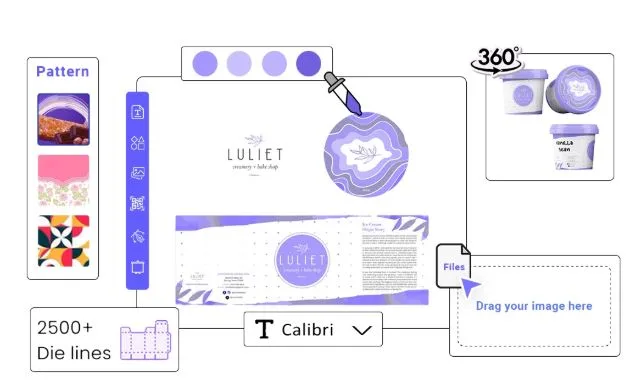
When it comes to packaging design software built specifically for print businesses and eCommerce brands that sell custom packaging, DesignNBuy’s Web-to-Pack solution is the most complete option on this list. It is not a generic design tool with packaging features bolted on — it is a dedicated packaging design platform that handles the full journey from customer-facing design to production-ready file output.
What makes it immediately stand out is the breadth of packaging formats it supports. From corrugated boxes and folding cartons to pouches, paper bags, labels, sleeves, and custom die-cut packaging, the platform covers virtually every format an eCommerce brand or print service provider would need. Access to over 2,500 die lines directly within the tool means customers are not working with approximations — they are designing on the actual structure their packaging will take.
The 3D preview capability deserves particular mention. Customers can inspect their packaging in a live 3D environment, viewing folds, flaps, finishes, and embellishments before placing an order. This dramatically reduces the back-and-forth between brands and print providers, and nearly eliminates costly reprints caused by design errors that only become visible once the box is folded. The inside and outside personalisation feature extends this further, allowing brands to design both interior and exterior surfaces — which has become essential for the unboxing experience that DTC brands invest in heavily.
On the operational side, the platform includes a dynamic pricing engine that adjusts in real time based on dimensions, quantity, material, finish, and customisation complexity. Customers see accurate pricing as they design, which reduces abandonment and eliminates manual quoting. AI-powered tools — including text-to-image generation, background removal, and smart colour detection — further reduce the effort required from customers who do not have dedicated design resources.
Key features:
- 2,500+ die lines covering all major packaging formats
- Real-time 3D packaging preview with fold, flap, and finish inspection
- Inside and outside surface personalisation
- AI-powered design tools including text-to-image and background removal
- Dynamic pricing engine based on size, quantity, material, and finish
- Premium embellishment options including foil stamping, embossing, and spot UV
- Variable data printing support for B2B and promotional packaging orders
- Native integration with Shopify, Magento, WooCommerce, and BigCommerce
- Print-ready file output with bleed, crop marks, and dielines included
2. Pacdora
Pacdora is a browser-based packaging design platform that allows users to design, preview, and source custom packaging online. It offers a library of structural templates and a 3D visualisation feature, and has gained traction among small eCommerce brands and product businesses that want to design packaging without hiring an agency or purchasing desktop software.
The tool is accessible and relatively quick to get started with, which makes it appealing for early-stage brands exploring packaging for the first time. The 3D preview works well for standard box structures, and the template library covers the most common packaging categories. Where Pacdora is more limited is in production depth — advanced configuration options, custom die lines, and print-ready technical file output require more workarounds than they should for a professional packaging workflow. It functions better as a design exploration tool than a production-grade platform.
Key features:
- Browser-based packaging design with no software installation
- 3D packaging preview for standard box structures
- Structural template library for common packaging formats
- Basic branding and graphics customisation
- Design export for sharing and review
3. Packly
Packly is an Italian-based packaging platform that focuses on making custom packaging accessible for small quantities — a practical option for brands that want short runs without the minimum order quantities typical of traditional print suppliers. Customers can select a packaging format, enter dimensions, customise the design, and place an order directly through the platform.
Its core strength is the low-barrier ordering process. For brands that need a small batch of custom boxes or folding cartons without committing to a large production run, Packly delivers a streamlined experience. The design editor is functional for straightforward customisation — adding logos, colours, and text — but it is not built for complex or layered packaging design. Brands with intricate structural requirements or a need for premium finishes will find the platform limiting relatively quickly.
Key features:
- Short-run custom packaging with low minimum order quantities
- Integrated ordering and production workflow
- Dimension-based packaging configuration
- Basic design editor with logo and colour customisation
- Folding carton and box format support
4. Boxshot
Boxshot is a desktop and web-based 3D packaging design and mockup tool primarily used by designers and agencies to create photorealistic packaging visualisations. It supports a wide range of packaging shapes and structures, and produces high-quality renders that work well for presentations, eCommerce product listings, and marketing materials.
Where Boxshot excels is in its rendering quality and the variety of packaging shapes it can visualise, making it a strong choice for design professionals who need to present packaging concepts to clients or stakeholders before committing to production. However, it is fundamentally a mockup and visualisation tool rather than a production-grade packaging design platform. There is no customer-facing design editor, no print-ready output workflow built around commercial packaging production, and no eCommerce integration — which means it works well as one part of a broader process but cannot function as a standalone web-to-pack solution.
Key features:
- Photorealistic 3D packaging mockups and renders
- Wide range of supported packaging shapes and structures
- Desktop and web-based design options
- Export for marketing and presentation use
- Suitable for agency and freelance design workflows
5. Packwire
Packwire is a self-service custom packaging platform built around a browser-based design interface that allows brands to create, price, and order custom packaging without going through a sales team. It appeals particularly to small eCommerce businesses and startups that want control over their packaging design process without committing to large minimum order quantities — orders can start from as few as ten units, which makes it a practical option for brands testing packaging concepts or handling small product launches.
The platform’s real-time pricing calculator is one of its more useful features, giving buyers instant cost visibility as they configure their packaging, which removes the delay of manual quoting. The digital proofing system also allows designs to be approved quickly before production. Where Packwire falls short is in the depth of its design and configuration capabilities. The editor handles basic branding — logos, colours, text — but lacks the structural customisation, die-line flexibility, and advanced print finish options that growing brands tend to require once they move past initial packaging decisions. It is a solid entry point for small-scale, self-service packaging orders but is not built to scale with a business as its packaging needs become more complex.
Key features:
- Self-service online packaging design with no sales team required
- Low minimum order quantities starting from ten units
- Real-time pricing calculator for instant cost visibility
- Digital proofing and online design approval workflow
- Supports shipping boxes, mailer boxes, and product boxes
6. Pietra
Pietra is a platform built specifically for consumer brands and independent product businesses that need help with both product sourcing and packaging. It connects brands with manufacturers and suppliers, and includes tools to manage packaging design and production as part of a broader product development workflow.
For early-stage DTC brands that are figuring out their packaging alongside their product for the first time, Pietra offers a practical starting point — particularly because it combines sourcing, design, and production coordination in one place. Where it is less suited is for established print businesses or eCommerce operators who already have a production setup and need a customer-facing web-to-pack tool rather than a sourcing and development platform. Pietra is oriented around brand building and product development, not around selling custom packaging to end customers at scale.
Key features:
- Packaging design as part of a broader product development workflow
- Supplier and manufacturer sourcing integration
- Suitable for DTC brands building packaging from scratch
- Packaging template and customisation tools
- Production coordination and order management
7. Printbox
Printbox is a cloud-based web-to-print platform with a focus on photo products — photo books, calendars, greeting cards, and personalised gifting items. It has expanded to include some packaging-adjacent product types, and its customer-facing editor is designed for guided, template-based experiences that work well for consumers who want to create something personal without design expertise.
For eCommerce businesses operating in the gifting and personalised photo product space, Printbox provides a polished consumer experience. Outside that niche, it becomes a narrow fit. Brands that need structural packaging design — boxes, pouches, folding cartons — with die lines, dimensional configuration, and production-grade output will find Printbox’s scope too limited. It is a specialist platform that performs well within a specific slice of the packaging and personalisation market.
Key features:
- Cloud-based editor built for photo and gifting products
- Template-based guided design experience for non-designers
- Suitable for personalised gifting and photo merchandise
- Consumer-friendly interface with minimal learning curve
- Integration with fulfilment workflows for photo products
Choosing the Right Tool for Your Business
The packaging design software market covers a wide spectrum — from mockup tools and sourcing platforms to full-stack web-to-pack solutions built for production. Understanding where your business sits on that spectrum is the most important step before committing to any platform.
If you are a design agency or a brand that needs to present packaging concepts before production, a visualisation tool like Boxshot does the job. If you are an early-stage DTC brand figuring out packaging for the first time alongside product development, Pietra offers a practical entry point. If you need short-run custom packaging without much complexity, Packly, Pacdora, or Packwire will get you started.
But if you are a print service provider, a packaging business, or an eCommerce brand that wants to give customers a genuine self-service packaging design experience — complete with structural accuracy, real-time 3D preview, print-ready output, and eCommerce integration — DesignNBuy’s Web-to-Pack platform is the only tool on this list built to deliver all of that in one place. The combination of 2,500+ die lines, inside and outside design, AI-powered tools, dynamic pricing, and native eCommerce integrations gives it a scope that none of the other tools here can match end to end.
The right packaging design tool is the one your customers can use confidently and your production team can rely on without extra manual steps. For most eCommerce and print packaging businesses operating at any meaningful scale, that combination points clearly in one direction.