Why Local Government Agencies Should Modernize Capital Projects in Phases
Local governments are facing growing pressure to deliver more infrastructure projects with fewer resources. Aging systems, staffing shortages, tighter budgets, and increasing compliance requirements are making it harder for agencies to manage capital programs efficiently. At the same time, communities expect faster project delivery, greater transparency, and better use of public funds.
Many counties and cities still rely on spreadsheets, emails, and disconnected legacy systems to manage Capital Improvement Programs (CIPs). While these processes may have worked in the past, they often create delays, duplicate work, reporting challenges, and limited visibility across projects.
The good news? Modernizing your capital projects does not require a massive technology overhaul. For most local agencies, the best approach is phased modernization, improving processes and implementing technology step by step to reduce risk, improve adoption, and deliver faster results.
Why traditional capital program management falls short
Today’s infrastructure programs are far more complex than they were even a decade ago. Local governments now manage projects with multiple funding sources, stricter compliance requirements, aggressive delivery timelines, and growing public expectations around transparency and accountability.
Unfortunately, many agencies still rely on spreadsheets, email chains, and disconnected legacy systems to manage capital improvement programs. While these methods may have worked in the past, they often create delays, duplicate work, communication gaps, and limited visibility into budgets and project performance.
As project complexity continues to increase, these manual processes can slow delivery timelines, increase administrative burden, and make it harder for lean teams to manage growing infrastructure demands.
Step 1: Improve processes before implementing technology
Successful modernization starts with understanding how work actually gets done today. Before evaluating software, agencies should align key stakeholders across departments, including public works, engineering, procurement, finance, IT, legal, consultants, and contractors. Early collaboration helps build organizational buy-in and ensures teams understand the purpose and benefits of modernization.
Leadership support is equally important. When department leaders actively champion modernization efforts, agencies are more likely to achieve long-term adoption and success. These conversations also help external partners understand how improved processes can simplify coordination, accelerate approvals, and improve project visibility.
Step 2: Document and optimize existing workflows
Once stakeholders are aligned, agencies should map their current workflows. This means documenting how projects move through approvals, procurement, budget tracking, reporting, and interdepartmental coordination.
Different project types often follow different processes. A road reconstruction project may require a different workflow than a utility upgrade or parks improvement initiative. Capturing these distinctions helps agencies better understand where inefficiencies exist and where processes can be standardized.
By documenting current workflows, agencies can identify bottlenecks, eliminate redundant steps, and improve coordination before implementing new technology. This creates a stronger operational foundation for long-term modernization.
Step 3: Choose software designed for local governments
One of the biggest mistakes agencies make is selecting software built for large enterprise organizations or state transportation agencies. These platforms are often expensive, difficult to implement, and resource-intensive to maintain.
Local governments need solutions that are easy to deploy, simple to use, and flexible enough to grow alongside evolving infrastructure programs. Increasingly, they also need platforms built with AI at the core, not bolted on as an afterthought, so that intelligence is embedded into every stage of planning and delivery.
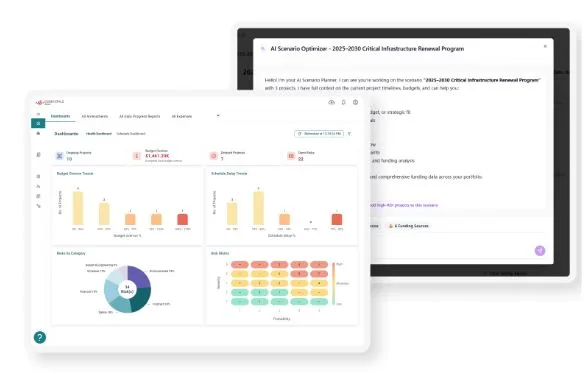
Aurigo Essentials is an AI-native construction project management platform purpose-built to address the needs of local government agencies managing capital planning and construction projects. Unlike enterprise platforms designed primarily for large transportation agencies, Aurigo Essentials helps lean teams modernize operations without lengthy deployments or complex implementation cycles.
Aurigo Essentials Plan helps agencies improve capital planning by supporting multiyear CIP development, AI scenario modeling, funding analysis, and project prioritization. This gives decision-makers better visibility into project investments and helps ensure funding is directed toward the highest-impact initiatives.
On the delivery side, Essentials Build streamlines construction project management through budget tracking, schedule management, contractor coordination, document control, and mobile-ready field reporting. Together, the modules create a connected environment where planning and execution work seamlessly together, improving visibility across the entire capital program life cycle. Because the platform is modular, agencies can start with the capabilities they need most today and expand over time as modernization efforts mature.
Why incremental modernization works better
The agencies that struggle most with modernization are often the ones trying to change everything at once.
A phased approach allows agencies to:
- Reduce implementation risk
- Improve user adoption
- Achieve faster ROI
- Build internal confidence
- Scale modernization gradually
Even small operational improvements can create significant long-term benefits. Faster approvals, improved reporting, and reduced administrative work free up staff time to focus on delivering more projects and improving community outcomes. And with an AI-native platform in place, those gains compound over time as the system learns from project data to surface insights that help agencies continuously improve.
Modernize your capital projects without disruption
Modernizing a capital project does not have to mean a disruptive multiyear transformation. By improving workflows, engaging stakeholders early, and implementing technology in phases, local governments can modernize operations while staying within budget and staffing constraints.
The key is to start with the right first step, prove success early, and build momentum over time.
Disclaimer: This article is for informational and educational purposes only. The views and recommendations shared regarding capital project modernization may vary based on local government policies, regulations, and operational needs. Readers should consult qualified professionals or official agencies before making project-related decisions.